
Everyone from the kopitiam uncle to K-pop stans seems to be chasing air miles these days. I get it—racking up points for a jet-setting lifestyle sounds way sexier than hoarding cash rebates. But as someone who doesn’t travel much, I’m firmly, unabashedly in the cashback camp. What? Don’t judge.
If you’re like me and prefer cold, hard savings over glamorous airport lounges, this article’s for you. I’ve reviewed the best cashback credit cards in Singapore and narrowed it down to 8 winners across 6 categories: unlimited cashback, groceries, dining, online shopping, and transport.
Ready to earn those cash rebates? Let's take a look at the best cashback credit cards in Singapore in 2026.
[ms-toc title="Best Cashback Credit Cards in Singapore (Oct 2026)"]
1. TL;DR: Best cashback credit cards in Singapore (2026)
If you want the short version, here it is. Whether you’re a die-hard supermarket loyalist, a dining-out fiend, or just want fuss-free unlimited cashback, there’s a card that fits your spending habits. We picked the winners based on cashback rate, minimum spend, category breadth, and caps so you don’t have to dig through the fine print.
Category | Winner | Runner-up |
Dining | HSBC Live+ Card | Maybank Family & Friends Card |
Groceries | DBS yuu Card | 10% on groceries on MCC basis, $800 min spend, $20/category cap |
Shopping | UOB EVOL Card | OCBC FRANK Card |
Transport | UOB One Card | Standard Chartered Smart Credit Card |
Unlimited cashback | UOB Absolute Cashback Card | Citi Cash Back+ Card and OCBC INFINITY Card |
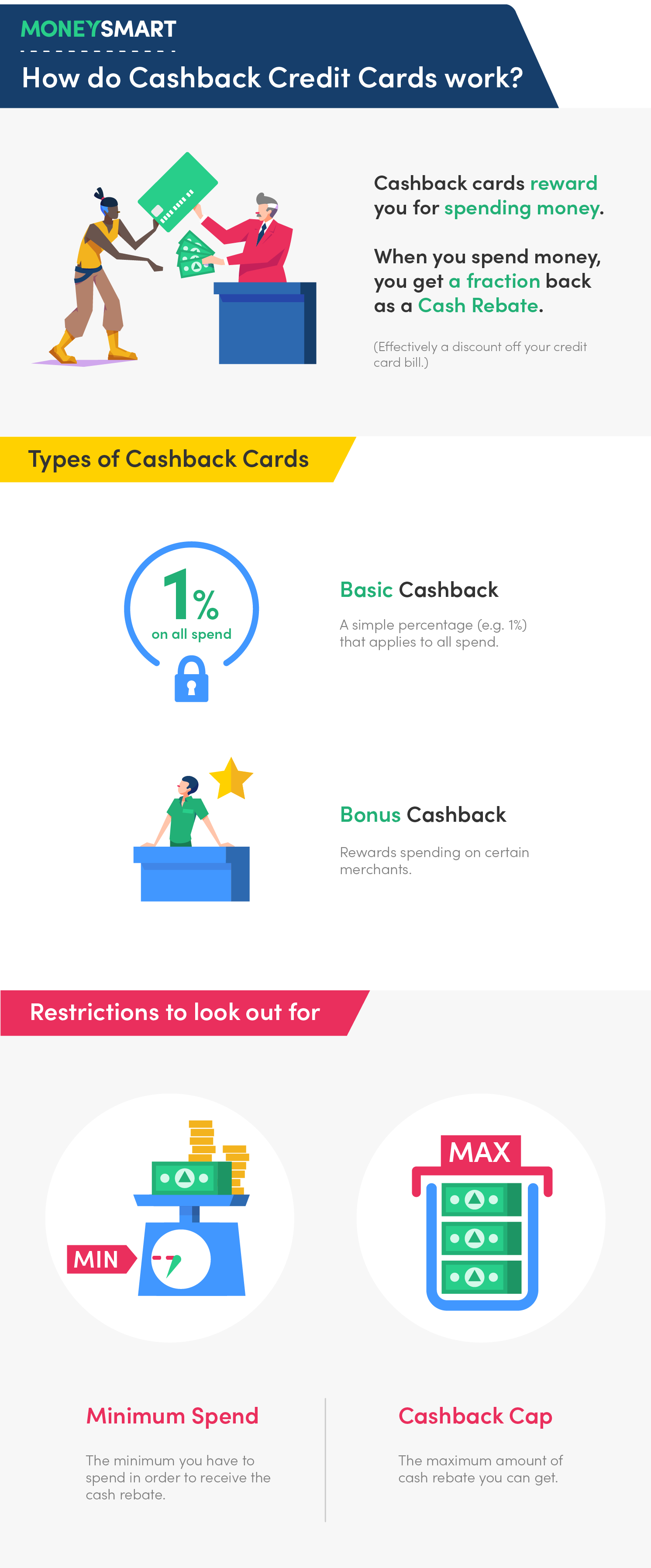
Before we go into more details, let’s get you orientated. Here’s a quick summary of how cashback credit cards work, so you understand the mechanics that underlie your rewards.
2. Best cashback credit card for dining
Winner: HSBC Live+ Card

- on Dining, Shopping and Entertainment
- 8% Cashback*
- on fuel at Caltex and Shell gas stations in Singapore
- 5% Cashback*
- on All Other Spends
- 0.3% Cashback*
Get S$400 Cash or 6,140 SmartPoints (use SmartPoints earned to redeem the latest Apple products on our Rewards Store) when you spend a min. of S$500 within 30 days from Card Account Opening Date!
Dive into spooktacular Halloween rewards with MoneySmart! Each day, the first 10 fastest claimants snatch exclusive Flash Deal prizes—from iPhone 18 Pro, MacBook Neo, Switch 2, PS5 and more—on top of your baseline reward! T&Cs apply.
For now, the crown goes to the HSBC Live+ Card, thanks to its 8% cashback on dining, shopping, and entertainment for the first 2 calendar quarters. With a relatively low $600/month minimum spend (or $1,000 total if you’re issued mid-quarter), it’s not hard to unlock. Even better, the dining cashback is based on MCC codes, so you’ll earn at everything from your neighbourhood zi char to your favourite café abroad instead of just a fixed list of partner restaurants.
But why is it the winner only for now? The 8% cashback hinges on a promo that’s only valid until 31 March 2027. After that, you’ll earn 5%. Total cashback is capped at $250 per calendar quarter. Yes, this promo has been renewed again and again since the card’s launch in Jun 2024, but there’s no guarantee HSBC will extend it again.
Runner-up: Maybank Family & Friends Card
The Maybank Family & Friends Card is wonderfully versatile because you can pick up to 5 categories on which to earn up to 8% cashback. That's the same maximum rate as HSBC Live+, but with higher minimum spends:
Honourable mention: Citi Cash Back Card
With the Citi Cash Back Card, you take home a solid 6% dining cashback on MCC-based spend with the same $800/month minimum spend. Flexible coverage, decent rate, but not quite HSBC’s 8%.
Other dining cashback cards and why they didn’t win
Card | Dining cashback rate | Why it didn’t win |
2% unlimited on Wine & Dine with $1,000/month min spend | Lower rate than top contenders, with a high minimum spend | |
Up to 18% at foodpanda and CHAGEE (requires $800/month spend across 4 participating merchants, bonus capped at $144/month | Very high rate, but restricted to specific yuu partner outlets; doesn’t cover broader dining MCCs | |
5% on dining (shared $25/month cap across dining, entertainment & transport) | Cashback cap is low, especially since it will be shared across 3 categories | |
5% on dining (including overseas & food delivery) with $800/month min spend | Good MCC breadth but lower rate than HSBC Live+ and Maybank F&F | |
10% on online food delivery and 5% on dining out islandwide (excluding fast food), with $800/month min spend and Daily$20 monthly cap | The low cap means the 10% maxes out after just $200 of food delivery a month, and fast food doesn’t count | |
Up to 10% at “Smart Dining” merchants with $1,500/month min spend | Restricted to a fixed merchant list and high minimum spend of $1,500 to unlock highest rate | |
5% ($500/month min spend, $30 quarterly cap) or 15% ($2,000/month, $250 quarterly cap) on 1 bonus category of your choice, including dining | Bonus applies to just 1 category, you must hit the minimum spend in all 3 months of the quarter, and the 5% tier’s $30 quarterly cap is tight | |
Up to 10% at selected partners only (McDonald’s and GrabFood) | Limited: for dining, you’ll only earn the bonus at McDonald’s and GrabFood; high $2,000/month minimum spend to unlock highest rate |
3. Best cashback credit card for groceries
Winners: NTUC Link Credit Card by Trust, DBS yuu Card
.png)
- savings on groceries and food
- Up to 21%
- petrol savings (on Caltex and Esso)
- Up to 20%
- FX Fees
- 0%
Dive into spooktacular Halloween rewards with MoneySmart! Each day, the first 10 fastest claimants snatch exclusive Flash Deal prizes—from iPhone 18 Pro, MacBook Neo, Switch 2, PS5 and more—on top of your baseline reward! T&Cs apply.
Golden chance to win up to S$8K cashback!
For new credit card customers! Get a sure-win cashback gift of up to S$8,000 when you choose Cashback as your reward. T&Cs apply.

- at participating merchants with no min. spend
- 5% cash rebates
- spend min. S$800 & at 4 participating merchants per calendar month
- Up to 18% cash rebates
- on all other spend
- 0.25% cash rebates
If you’re loyal to a single supermarket chain, merchant-specific cards can be unbeatable. The NTUC Link Credit Card by Trust gives market-leading rates of up to 21% savings at FairPrice stores (including FairPrice Online). The catch: the higher tiers count only what you spend outside FairPrice Group, and you’ll need to keep it up for 3 consecutive months to unlock the quarterly bonuses.
Meanwhile, the DBS yuu Card offers up to 18% cashback at Cold Storage and Giant. These aren’t MCC-based, but if you do most of your grocery runs at one of these chains, the extra cashback is worth it.
Card | Minimum spend tier | Grocery cashback rate | Merchants |
$0 | 5% at participating merchants | Cold Storage (excluding Cold Storage On The Go), CS Fresh, Giant, Jasons Deli, Guardian, 7-Eleven, and other yuu merchants | |
$800/month, at 4 participating merchants | 18% (capped at $144/month bonus cashback) | ||
$0 | Up to 4.5% for FairPrice members | FPG groceries refer to FairPrice, FairPrice Finest, FairPrice Xtra, FairPrice Xpress, FairPrice online, Warehouse Club, Unity, Cheers. | |
$450/month outside FPG, for 3 consecutive months | Up to 15% for FairPrice members | ||
$800/month outside FPG, for 3 consecutive months | Up to 21% for FairPrice members |
Runner-up: CIMB Visa Signature
For those who want the highest MCC-based rate, the CIMB Visa Signature offers 10% cashback on all grocery spend, both in-store and online. The catch? You’ll need to hit $800/month minimum spend, and cashback is capped at $20 per category—meaning you’ll only earn cashback on the first $200 of grocery spend per month. Great for light-to-moderate shoppers, not for families doing $400+ grocery runs.
Honourable mentions: OCBC 365 Credit Card, POSB Everyday Card, Citi SMRT Card
Doing $400+ grocery runs? From 1 Nov 2026, the OCBC 365 Credit Card earns 6% cashback on groceries with an $800/month minimum spend and a generous $160/month cap. The cap is shared with dining, land transport, and petrol, but it still leaves far more room than CIMB’s $20.
If you shop at Sheng Siong, the POSB Everyday Card is all for you: 5% cashback with a remarkable $0 minimum spend, capped at Daily$20 per month. That’s hard to beat for casual shoppers.
The last honourable mention goes to the Citi SMRT Card. Don’t judge it by its unglamorous name. With a low $500 minimum spend, this card offers 5% savings on groceries from supermarkets, alongside online shopping and public and private transport. Just note that rebates come as SMRT$ rather than cash, capped at SMRT$600 per year.
Other grocery cashback cards and why they didn’t win
Card | Grocery Cashback Rate | Why It Didn’t Win |
6% on groceries (MCC-based) with $800/month min spend, $80/month cap across all categories | Strong rate, but lower than CIMB Visa Signature with the same minimum spend | |
6% (capped at $20) at RedMart with $500 minimum monthly spend | Restricted to one merchant; cap is low, limiting total savings potential | |
6% on groceries (choose as one of 5 preferred categories) with $800/month min spend, or 8% with $1,600/month min spend | Competitive but falls short of the cards above, and the cap of $25/category limits big spenders | |
8% with $2,000/month min spend, or 6% with $1,000/month spend (min. 10 transactions a month | High rate, but very high spend requirement |
4. Best cashback credit card for shopping
Winners: UOB EVOL Card and UOB One Card

- on Local Online, Mobile Contactless, Telco, Gym, Streaming spend
- 10% Cashback
- FX Fees on overseas FX spend worldwide, with no min spend, no cap
- 0%
- Min. Spend per month for 10% cashback
- S$800
[MoneySmart Offer]
Get guaranteed S$60 Cash - when you are a New-To-UOB customer and spend S$500 within 30 days! T&Cs apply.
Dive into spooktacular Halloween rewards with MoneySmart! Each day, the first 10 fastest claimants snatch exclusive Flash Deal prizes—from iPhone 18 Pro, MacBook Neo, Switch 2, PS5 and more—on top of your baseline reward!
Looking at high rates, broad coverage, and a wide range of shopping categories, the UOB EVOL Card comes out on top. It offers 10% cashback on combined online and mobile contactless spend, with an $800/month minimum spend. On top of that, you’ll also get to enjoy 10% cashback on selected gym, telco and streaming spend, and 0% forex fees on all overseas foreign currency spend. The only downside? A $30/month cap, so anything above $300 in eligible spend won’t earn cashback.
Willing to sacrifice category breadth for a bigger cap? If you’re more of a Shopee-holic than a general shopaholic, the UOB One Card is worth a look. Even the lowest $600/month tier (with at least 10 transactions a month) gives 8.33% cashback at Shopee, which is made up of 3.33% quarterly cashback and 5% additional cashback. Best of all, the card offers a generous $120/month cap on the additional cashback you earn, equivalent to $2,400 worth of spending. The catch is that it’s Shopee-only, so not great for varied shopping.
Runner-up: OCBC FRANK Card
A strong all-rounder, the OCBC FRANK Card boasts 8% cashback on local online/contactless mobile spend and foreign spend with $800/month minimum spend. Rather than rewarding you based on MCC, it awards cashback based on how you pay, greatly widening your cashback net. Cashback is capped at $25 per category, or up to $100 a month in total. Just note that only spend in the cashback categories counts towards the $800 minimum.
Honourable mentions: CIMB Visa Signature, HSBC Live+ Card
The CIMB Visa Signature comes with a generous 10% cashback, but only for online spend. Plus, it limits you to a $20/category cap and requires $800/month minimum spend.
With the HSBC Live+ Card, you can enjoy 8% cashback on shopping with a low minimum monthly spend of $600, but only for your first 2 calendar quarters. After that, it drops to 5%. Cashback is capped at $250 per quarter.
Other shopping cashback cards and why they didn’t win
Shopping cashback card | Rate / Min spend / Cap | Why it didn’t win |
5% on online shopping / $500 min spend / 600SMRT$ cap per year | Decent rate and low min spend, but lower than top contenders and capped | |
6% on shopping (online & in-store) / $800 min spend / $50 per month cap for shopping | Solid coverage but rate lower than top contenders | |
6% on shopping (if you select it as 1 of 5 preferred categories) with $800 min spend, or 8% with $1,600 min spend / capped at $25 per month per category | The top rate needs a high $1,600/month spend, and the cap limits heavy shoppers | |
5% at Amazon.sg, Lazada, Shopee, RedMart, Taobao, TikTok Shop and POPULAR / $800 min spend / Daily$20 monthly cap | Limited to specific merchants and not MCC-based; cap of $20/month | |
5% ($500/month min spend, $30 quarterly cap) or 15% ($2,000/month, $250 quarterly cap) on 1 bonus category of your choice | High minimum spend required to unlock highest rate, which you must hit in all 3 months of the quarter; selecting this as your bonus category also limits you to only earn bonus rates on shopping |
5. Best cashback credit card for transport
Winner: UOB One Card

- cashback on daily spend at McDonald's, Grab, SimplyGo & Shopee
- Up to 10%
- cashback at all grocery spend
- Up to 8%
- cashback cap a year
- Up to S$2,240
[MoneySmart Offer]
Get guaranteed S$60 Cash - when you are a New-To-UOB customer and spend S$500 within 30 days! T&Cs apply.
Dive into spooktacular Halloween rewards with MoneySmart! Each day, the first 10 fastest claimants snatch exclusive Flash Deal prizes—from iPhone 18 Pro, MacBook Neo, Switch 2, PS5 and more—on top of your baseline reward!
For a mix of SimplyGo, petrol, and Grab rides, the UOB One Card delivers the highest overall earning potential. You can get up to 10% cashback at selected transport merchants like Grab and SimplyGo, plus strong petrol savings of up to 22.66% at Shell and SPC.
The UOB One Card’s 10% cashback on transport is unlocked for high spenders hitting the $2,000/month tier, but even the lower tiers ($600 or $1,000/month) give respectable returns of 8.33% cashback for daily commuters. With a generous $120/month cap on additional cashback, you’re unlikely to hit the ceiling on commuting alone. Just remember you’ll need at least 10 transactions a month, and GrabPay Wallet top-ups don’t count.
Runner-up: OCBC 365 Credit Card
If your commute is a bit of everything (MRT one day, a cab the next, a petrol top-up on the weekend), the OCBC 365 Credit Card covers it all. From 1 Nov 2026, it earns 6% cashback on buses and trains (including SimplyGo), taxis, and petrol at any service station, with an $800/month minimum spend.
The rate isn’t the highest in any single area, but the $160/month cap is one of the roomiest around. It’s shared with dining and groceries, which also earn 6%, so it’s a strong everyday all-rounder too. Note that EZ-Link and Transit Link top-ups don’t count.
Honourable mention: DBS yuu Card, Standard Chartered Smart Credit Card
If you’re already deep in the yuu ecosystem, the DBS yuu Card offers up to 18% cash rebates on SimplyGo, Gojek, and Charge+. That’s the highest rate here by far, but you’ll need to spend $800/month and shop at 4 participating yuu merchants to unlock it. Bonus rebates are capped at up to $144/month.
Heavy public transport user? With the Standard Chartered Smart Credit Card, earn 8% cashback on “Smart Transport” (SimplyGo and EV charging) when you spend above $800/month, or 10% above $1,500/month. Best of all, its cashback is uncapped at every tier, so you never need to worry about charging too much to it. The catch is that its bonus cashback only covers SimplyGo and EV charging, so no taxis or petrol.
Other transport cashback cards and why they didn’t win
Card | Rate / Min spend / Cap | Why it didn’t win |
2% unlimited on taxis & automobiles / $1,000 min spend / No cap | Low rate compared to top contenders; better suited for those wanting unlimited coverage | |
8% on petrol and private commute / $800 min spend / $80 monthly cap across all categories | Strong rate for drivers and ride-hailers, but no public transport coverage, and OCBC 365 covers more ground with double the cap | |
Up to 5% on SimplyGo, taxis and private hire / $500 min spend / 600SMRT$ annual cap | Decent rate for $500/month minimum spend, but it just isn't as competitive as our winning cards | |
5% on transport (SimplyGo, Grab, TADA, Gojek, ComfortDelGro) / $500 min spend / $25 cap shared with dining & entertainment | Low shared cap reduces earnings potential for transport | |
6% on transport with $800 min spend, or 8% with $1,600 min spend (choose as 1 of 5 preferred categories) / $25 per category cap | High top rate, but needs $1,600/month, and the cap is used up after about $313–$417 of transport spend, not ideal for frequent commuters or drivers | |
Up to 10% on SimplyGo and BlueSG (mobile contactless) / $800 min spend / $25 cap per category | High rate, but cap limits earnings | |
10% on SimplyGo / $800 min spend / Daily$20 monthly cap; 6% at SPC (petrol) / $0 min spend / No cap | Good SimplyGo and single-merchant petrol savings, but no coverage for taxis/private hire | |
5% ($500/month min spend, $30 quarterly cap) or 15% ($2,000/month, $250 quarterly cap) on 1 bonus category of your choice | High minimum spend required to unlock highest rate, which you must hit in all 3 months of the quarter; selecting transport as your bonus category also limits you to only earn bonus rates on transport |
6. Best cashback credit card for unlimited cashback
If optimising specific spend categories is too much work for you, let’s take a step back and look at the all-in, catch-all type of cashback card: unlimited cashback credit cards. These cards offer cashback on almost everything, and usually come with a $0 minimum spend requirement. They’re great for:
- People who cannot be bothered remembering which card to tap on the train, which to use when eating out, etc.
- Earning cashback on large purchases like furniture or electronics—these would otherwise bust the cap on most other cashback credit cards that have monthly or annual caps
Winner: UOB Absolute Cashback Card

- Cash Back on Eligible Spend
- 1.7%
- Min. Spend per month
- S$0
- Cash Back Cap
- Unlimited
[MoneySmart Offer]
Get guaranteed S$60 Cash - when you are a New-To-UOB customer and spend S$500 within 30 days! T&Cs apply.
Dive into spooktacular Halloween rewards with MoneySmart! Each day, the first 10 fastest claimants snatch exclusive Flash Deal prizes—from iPhone 18 Pro, MacBook Neo, Switch 2, PS5 and more—on top of your baseline reward!
[UOB Stackable Offer]
Get a Samsonite EVOA Z Spinner 25” Expandable (worth S$600) when you spend min. S$1,000 worth of eligible spend on the card per month for 2 consecutive months from card approval date. T&Cs apply.
When it comes to unlimited cashback cards in Singapore, the UOB Absolute Cashback Card isn’t just the highest no-minimum-spend rate after promos, at an impressive 1.7%. It’s also an ultra-rare card that earns you cashback on things like insurance premiums—and this is after its May 2024 nerf, before which it even earned you 1.7% on categories like education, tax payments, pet stores and veterinary services, medical services and hospitals, utilities, and more. Those now earn 0.3%.
For a limited time, you can also earn up to 2% cashback on contactless spend, locally and overseas, until 31 January 2027.
The only catch? The UOB Absolute Cashback Card is an American Express card, so acceptance can be slightly more limited compared to Visa or Mastercard.
Runner-ups: Citi Cash Back+ Card, OCBC INFINITY Card
The Citi Cash Back+ Card and OCBC INFINITY Cashback Card both offer 1.6% unlimited cashback with no minimum spend. They’re both Mastercard, which might be preferable if you’re worried the UOB Absolute Card may not be accepted due to it being with Amex.
How do you decide between them then? Consider:
- Which has a better welcome gift? This factor was what made me choose the Citi Cash Back+ for myself. Check out our article on credit card promotions in Singapore for a summary.
- Do you prefer redeeming cashback in your own time, or have it automatically offset your next bill? The former is the OCBC INFINITY, and the latter the Citi Cash Back+.
- Do you have or plan to open a savings account like the OCBC 360 savings account? In my opinion, the OCBC 360 is better than the Citi Wealth First account, and the OCBC INFINITY Card can help to earn you higher bonus interest. Read more in my review of savings accounts in Singapore.
Honourable mentions: American Express True Cashback Card
The American Express True Cashback Card offers a juicy 3% cashback on up to $5,000 spend in the first 6 months (up to $150) before reverting to an unlimited 1.5% cashback. It’s perfect if you have known big purchases you’re planning for at merchants that take Amex.
Other unlimited cashback cards and why they didn’t win
There are many other unlimited cashback cards in Singapore that generally offer between 1.5 – 1.7% with no minimum spend. If you ask me, 0.1% isn’t going to make a huge difference—I myself use the Citi Cash Back+ just because the welcome gift appealed to me—so here’s a summary if you want to browse the alternatives:
Unlimited cashback card in Singapore | Cashback rate | Why it didn’t win |
– 3.0% cashback on up to $5,000 spend in the first 6 months | The 3% is impressive, but only lasts for 6 months and is limited to $5,000 spend | |
– 2% unlimited cashback on dining, online food delivery, entertainment, transport, and luxury goods with ≥ $1,000 spend in a statement month. | 2% cashback comes with a high minimum spend of $1,000; otherwise, the 1% cannot compete | |
– 2% unlimited cashback on travel, overseas spending, and online spend in foreign currency with ≥ $2,000 spend in a statement month | 2% cashback comes with an even higher minimum spend of $2,000 (and a $120,000 minimum income); again, otherwise, the 1% cannot compete | |
Unlimited 1.6% with no minimum spend; cashback does not expire | Decent, but it falls just 0.1% short of UOB Absolute Cashback | |
Unlimited 1.6% with no minimum spend; cashback automatically offsets your next credit card bill | Decent, but it also falls just 0.1% short of UOB Absolute Cashback | |
1.5% unlimited cashback with no minimum spend | 1.5% is not as competitive, and insurance premiums and AXS payments don’t earn cashback | |
1.5% unlimited cashback on local spend (0.5% on foreign spend) in Unlimited Cashback mode | 1.5% is below UOB Absolute, and you can’t earn the bonus category rates at the same time | |
– Unlimited 1.7% with no minimum spend on almost everything, even insurance premiums | With the highest unlimited cashback rate in Singapore (excluding limited-time promotions), it won! |
7. Best cashback credit card for flexible spending
Winner: DBS Chromo Card
.png)
- on your top 2 local spend categories every month
- Up to 5% Cashback
- & 5-year annual fee waiver
- 0 FX Fees
- Flexibility to choose your reward preference every month
- Miles or Cashback
Most category cards make you place your bets upfront. Pick dining, then spend the month shopping, and tough luck. The DBS Chromo Card skips that guessing game. Each month, it looks at your local spending across 6 categories (dining, shopping, travel, transport, entertainment, and wellness) and automatically gives your top 2 up to 5% cashback. Everything else earns 1%.
To unlock the bonus rate, you’ll need to spend at least $500/month, and total cashback is capped at $150/month. That $150 cap is monthly, which is generous next to most category cards at this spend level. The annual fee is waived for the first 5 years. If you’d rather chase miles, you can switch the whole card to 1.3 miles per $1 in any month.
The catch? It’s only open to applicants aged 21–29. From the fourth month after your 30th birthday, the bonus rates drop to a flat 1.7% cashback or 1.3 miles per $1.
Runner-up: Trust Freedom Credit Card
- Stockback
- 3%
- Cashback
- Up to 15%
- per dollar spent
- 1.3 miles
Dive into spooktacular Halloween rewards with MoneySmart! Each day, the first 10 fastest claimants snatch exclusive Flash Deal prizes—from iPhone 18 Pro, MacBook Neo, Switch 2, PS5 and more—on top of your baseline reward! T&Cs apply.
Golden chance to win up to 8K USD stocks!
For new credit card customers! Get a sure-win stock gift valued up to 8K USD when you sign up and select Stockback as your reward.
Or get a sure-win cashback gift of up to S$8,000 when you choose Cashback as your reward. T&Cs apply.
Up to 100k Miles Welcome Offer!
Simply apply for Freedom card and accumulate min. spend within the first 31 days to:
- Get 20,000 Max Miles when you spend min. S$1,000
- OR get 50,000 Max Miles when you spend min. S$5,000
- OR get 100,000 Max Miles when you spend min. S$15,000 (that’s a round-trip ticket to Europe!)
Terms and conditions apply.
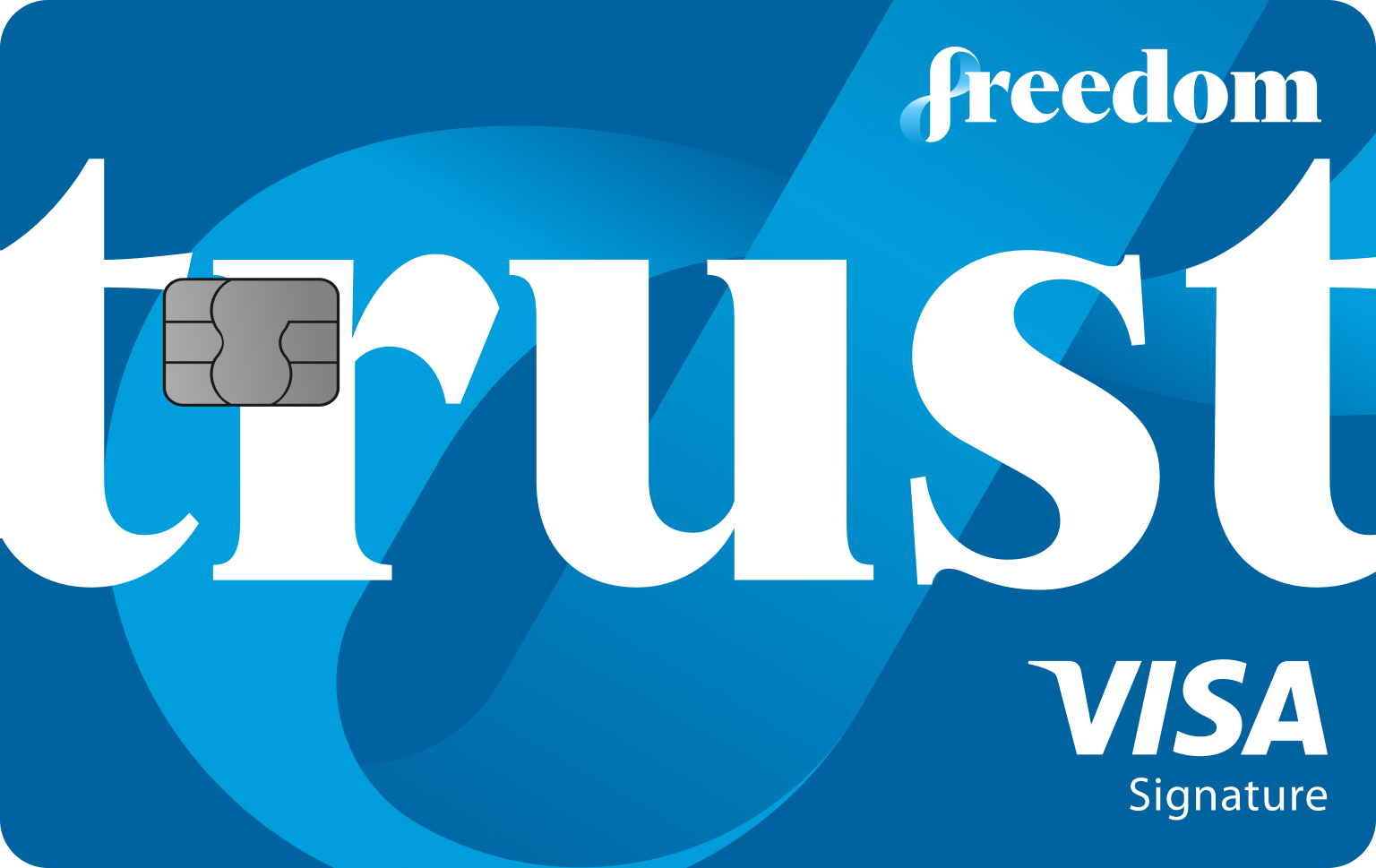
If the Chromo’s age limit rules you out, or you want more say in how you’re rewarded, the Trust Freedom Credit Card is the next best thing. It’s 3 cards in one: cashback, miles, or stockback. You can switch modes every quarter without reapplying.
In cashback mode, you get 2 options. Unlimited cashback mode gives you a flat 1.5% on local spend. Bonus cashback mode lets you pick 1 preferred category, from dining and shopping to travel and wellness, and earn 5% cashback with a $500/month minimum spend or 15% with $2,000/month. Everything else earns 1% locally. Both modes also earn 0.5% on foreign spend, which the Chromo doesn’t. Add a $0 annual fee and no FX fees, and it’s a card that stays useful well past your 20s.
The trade-offs? Unlike the Chromo, it won’t follow your spending around. You choose your bonus category, and you’ll need to hit the minimum spend in all 3 months of the quarter to earn the bonus rate. The caps are also tight at the lower tier. Bonus cashback is capped at $30 per quarter at 5%, so only about $200 a month of category spend earns the bonus rate. At 15%, the cap rises to $250 per quarter.
7. Finding the best combination for you
While we’ve crowned the best cards for each category, the reality is your personal “best” might be a mix—either across 2 or more cards, or within a single card that covers multiple categories well.
If you have high, consistent spend in different areas (say, dining and groceries), pairing two specialised cards could maximise your returns. But if your monthly spend isn’t high enough to meet the minimum spends on multiple cards, a versatile card that earns well across categories might be the smarter move.
For example, I wanted a card for my daily commute and online shopping. On paper, the Citi SMRT Card isn’t a winner in any single category, but it gives me decent cashback on SimplyGo rides and online spend with just a $500 minimum. I also keep the Citi Cash Back+ Card in my wallet to whip out for big purchases that would bust other cards’ cashback caps.
 Medium.jpeg)
- on Online Purchases, Groceries, Taxi, Ride-hailing, SimplyGo & Malaysia Ringgit Spend
- 5% Savings
- on Other Retail Spend
- 0.3% Savings
- Min. Spend per statement month to earn max rebates
- S$500
Snap up baseline gifts: be among the first 200 approved applicants spending S$500 to enjoy S$450 CASH or a S$500 Amazon.sg Gift Card, or still grab S$400 Cash or 6,140 SmartPoints (use SmartPoints earned to redeem the latest Apple products on our Rewards Store) if you come after.
But the real treat? Dive into spooktacular Halloween rewards with MoneySmart! Each day, the first 10 fastest claimants snatch exclusive Flash Deal prizes—from iPhone 18 Pro, MacBook Neo, Switch 2, PS5 and more—on top of your baseline reward! T&Cs apply.

- Cash Back on Eligible Spend
- 1.6%
- Min. Spend per month
- S$0
- Cash Back Cap per month
- Unlimited
Snap up baseline gifts: be among the first 200 approved applicants spending S$500 to enjoy S$450 CASH or a S$500 Amazon.sg Gift Card, or still grab S$400 Cash or 6,140 SmartPoints (use SmartPoints earned to redeem the latest Apple products on our Rewards Store) if you come after.
But the real treat? Dive into spooktacular Halloween rewards with MoneySmart! Each day, the first 10 fastest claimants snatch exclusive Flash Deal prizes—from iPhone 18 Pro, MacBook Neo, Switch 2, PS5 and more—on top of your baseline reward! T&Cs apply.
The key is to map your spending patterns by looking at your actual monthly expenses first. Then choose a combo of cards or a single all-rounder that covers your biggest spend categories without overcomplicating your wallet.
Want to find out more about the best cash back credit cards in Singapore? Compare and apply on MoneySmart!
We also have a comparison tool for the best cash back credit cards in Hong Kong!
Related Articles