
We always try to be number 1, and Singapore has done it once again by being the most expensive city in Asia to live for locals and expats, according to a study by the Lee Kuan Yew School of Public Policy.
And we’re certainly feeling the pinch. I mean, strawberry matcha latte for $8.50? *shudders* And that's just your caffeine fix. Just look at how housing prices and COE have increased. Singapore also holds several other ‘accolades’ in being expensive, such as the Guinness World Record for being the most expensive city in the world to buy a car.
If you’re a young working adult or potential expat about to accept a job offer in Singapore, here’s our guide to the cost of living in Singapore in 2026 for a range of budgets and lifestyles.
[ms-toc title="Singapore's cost of living: A full cost breakdown (2026)"]
1. Housing costs
Moving to Singapore from overseas or just moving out of your parents’ home? Whether you’re renting or buying a home, your biggest expense is going to be housing.
You should budget at least $500 for a common room to over $7,000 for an entire flat per month if you’re renting. For Singaporeans/PRs eligible to buy a flat, you have to budget up to a maximum of 30% of your monthly income for your housing loan.
Renting in Singapore
Most expats rent a home in Singapore. Be warned—it’s not cheap. If you’re planning on renting, here are some factors for you to consider:
- What type of property do you want to live in—public or private housing?
- Do you want to rent one room or the entire unit?
- What location—nearer or further from the city centre?
- How might your landlord’s rules affect your expenditure?
1) What type of property do you want to live in—public or private housing?
Housing Development Board (HDB) flats are public housing in Singapore. The advantage of these is that they are cheaper, albeit also more basic in design and amenities.
Private housing options available for rental are usually condominium (“condo”) apartments. These will come with a bigger price tag, but are also swankier and usually come with amenities like gyms and pools.
2) Do you want to rent one room or the entire unit?
If you’re single and looking to rent just a room in a shared HDB flat or a condo apartment with a shared bathroom, expect to pay about $500 to $2,200 each month.
Don’t like to share? It’ll cost ya. Based on HDB’s rental statistics, it costs about $2,250 to rent a 2-room HDB flat, and $3,200 to $5,150 to rent a 5-room HDB flat. However, those are median costs. We’ve also seen some 5-room HDBs being rented out for as high as $7,000 in prime locations.
If you’re looking to rent a condo unit, expect to pay anything from ~$1,700 (non-prime location) to ~$5,000 (prime location) for a studio apartment.
3) What location—nearer or further from the city centre?
Another factor is the distance of your home to the city centre. The more centrally located the property, the more expensive it is. The public transport system in Singapore isn’t bad, though, so you can save some money by renting a place in the city fringe. As a plus, neighbourhoods away from the city centre have more character and cheaper dining options.
4) How might your landlord’s rules affect your expenditure?
Be aware that some landlords have a laundry list of T&Cs you have to agree to. Some won’t allow you to cook when they are living in the same unit as you, which means you’ll be forced to eat out or order food every day. There could also be restrictions on having visitors over, doing laundry, and how much air-conditioning you can use. (if you’re an expat who’s not used to the weather in Singapore, you might want to reconsider somewhere else without strict aircon rules).
If you are allergic to rules but can’t afford to rent a whole unit, look for a room in an apartment that’s occupied only by fellow tenants, without the landlord living together.
Buying a home
How much does it cost to buy a home in Singapore? That depends on the type of property you want to buy and what you’re eligible for, depending on whether you are a Singapore Citizen, a Singapore Permanent Resident (PR), or a foreigner.
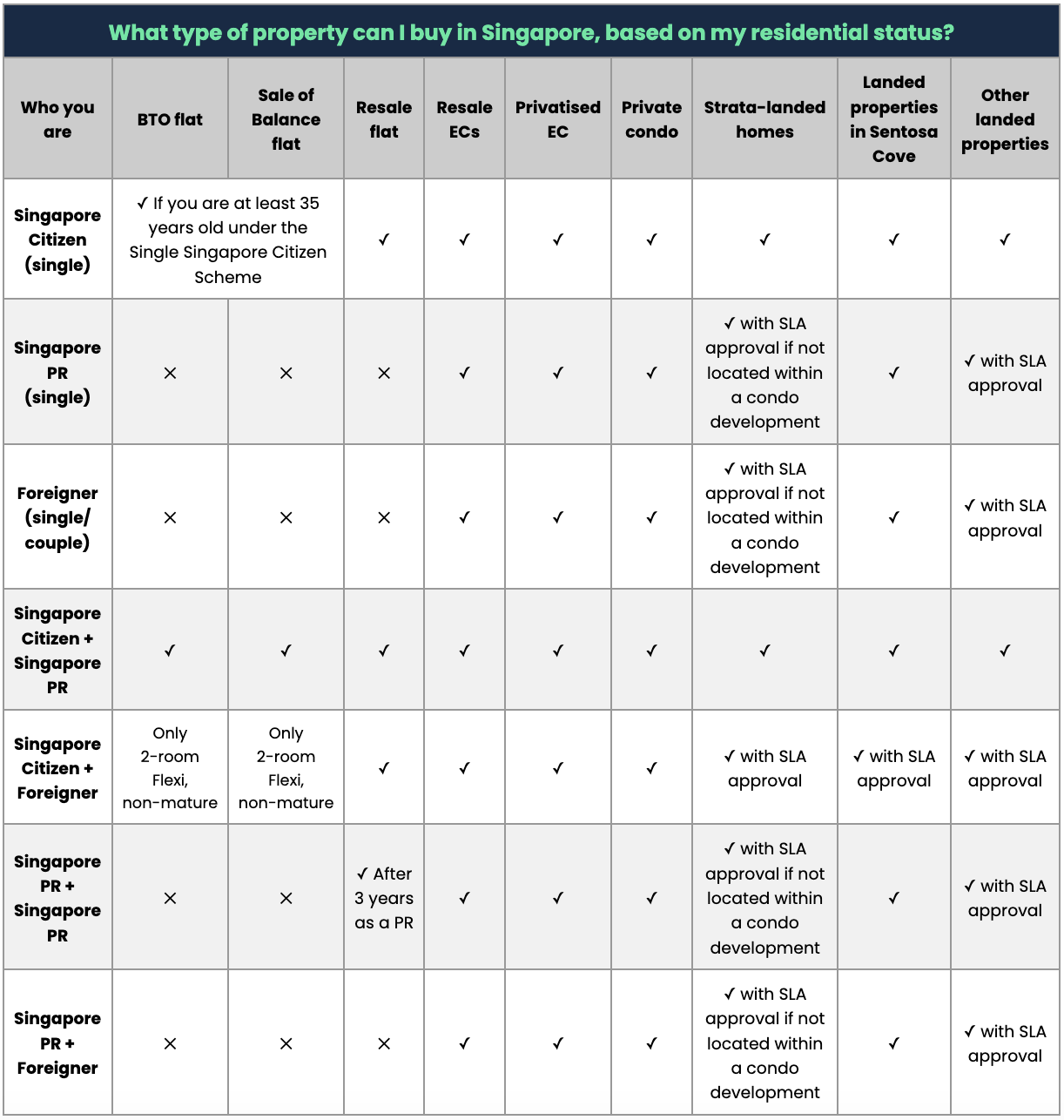
Here’s a summary of what property you can buy in Singapore based on your residential status. We’ll also go into more detail below.
Singapore Citizens
If you’re a Singaporean looking to buy a home, you’re free to buy any type of housing from an HDB flat (including BTO and Sale of Balance flats) to private property so long as you can afford it.
Resale HDB flat prices can get quite high in the more central areas. You can check HDB’s resale flat prices to get a gauge of how much you should budget. According to figures on Propertyguru, for resale property you can expect to pay anywhere from about $300,000 to almost $1,000,000 for a 3-room HDB flat. Yes, prices have reached THAT high. However, there are still plenty of HDB flats within a more median price range, depending on the location and remaining leasehold.
So how much would a HDB flat cost in Singapore in 2026? Let’s assume you pay a minimum 25% downpayment for an HDB flat and take out a 25-year-loan. For homes within the price ranges above, you can expect to pay anywhere from $1,360 to $3,000 per month in loan instalments. Use our mortgage calculator to help you do the math.
Thinking about purchasing private property? Be prepared to service a huge home loan unless you have a large income. You need to fork out anything from around $580,000 for a terrace house to a whopping $4,000,000 and up for private property, while the average condo unit costs about $1,500,000 and above.
Singapore PRs
If you’re a Singapore PR, you can purchase both private and public housing in Singapore within certain restrictions. Singapore PRs can purchase the following types of private housing in Singapore:
- Resale executive condominiums (ECs)
- Privatised ECs (ECs more than 10 years old)
- Private condos
- Strata-landed homes—bungalows, semi-detached houses and terrace houses that usually share communal facilities condo-style. You’ll own the house, but not the land it sits on.
- Landed properties in Sentosa Cove
- Landed properties (with permission from Singapore Land Authority (SLA))
When it comes to new public housing, a Singapore PR can only buy BTO and Sale of Balance flats if they are applying with a Singapore Citizen. In this case, you can also apply for CPF Housing Grants to defray some costs.
To buy a resale flat, Singapore PRs have it the easiest if they apply with a Singapore Citizen. This opens up the option of any resale flats from 2-room to 5-room in any location, including Prime Location Housing (PLH) units near the city centre.
Otherwise, Singapore PRs applying with a non-Singapore Citizen can apply under two types of criteria: Fiancé/fiancéeor as a Core family nucleus. TheCore family nucleus is aimed at families—that means you + spouse + child(ren), or you + your parents + siblings. The Fiancé/fiancéecriteriais for couples ready to tie the knot, meaning just you + spouse-to-be with no kids.
Under these schemes, you can buy a resale flat so long as you and all other flat owners/occupiers have been a Singapore PR for at least 3 years. Note however that you cannot purchase 3Gen flats and PLH flats, which can only be purchased with a Singapore Citizen.
Can Singapore PRs buy a resale flat alone? Unfortunately not. When it comes to buying public housing, Singapore PRs cannot fly solo.
Foreigners
If you are neither a Singapore Citizen nor a Singapore PR, these are the types of private housing you can buy:
- Privatised ECs (ECs more than 10 years old)
- Private condos
- Landed properties in Sentosa Cove
- Landed properties (with permission from Singapore Land Authority (SLA))
The only way you can buy public housing (i.e. BTO and Sale of Balance flats) is if you apply with a Singapore Citizen (not a Singapore PR).
2. Transportation costs
As with everything else in life, your monthly transportation costs can vary wildly depending on how far you need to travel each day and what mode of transport you use. If you’re lucky enough to be living close to your workplace and the city centre, you’ll spend less on transport than someone who lives in Jurong West and has to commute to the CBD daily.
Unless you have quite a bit of disposable income, buying a car in Singapore may not be very financially savvy. They’re famously expensive here and will set you back an extra $2,000 to $3,000 a month for car loan instalments, insurance, petrol, parking, and maintenance.
ALSO READ: Should You Buy a Used Car in Singapore? Pros, Pitfalls & Price Comparisons
You are likely to rely on a combination of public transport (buses and MRT) and taxi or ride-hailing services. Public transport is pretty affordable, generally costing about $128 per month for an unlimited MRT and bus concession pass for Singaporeans/PRs. This pass might be worth it if you commute everyday—use the fare calculator to check. If you work from home a few days per week, it may not be as worth it. You can always pay per trip using a pre-paid EZ-Link card or an existing credit/debit card.
Trying to get home after a drinks session at 1 am? Ride-hailing apps or taxis will likely be your go-to choices. Grab rides typically cost around $15 to $40 per trip depending on the distance, but peak surcharges can cause these prices to soar to $50 or more. Assuming you take a $25 Grab ride once a week, you’ll need to budget an additional $100 a month on transport.
If you have a driver’s licence, you could consider a car-sharing service such as GetGo or Tribecar.
3. Meal costs
On one end of the spectrum, Singapore is a hawker haven. At the other end, we have a pretty good range of fine dining restaurants. And if you’re planning on buying your own groceries to cook at home (which you should), that’s a whole different story.
So how much will you spend on your meals in Singapore? It really varies wildly depending on your lifestyle, but here’s a rough idea of what you can expect.
Eating at home
Groceries—The cheapest items you can find in supermarkets are usually the ones produced in Southeast Asia such as Malaysia or Thailand. Singapore-produced groceries may not always be cheaper. Items such as your everyday food include fruit and vegetables like tomatoes, spinach, and pumpkin, certain canned foods (e.g. anything from Ayam Brand), bread, soy milk, some cooking oils, and eggs.
Milk, non-tropical fruits and non-Asian products like cheese tend to be more expensive than local produce or those imported from nearby Asian countries. What that means is, per unit, fresh milk from Australia will cost more than soy milk produced here, and USA strawberries will cost more than Thai mangoes.
Here are the prices of some common groceries you’d buy in a week to give you an idea of what to expect:
Item | Price |
Eggs (Seng Choon, pack of 10) | $3.88 |
Bread (Gardenia, Enriched White, 400g loaf) | $2.50 |
Fresh milk (Meiji, 2 litre bottle) | $6.97 |
Breakfast cereal (Kellogg’s Cornflakes, 275g) | $5.00 |
Fruit and vegetables (300g Cai Xin x 5) | $9.45 |
Chicken breast (400g x 5) | $29.40 |
Rice (5kg bag for 3 months) | $12 (3 months, $1 a week) |
TOTAL | $69.20 |
If you cook at home every day, we estimate that you’ll probably spend $278.40 a month on groceries.
Eating out
Hawker food and casual dining—On one end of the scale, a meal at a suburban hawker centre can cost as little as $3 to $6 (not including drinks). When it comes to casual dining, budget about $20 to $30 for a meal at a mid-range restaurant.
Fine dining—If you want to eat fancy, Singapore’s a great place to be. The city is home to many fancy restaurants helmed by acclaimed chefs, from one- to three-Michelin starred restaurants. The only downside is the cost. Singapore is the second most expensive city in the world for fine dining. A meal at one of these can easily set you back $100-500 or more per person—even more if you order wine.
If you do plan on dining out, save money and check out the best credit cards for dining.
Coffee and tea—A kopi (local slang for “coffee”) at a local hawker centre can cost you a little more than $1.50, while a coffee at a Western-style cafe or a chain like Starbucks can set you back by $7 to $10.
4. Utility costs
Utility bills—This really depends on your lifestyle and housing arrangements. If you’re renting, some landlords already include utility bills in the rental cost, while others will split the utility bill with you at the end of each month. Buying a house and paying for utilities yourself? A 4-room HDB flat incurs an average electricity bill of $100.68 and an average water bill of around $23 (based on current tariff rates by SP Group).
Mobile data—You should budget about $8 - $12 a month for a basic SIM-only plan.
Household essentials—Toilet paper ranges from $4 to $8 for a pack of 10 rolls. You can get a 3L container of laundry detergent for under $10, and dishwashing liquid for easily half that price.
Ongoing vehicle costs—If you own or plan to own a car in Singapore, you probably already know it doesn’t come cheap. But don’t forget to factor in recurring costs such as road tax, fuel, and insurance. By our latest estimates, it would set you back around $182,200 to buy and upkeep a new car for a year.
ALSO READ: Should You Buy a Used Car in Singapore? Pros, Pitfalls & Price Comparisons
5. Recreation costs
Recreation—Movie tickets cost about $11+ on weekdays and $15.50 to $16 on Fridays and weekends.Students and seniors can get movie discounts, bringing ticket prices down to as low as $4 or $5. Alcohol is horribly expensive, with a pint of beer at a bar in the city centre going for about $10 to $15.
If you’re on a budget, make friends who don’t always need to be seen in fancy places. That way, you can BYOB and use the savings to enjoy cheaper activities like picnics, cycling, hiking or having movie nights at someone's house.
Dating—Easy tiger, you might want to swipe a little more slowly on Tinder. If you’re into the dinner-and-drinks date night combo, you can easily spend $50 or more per person in a single night, depending on how expensive your/their tastes are.
Travel—Besides eating, travelling might just be Singaporeans’ favourite pastime. Taking a quick trip to somewhere nearby can cost you as little as $5+ for a train ride to Johor Bahru (even less if you take a bus) or $76 for a 2-way trip to Batam. Further afield, a round trip to Tokyo will cost you at least $500+, and 2-way flights to Europe will set you back by at least twice as much.
6. Cost of health and personal care
Health insurance—While all Singaporeans and PRs are covered by MediShield Life for basic public hospital treatments, you can add on an Integrated Shield Plan (IP) and IP riders for more coverage. Premiums for IPs will cost you as much as about $440/year in your 30s and go up to $600-$12,000+/year once you’re above 70. Foreigners can get expat health insurance with premiums starting from about $550/year in your 30s, increasing with age and if you have pre-existing medical conditions.
Doctors’ visits—Should you get sick and need to visit the doctor, a trip to a General Practitioner (GP) clinic in Singapore will set you back by about $20 to $40 in consultation fees. Private clinics charge around $80 and up for consultation. Of course, these prices are before any weekend surcharges and costs of medication. You can also opt for telemedicine, for which costs range from $8 to $25 for a basic consultation.
Personal medication—Over-the-counter medication costs about $8 for a box of 20 Panadol capsules (that’s paracetamol, if you aren’t familiar with it) and $5+ for a box of 24 Strepsils lozenges.
Gym memberships—These are typically about $100 to $400 a month, but can get more expensive if they’re at a fancy pilates or spin studio. Some chain gyms offer cheaper rates but you’re often locked in for a period of 12 to 24 months, which may not be worth it if you rarely go to the gym or travel often.
Check out our list of 10 gym memberships under $100. You can thank us later.
7. So, what is the cost of living in Singapore in 2026?
Depending on your lifestyle, here’s your potential cost of living in Singapore in 2026.
Cheapskate | Mid-range | High-end | |
Accommodation (rental) | $500 (1 room in a shared HDB flat) | $1,500 (shared condo unit) | $7,000 (entire apartment) |
Transportation | $130 (public transport) | $230 (public transport + Grab/taxis) | $2,100 (car/Grab) |
Food | $280 (cook at home/hawker centres) | $500 (hawker + midrange restaurants) | $2,000 (fancy restaurants) |
Housing utility bills | $0 (included in the rental cost) | $70 (split energy and water bills with 1 housemate) | $200 (entire energy and water bills) |
Mobile data | $10 (basic SIM-only plan) | $30 (more data) | $60 (data plan with frills) |
Recreation | $100 (Netflix, movies, the occasional drink) | $300 (Netflix, movies. and moderate drinking) | $1,500 (going to swanky clubs, dating, travelling) |
Health and personal care | $510 (basic insurance, 1 GP visit, over-the-counter medicine) | $610 (high coverage insurance and 1 GP visit, over-the-counter medicine) | $810 (higher coverage insurance and 1 visit to a private clinic, over-the-counter medicine) |
Exercise | $0 (running, hiking, working out at home) | $100 (cheap gym) | $400 (specialised gym) |
Total | $1,530 | $3,340 | $14,070 |
It all depends on the type of lifestyle you want to lead, what you can do without or can’t do without, and discerning between your needs and wants.
Found this article useful? Share it with family & friends.
Related Articles