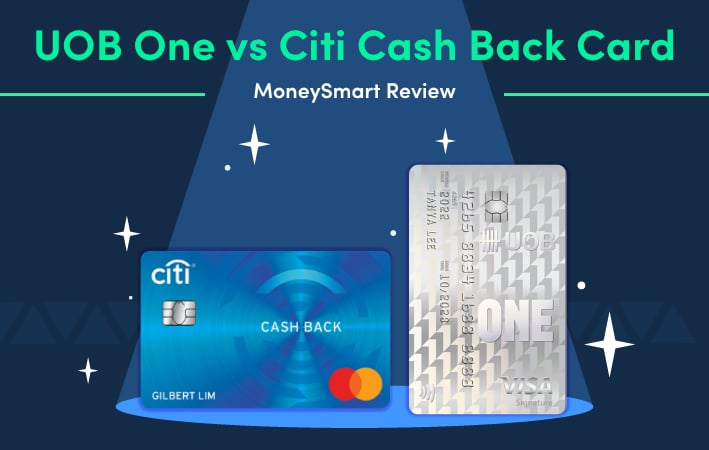
When it comes to cashback, is less more? I wouldn't think so. More cashback is always better, right? At least, that's what I assumed, until I started comparing two of Singapore's most popular cashback credit cards: the UOB One Card and the Citi Cash Back Card. That conviction didn't survive the comparison.
The UOB One Card currently boasts up to 20% cashback on everyday merchants like McDonald's, Grab, and Shopee. In the other corner, the Citi Cash Back Card comes in swinging with up to 8% cashback on groceries, petrol, and ride-hailing. On paper, that's not even close. But what those headline figures don't show is that the two cards reward you in almost completely different ways—and that's enough to flip the "obvious" pick entirely, once you look at how you actually spend.
So I dug into both cards' full terms to find out exactly where that flip happens. Here's what I found, and two quick checks to work out which card actually fits how you spend.
[ms-toc title="UOB One vs Citi Cash Back: When Does 8% Cashback Beat 20%?"]
1. First, the fees (and why they're a non-issue here)
Before we get into the meaty cashback part of this comparison, let's deal with the boring stuff first: fees. The good news is that the picture is pretty simple. These 2 cashback credit cards are priced almost identically, which is worth knowing precisely because it means none of it should factor into your decision.
Every fee/rate except the interest rate is identical, and the latter only differs by 0.1% p.a. This means your decision between these two cards comes down to their benefits instead. You need to consider two things: how much you spend every month, and what you actually spend it on.
2. UOB One vs Citi Cash Back: What do they offer?
Let's start with what each bank actually puts on the tin, before we get into what it takes to earn it.
*The 20% rate is a limited-time Enhanced Cashback promo, running from 15 May to 30 September 2026, open only to customers who are new to UOB. Everyone else—including existing UOB One cardholders—earns the standing rate, which tops out at 10%.
Note the asterisk. The 20% figure is a new-customer bribe with an expiry date, not a permanent feature of the card. Once that quarter ends, the rate you're comparing against Citi's 8% is 10%, not 20%. While having that headline cashback figure already paints a different picture, there’s another piece of the puzzle to consider: hitting even the standing 10% comes with strings attached.
3. The fine print: UOB One and Citi Cash Back's actual cashback requirements
Here's where "bigger number wins" is not going to hold up. These 2 cards have fundamentally different mechanics to earn the highest cashback they promise..
At this point, I want you to notice two things.
a) Quarterly vs monthly cashback
The first is how the quarterly nature of UOB One's tiers make their cashback mechanism more unforgiving. To earn a given tier's bonus rate for the quarter, you need to clear its minimum spend and 10-transaction count in all 3 statement months in a row—not just on average. Fall short in just one of those three months, and that quarter's bonus rate doesn't kick in, no matter how strong the other two months were.
On the flipside, Citi's cashback works on a monthly basis. That means you need to hit $800 a month to earn cashback for your expenditure that month, instead of having to hit the minimum spend for 3 months in a row. If you miss the $800 mark one month, your cashback drops to 0.2% for that month with no knock-on effect to the months around it.
b) Bonus merchants vs categories
UOB One's bonus categories are tied to 3 named merchants—Grab, Shopee, McDonald's, and SimplyGo—plus groceries and SP Utilities as broader categories. Spend outside that list, however much of it, earns you the base rate only. Citi Cash Back takes the opposite approach: it doesn't care which specific restaurant, supermarket, or petrol station you use, only which category the transaction falls under. While UOB One considers the specific merchants, Citi Cash Back clocks the Merchant Category Code (MCC) instead. That distinction is important enough that it gets its own section further down.
4. How to pick between UOB One and Citi Cash Back: 2 quick checks
With the mechanics on the table, the actual decision comes down to 2 straightforward questions:
- Does your spend clear UOB One's or Citi Cash Back’s tiers?
- Does it land in either card's bonus list in the first place?
Get both checks right, and picking a card stops being about which percentage looks bigger and starts being about which one matches how you already spend.
Check 1: Does your monthly spend hit UOB One's cashback tiers?
UOB One's rate climbs the more you spend — but remember, every tier is judged monthly, not averaged across the quarter.
*Excludes the limited-time Enhanced Cashback promo for new-to-UOB customers. Also requires 10 or more transactions every qualifying month.
Below $800 a month, UOB One wins outright—Citi hasn't unlocked anything yet, since it hasn't crossed its own minimum spend line. Once you cross $800, though, Citi catches up quickly, and even pulls ahead on groceries specifically, because UOB's grocery bonus doesn't switch on until you reach the $1,000 tier.
It's worth running actual numbers here, because percentages alone can be misleading once caps enter the picture. Say your monthly spend is $1,500, split $600 on Grab rides and $900 on groceries—a realistic mix for plenty of households, and easily above 10 separate transactions if you're paying per ride and per grocery run rather than in one lump sum.
Here's how that split plays out for each card, alongside a second profile where the result flips the other way:
You’ll notice that in the example above, it’s the same $1,500 total each time with the same two categories in play, but the winner flips depending on exactly where that spend lands. UOB wins the first profile because Grab sits on its named-merchant list, with plenty of cap room to spare. Citi wins the second because its dining category rewards any restaurant, while UOB's dining bonus is locked to McDonald's specifically—leaving that $900 earning only the 3.33% base rate. That's the entire premise of Check 2, coming up next: the category-versus-merchant divide can matter more than the headline percentage on the card.
ALSO READ: Best Credit Card Promotions in Singapore: Citibank, DBS, HSBC, UOB, and More
Check 2: Does your spending match UOB One or Citi Cash Back's bonus categories?
Even if your spend level clears UOB's tier, none of it matters if your money isn't going to the right places—and this is where the two cards part ways completely, because they don't define "the right places" the same way at all.
Groceries is a dead heat: both cards key off the same merchant category code, so your grocery bill earns the same way regardless of which specific supermarket you shop at—the only thing that decides the winner here is your spend level from Check 1.
Dining is where Citi Cash Back pulls meaningfully ahead. UOB's dining bonus is locked to McDonald's by name, full stop. Citi rewards any restaurant, fast food outlet, or caterer. If your idea of "eating out" is closer to small eateries, centres, cafes, or actual restaurants than the McDonald's drive-through, UOB simply isn't paying you anything extra on that spend. In fact, you'd be earning the 3.33% base rate on money that Citi would reward at 6%.
Transport is closer to a wash, but for different reasons on each side. Citi covers more ground on ride-hailing operators and adds petrol into the mix, which UOB doesn't reward at all as cashback (Shell offers a separate fuel discount scheme, not cashback). But UOB is the only one of the two that pays out on public transit through SimplyGo—so if your daily commute is the MRT or a bus rather than Grab, Citi's private commute category won't help you at all.
ALSO READ: Citi Cash Back Card Review 2026: Earn Up to 8% Cashback on Petrol, Dining, and More
5. UOB One vs Citi Cash Back: our verdict
Put both checks together, and the answer to "when does 8% beat 20%" becomes clear: it beats it whenever your spend doesn't fit UOB One's named merchants, or doesn't clear its tier in the first place. For a lot of people, that's most months—not because UOB's card is bad, but because its rewards are narrower and its rules are stricter than the headline number lets on.
UOB One pays more, but only for exactly 4 merchants and the groceries category, and only once you've cleared a monthly tier with at least 10 transactions to match. Citi Cash Back pays less per transaction, but on anything you'd already call dining, groceries, or petrol—with no tiers to climb and no transaction count to hit.
Even when your spend does fit UOB's list, it's asking you to track more: which tier you're in, how many transactions you've made, and whether your spend landed on one of four specific names. Slip up on any of those, and you lose more than you'd expect. Citi asks for less, and forgives more when you fall short of it.
Check which one actually describes your receipts before you check which one has the bigger percentage on the box.
6. UOB One and Citi Cash Back welcome gifts
If the cashback math still has you torn, the current welcome offers might help tip the decision. Take a look at what’s on offer:

- Cash Back on Groceries, Petrol & Private Commute
- Up to 8%
- Total Cash Back Cap, per month
- S$80
- at Caltex, Shell & Esso
- Up to 23.64% savings
Snap up baseline gifts: be among the first 200 approved applicants spending S$500 to enjoy S$450 Upsized Cash or a S$500 Amazon.sg Gift Card, or still grab S$400 Cash or 6,140 SmartPoints (use SmartPoints earned to redeem the latest Apple products on our Rewards Store) if you come after.
But the real treat? Dive into spooktacular Halloween rewards with MoneySmart! Each day, the first 10 fastest claimants snatch exclusive Flash Deal prizes—from iPhone 18 Pro, MacBook Neo, Switch 2, PS5 and more—on top of your baseline reward! T&Cs apply.

- cashback on daily spend at McDonald's, Grab, SimplyGo & Shopee
- Up to 10%
- cashback at all grocery spend
- Up to 8%
- cashback cap a year
- Up to S$2,240
[MoneySmart Offer]
Get guaranteed S$60 Cash - when you are a New-To-UOB customer and spend S$500 within 30 days! T&Cs apply.
Dive into spooktacular Halloween rewards with MoneySmart! Each day, the first 10 fastest claimants snatch exclusive Flash Deal prizes—from iPhone 18 Pro, MacBook Neo, Switch 2, PS5 and more—on top of your baseline reward!
Found this article useful? Share it with the friend who's always asking which cashback card to get.
Related Articles