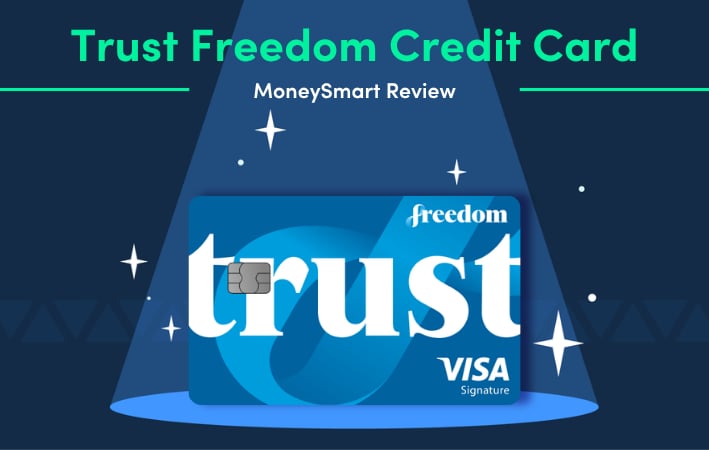
In my Trust Cashback Credit Card review, I said it Frankensteined 2 cashback modes (bonus cashback and unlimited cashback) into one card. That card just got an upgrade, with a new face and new name—the Trust Freedom Credit Card. The Frankensteined cashback duo is still very much alive inside Freedom, but it's no longer flying solo. Now, it's got 3 new, less mad-scientist teammates to work with.
Launched on 13 August 2026 alongside Trust's Everyday Investor Report, Freedom is Trust's answer to a problem the study surfaced: 33% of young Singapore residents still haven't started investing, mostly because they don't know where to begin or don't feel confident enough to try. Freedom's pitch is that you don't need to "start investing" at all—you just need to keep spending the way you already do, and let stockback do the rest. Yup, you read that right. Stockback—a first in Singapore’s credit card scene.
So is the Trust Freedom card actually worth signing up for, or is it just a cashback card wearing an investing costume? Here's the full breakdown.
[ms-toc title="Quick navigation: Trust Freedom Credit Card Review"]
See our credit card ranking rubric to find out how we rank credit cards.
1. What is the Trust Freedom Credit Card?
- Stockback
- 3%
- Cashback
- Up to 15%
- per dollar spent
- 1.3 miles
Dive into spooktacular Halloween rewards with MoneySmart! Each day, the first 10 fastest claimants snatch exclusive Flash Deal prizes—from iPhone 18 Pro, MacBook Neo, Switch 2, PS5 and more—on top of your baseline reward! T&Cs apply.
Golden chance to win up to 8K USD stocks!
For new credit card customers! Get a sure-win stock gift valued up to 8K USD when you sign up and select Stockback as your reward.
Or get a sure-win cashback gift of up to S$8,000 when you choose Cashback as your reward. T&Cs apply.
Up to 100k Miles Welcome Offer!
Simply apply for Freedom card and accumulate min. spend within the first 31 days to:
- Get 20,000 Max Miles when you spend min. S$1,000
- OR get 50,000 Max Miles when you spend min. S$5,000
- OR get 100,000 Max Miles when you spend min. S$15,000 (that’s a round-trip ticket to Europe!)
Terms and conditions apply.
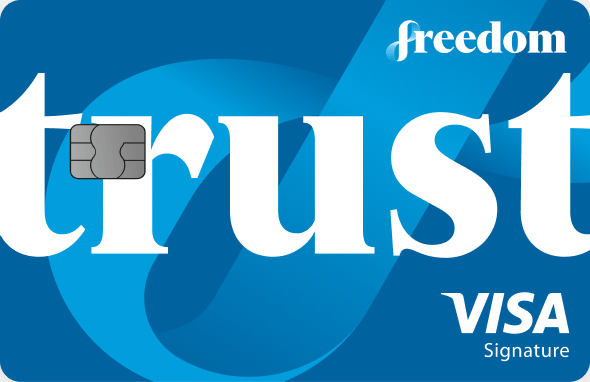
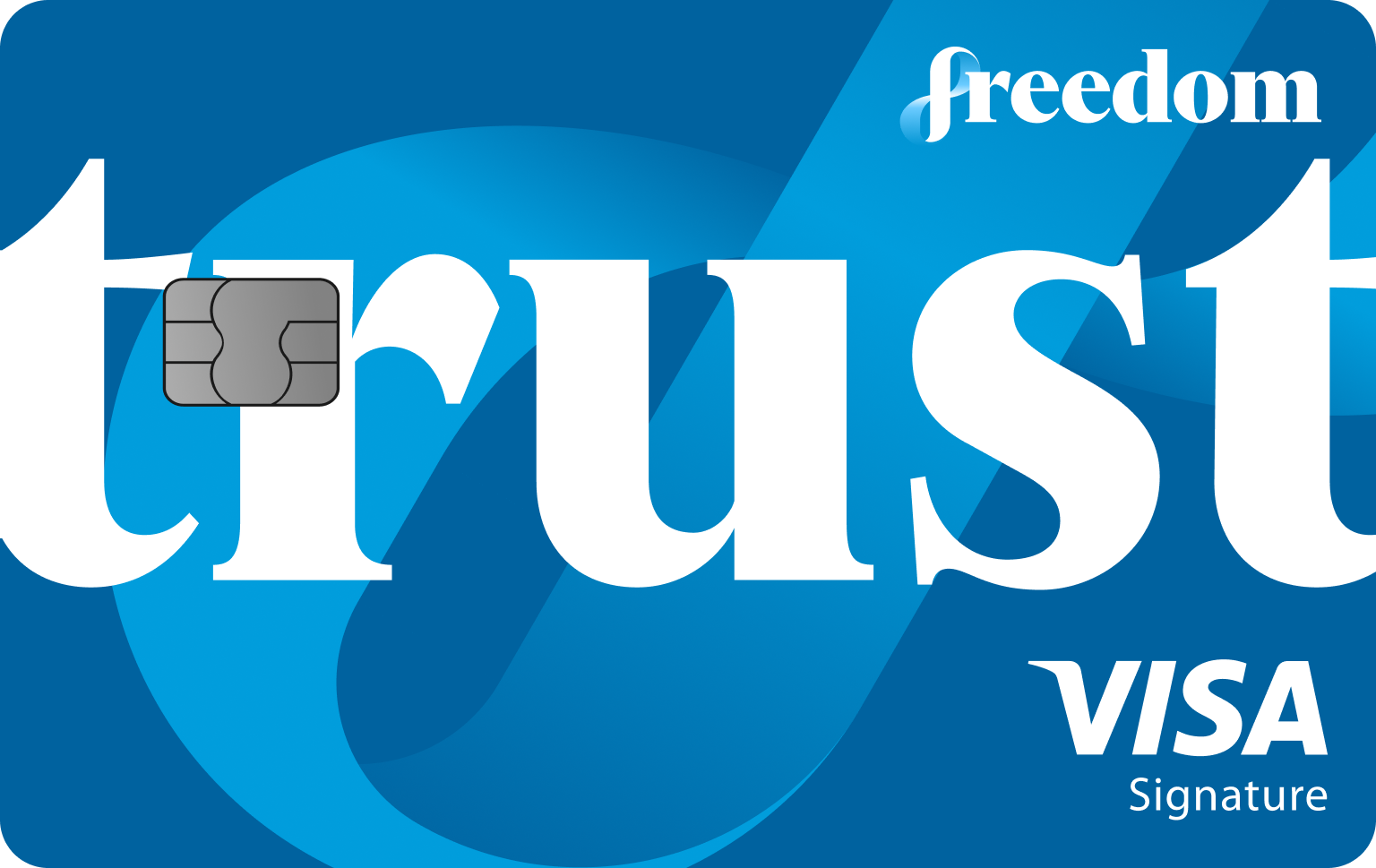
The Trust Freedom Credit Card is Trust Bank's reworked take on its original Cashback Card. Its cashback offer stays, alongside the $0 annual fee and $0 foreign transaction fee, but the bit that's turning heads is that the Freedom Card now comes with a completely new reward mode—stockback.
You might notice that Trust only issues 2 Trust credit cards—Freedom and the Trust Link Card—so on the surface, this looks like a small line-up. But Freedom's real trick is that it behaves like 4 cards in one. With this card, you pick 1 of these reward modes:
- Stockback
- Bonus cashback
- Unlimited cashback
- Miles
You can switch modes every quarter, so there's no need to commit to one mode for the life of the card. You also need not apply for a new card each time your financial goals change. We'll walk through each mode below.
2. Mode #1: Stockback
This is the headline feature—Freedom is the first credit card in Singapore to offer stockback rewards.
With stockback, every eligible dollar you spend earns a stockback value. Once your accumulated stockback hits S$10, Trust converts it to USD and uses it to automatically buy fractional shares of a US stock or ETF you've pre-selected, through investment partner Saxo. You can choose from a curated list of 50 US stocks and ETFs, and change your pick anytime before your next investment transaction goes through.
Stockback rates and caps
- 3% stockback on both local and foreign eligible spend, promotional until 31 Dec 2026
- From 1 Jan 2027, this drops to 2% on local eligible spend and 0.5% on foreign eligible spend
- Stockback value is capped at S$500 per quarter
- Minimum S$1 per transaction to earn stockback
"Eligible spend" here covers pretty much everything you'd swipe your card for, except the usual exclusions—things like bill payments, cash advances, and a handful of other transaction types. See the full list of exclusions if you want to check something specific.
How does the stockback work?
Let’s say you spend S$500 in a month and earn 2% stockback. That works out to be S$10 in stockback value—enough to trigger 1 investment transaction.
Here's what happens once you hit that S$10 threshold:
- Trust submits a purchase order for your selected stock or ETF on your behalf (if the day falls on a non-trading day, the order is deferred to the next trading day).
- You'll get your shares credited to your Trust Stocks account within 5 business days. Any leftover amount that doesn't cleanly convert into shares is credited as cash to your Stocks account, rounded to the nearest cent.
- If the order fails for any reason, you'll simply receive the reward as USD cash in your Stocks account instead of shares.
Trust also lets you sell your shares with no commission fee—the charge a brokerage normally takes each time you buy or sell a stock. This softens the blow of having your rewards locked into individual stock picks rather than cash you can spend on anything.
ALSO READ: Top 10 ETFs In Singapore: Start Investing In ETFs (2026)
3. Mode #2: Cashback
If you'd rather invest your money yourself and stick to traditional cashback rewards, the Trust Freedom Card still keeps the bonus cashback mode that made the original Cashback Card popular—plus adds a second unlimited cashback mode for those who would rather “spend and forget”.
Bonus cashback mode | Unlimited cashback mode | |
|---|---|---|
Local spend | 1% cashback | 1.5% cashback |
Foreign spend | 0.5% cashback | 0.5% cashback |
Bonus cashback | On 1 preferred category of your choice:
*for all months in a quarter | None |
3a. Mode #2a: Bonus Cashback
This is unchanged from the old Trust Cashback Card:
- 1% base cashback on local eligible spend, and 0.5% on foreign eligible spend
- Up to 15% bonus cashback on 1 preferred category of your choice (Dining, Travel, Entertainment, Shopping, Wellness, or Transport)
- You'll need to meet the minimum monthly spend in all 3 months of the quarter to earn the bonus rate.
There's a grace period, too: for the first calendar month after your card is approved, the minimum monthly spend requirement is waived. So if your card gets approved on 20 September, you can earn cashback without hitting the minimum spend for September—just make sure you meet it in October and November to qualify for the bonus rate that quarter.
Whichever tier you land on, cashback is credited automatically and offsets your next statement—you don't need to do anything to redeem it.
What is the effective cashback rate?
Don't expect 15% cashback on everything. The 15% (or 5%) rate only applies to your spend in your chosen preferred category—your base rate of 1% (local) or 0.5% (foreign) still applies to everything else.
Here's a worked example for someone who spends $500 a month for 3 consecutive months (Mar–May), with Shopping as their preferred category:
The total cashback earned in the quarter adds up to $274.50. This works out to an effective rate of roughly 4.6% on the full $6,000 spent, not 15%. The advertised 15% only ever applies to the slice of your spend that falls under your 1 preferred category.
3b. Mode #2b: Unlimited Cashback
This is the new cashback mode in the Trust Freedom Card, and it’s a much simpler offering:
- 1.5% cashback on all local eligible spend
- 0.5% cashback on all foreign eligible spend
- No minimum spend, no cap, no preferred category to track
It's the "I don't want to think about this" option—much simpler than its bonus cashback counterpart. It’s essentially your regular unlimited cashback, $0 minimum spend cashback card, à la the likes of the Citi Cash Back+ Card and Standard Chartered Simply Cash Credit Card.
ALSO READ: 6 Best Cashback Credit Cards in Singapore
4. Mode #3: Miles
The Trust Freedom Card's miles offering is simple: 1.3 miles per S$1 on both local and overseas spend.
As a base rate, the 1.3 mpd local earn rate is pretty decent compared to other miles cards in Singapore. While the overseas spend rate looks poorer on the surface, there's a huge win here: no fx fees. This means you earn the full 1.3 mpd—something that the other miles cards do not offer.
There's also no minimum spend and no cap on the miles you earn. To top it off, Trust is giving you instant miles conversions to Max Miles or KrisFlyer Miles at a ratio of 1:1.
There's lots of good things to say about the Trust Freedom Card's miles mode. I only have 3 things I would advise you to note:
- You earn miles for very S$5 spent—not for every S$1. So if your next café date chalks up a bill of $29.99, you'll only earn on the first $25 spent
- Miles conversions come with a fee of $27.25 (inclusive of GST)
- Miles expire after 3 years
5. Sign-up bonus: sure-win stock, cashback gift, or Max Miles
New Freedom cardholders get to pick their reward mode—Stockback, Cashback or Miles—and receive a gift, valid for sign-ups until 31 October 2026.
Choose stockback, and you'll get a stock gift worth one of: US$18, US$28, US$88, US$888, or US$8,000. The value is guaranteed, but the exact tier is randomised, as is which of 7 stocks you'll receive it in—Nvidia, Microsoft, Apple, Amazon, Alphabet (Google), Meta, or Tesla.
Choose cashback, and you'll get the SGD equivalent in cashback instead—S$18, S$28, S$88, S$288, S$888 or S$8,000—credited straight into your Freedom card account.
Either way, "sure-win" means you're guaranteed a reward, just not which denomination you land on.
Now if you choose miles, the story looks a little different:
- Get 20,000 Max Miles when you spend a minimum of $1,000 within the first 31 days
- OR get 50,000 Max Miles when you spend a minimum of $5,000 within the first 31 days
- OR get 100,000 Max Miles when you spend a minimum of $15,000 within the first 31 days
6. Fees and application
Here's a quick snapshot of what Freedom charges (or doesn't):
You’ll notice that the new Freedom Card folds in the same familiar features we loved from the Trust Cashback Card—think a $0 annual fee, 0% FX fees, and the option to use it for a balance transfer.
If you're looking at other borrowing options, compare personal loans in Singapore on MoneySmart.
7. Eligibility
You'll need to meet 1 of these criteria to apply for the Trust Freedom Credit Card—same as Trust's other credit cards:
You can check the full breakdown of eligibility criteria (and other application FAQs) on Trust's own FAQ page.
8. Trust Freedom Credit Card: pros and cons
Instant miles conversion |
9. Who should get the Trust Freedom Credit Card?
As the Trust Freedom Credit Card is 4 cards in 1, it'd naturally suit a wide range of people:
1. Investors. Especially new ones who've been putting off opening a brokerage account and would benefit from letting Trust do the investing for them—letting your spending do your investing is about as low effort as it gets. Seasoned investors may also want to take advantage of the limited-time 3% stockback offer while it lasts.
2. Cashback loyalists. Especially those who spend $2,000 and over per month and can make the most of the 15% bonus cashback tier, or those who are indecisive about which type of cashback they want and don't wish to hold on to too many cards.
3. Miles chasers. The $0 fx fee is a huge draw for overseas spending especially. You'll earn the full 1.3 mpd both locally and overseas, plus enjoy instant miles conversions.
3. Indecisive people in general. On that note, if you simply don't wish to hold on to too many cards while your needs (or preferences) keep changing, Freedom's mode-switching flexibility does the job on its own.
- Stockback
- 3%
- Cashback
- Up to 15%
- per dollar spent
- 1.3 miles
Dive into spooktacular Halloween rewards with MoneySmart! Each day, the first 10 fastest claimants snatch exclusive Flash Deal prizes—from iPhone 18 Pro, MacBook Neo, Switch 2, PS5 and more—on top of your baseline reward! T&Cs apply.
Golden chance to win up to 8K USD stocks!
For new credit card customers! Get a sure-win stock gift valued up to 8K USD when you sign up and select Stockback as your reward.
Or get a sure-win cashback gift of up to S$8,000 when you choose Cashback as your reward. T&Cs apply.
Up to 100k Miles Welcome Offer!
Simply apply for Freedom card and accumulate min. spend within the first 31 days to:
- Get 20,000 Max Miles when you spend min. S$1,000
- OR get 50,000 Max Miles when you spend min. S$5,000
- OR get 100,000 Max Miles when you spend min. S$15,000 (that’s a round-trip ticket to Europe!)
Terms and conditions apply.
10. Trust Freedom Credit Card vs other credit cards
Stockback: Trust Freedom vs the Tiger BOSS Debit Card
No other Singapore credit card currently offers stockback, so within that category, Freedom has no direct rival. Its closest comparison is actually a debit card: the Tiger BOSS Debit Card, which also charges $0 annual fee but rewards just 1% in fractional shares (versus Freedom's introductory 3%) and comes with an overseas payment fee starting from 0.26%. Freedom's edge here is the higher promotional rate, $0 FX fee, and a wider stock/ETF selection.
Unlimited cashback: Trust Freedom vs other flat-rate cards
At 1.5% with no minimum spend and no cap, Freedom's unlimited cashback mode doesn't make a super compelling argument on its own—it's on par with the Standard Chartered Simply Cash Credit Card at the same rate, and actually beaten by the Citi Cash Back+ Card and OCBC INFINITY Cashback Card (1.6%) and the UOB Absolute Cashback Card (1.7%).

- Cash Back on Eligible Spend
- 1.6%
- Min. Spend per month
- S$0
- Cash Back Cap per month
- Unlimited
Snap up baseline gifts: be among the first 200 approved applicants spending S$500 to enjoy S$450 Upsized Cash or a S$500 Amazon.sg Gift Card, or still grab S$400 Cash or 6,140 SmartPoints (use SmartPoints earned to redeem the latest Apple products on our Rewards Store) if you come after.
But the real treat? Dive into spooktacular Halloween rewards with MoneySmart! Each day, the first 10 fastest claimants snatch exclusive Flash Deal prizes—from iPhone 18 Pro, MacBook Neo, Switch 2, PS5 and more—on top of your baseline reward! T&Cs apply.

The case gets even weaker if you're the type who pairs a bonus cashback card with a flat, unlimited one. Seasoned cashback stackers often carry 1 card for their top spending category (where a bonus card can pay 5–15% or more) and a second, flat-rate card as a catch-all for everything else—including large one-off purchases that would otherwise blow past a bonus card's monthly cap. That combo earns more overall than any single card could on its own.
Freedom's 4-in-1 flexibility is great for switching between modes as your needs change over time, but within any given quarter, it can only be 1 mode at a time. The Freedom card may be 4-in-1, but it can't be 2 cards at once.
Bonus cashback: Trust Freedom vs Citi SMRT and UOB One Card
Freedom's bonus cashback tiers are 5% or 15%, with $500 and $2,000 monthly spend respectively. For a quick comparison, I’ve picked out the Citi SMRT Card and UOB One Card to illustrate where Freedom sits, but note that these are just 2 examples among the many bonus cashback cards on the market.
At the 5% cashback tier, the Citi SMRT Card matches Freedom's $500 minimum monthly spend, but rewards 5% cashback across more than 1 category (groceries, transport, and online shopping, versus Freedom's single preferred category). It also comes with a higher, annual cap of $600 rather than a per-quarter one, and the bonus cashback is given when you hit the minimum spend for each month instead of for all months in a quarter. In short, the Citi SMRT Card is lower effort for a wider range of cashback categories. However, you might still opt for the Freedom Card if you’re gunning for a particular preferred category it covers that the Citi SMRT Card does not, such as dining.
 Medium.jpeg)
- on Online Purchases, Groceries, Taxi, Ride-hailing, SimplyGo & Malaysia Ringgit Spend
- 5% Savings
- on Other Retail Spend
- 0.3% Savings
- Min. Spend per statement month to earn max rebates
- S$500
Snap up baseline gifts: be among the first 200 approved applicants spending S$500 to enjoy S$450 Upsized Cash or a S$500 Amazon.sg Gift Card, or still grab S$400 Cash or 6,140 SmartPoints (use SmartPoints earned to redeem the latest Apple products on our Rewards Store) if you come after.
But the real treat? Dive into spooktacular Halloween rewards with MoneySmart! Each day, the first 10 fastest claimants snatch exclusive Flash Deal prizes—from iPhone 18 Pro, MacBook Neo, Switch 2, PS5 and more—on top of your baseline reward! T&Cs apply.
At the 15% cashback tier, though, Freedom does better. The UOB One Card uses a similar mechanic—hit $2,000 in monthly spend for 3 consecutive months—but its bonus rate is split across specific merchants and categories (like Grab, Shopee, SimplyGo, and groceries) rather than paid as a flat 15% on your single preferred category. Its cashback is also credited quarterly rather than continuously.

- cashback on daily spend at McDonald's, Grab, SimplyGo & Shopee
- Up to 10%
- cashback at all grocery spend
- Up to 8%
- cashback cap a year
- Up to S$2,240
[MoneySmart Offer]
Get guaranteed S$60 Cash - when you are a New-To-UOB customer and spend S$500 within 30 days! T&Cs apply.
Dive into spooktacular Halloween rewards with MoneySmart! Each day, the first 10 fastest claimants snatch exclusive Flash Deal prizes—from iPhone 18 Pro, MacBook Neo, Switch 2, PS5 and more—on top of your baseline reward!
Again, I picked out these 2 bonus cashback cards as quick illustrations to see what else is out there at these minimum spends. If you're shopping around purely for cashback, it's worth comparing more than these 2—see our full round-up of cashback credit cards in Singapore for more options.
Miles: Trust Freedom vs other miles cards
I can't think of any other miles card that lets you earn miles on overseas spending with with no fx fees, which makes the Trust Freedom Card very impressive for travellers. One card that looks like it might match up is the new DBS Chromo Card, which earns 1.3 mpd and has no fx fees too. The catch? You only earn 1.3 mpd on local spending. Foreign spending doesn't earn you miles—but at least neither does it incur fx fees.
.png)
- on your top 2 local spend categories every month
- Up to 5% Cashback
- & 5-year annual fee waiver
- 0 FX Fees
- Flexibility to choose your reward preference every month
- Miles or Cashback
If you're looking at only the 1.3 mpd local earn rate, one card with a higher local rate is the UOB PRVI Miles Card at 1.4 mpd.

- on agoda and Expedia bookings via UOB PRVI Miles website.
- S$1 = Up to 8 miles
- on Overseas Spend
- S$1 = Up to 3 miles
- on Local Spend
- S$1 = 1.4 miles
[MoneySmart Offer]
Get guaranteed S$60 Cash - when you are a New-To-UOB customer and spend S$500 within 30 days! T&Cs apply.
Dive into spooktacular Halloween rewards with MoneySmart! Each day, the first 10 fastest claimants snatch exclusive Flash Deal prizes—from iPhone 18 Pro, MacBook Neo, Switch 2, PS5 and more—on top of your baseline reward!
11. FAQs
What stocks and ETFs can I choose from with Trust Freedom stockback?
Trust offers a curated list of 50 US stocks and ETFs. You can pick your preferred stock or ETF when you sign up and change your selection anytime before your next stockback investment transaction is processed.
What happens to my stockback reward if my selected stock gets delisted?
If Trust runs into issues submitting your order—for example, if your selected stock or ETF gets delisted—it'll return the reward to you as cashback on your Trust Freedom credit card instead, or in any other way it sees fit.
What happens to my stockback if I switch reward modes mid-quarter?
Reward modes can be switched every quarter. If you switch out of stockback, any stockback value you've already accumulated that hasn't hit the $10 threshold will still need to reach $10 to convert into shares—check the Trust App for how partial balances are handled at the point of switching.
Are there other Singapore credit cards that let you switch between cashback, miles, or stockback?
Not with this exact combination. Rewards cards let you convert your points earned to either miles or cashback, but switching between fundamentally different reward types—cash, miles, and now stocks—on a single card is unique to Freedom for now. There are also no other credit cards with stockback at all—the closest comparison is the Tiger BOSS Debit Card, which rewards fractional shares but isn't a credit card.
What happens to my stockback if I cancel the card?
Any accumulated stockback value that hasn't reached $10 will be forfeited and isn't transferable to another account if you close your Freedom card.
Can I switch reward modes anytime, or only quarterly?
Only quarterly. Stockback, bonus cashback, and unlimited cashback can each be selected once per quarter.
When will I receive my cashback?
It depends on which part of your cashback you're asking about. Base cashback (the 1% local/0.5% foreign rate, or the 1.5% unlimited rate) is credited as soon as each transaction is posted and completed, with no need to wait. Bonus cashback, on the other hand, is only credited on the first day after your quarter ends, since Trust needs to first confirm you've met the minimum monthly spend across all 3 months.
When does my quarter start, and can I change it?
Your quarters are anchored to the month your Freedom card was approved, not the standard Jan–Mar calendar quarters. For example, if your card was approved in September, your quarters would run Sep–Nov, Dec–Feb, and so on. This is fixed based on your sign-up month and can't be changed.
Can I select my own repayment date?
If you're new to Trust and don't hold any other Trust credit card, you can select your own repayment date when you sign up. Existing Trust Link or NTUC Link cardholders won't be able to pick a new repayment date—your Freedom card will follow your existing consolidated statement instead.
P.S. Here’s our MoneySmart credit card ranking rubric
In case you’re wondering, here’s how we decide on our credit card rankings.
Is that credit card MoneySmart? Our MoneySmart credit card ranking rubric | |
Category | Our rating |
Overall | The average rating for the credit card on the whole, calculated from the ratings for the individual categories below. Plus, we’ll give you a one-liner on who we think the credit card is best suited for. |
Earn rates: Air miles / Cashback / Rewards points | Air miles / Cashback / Rewards points . This category looks at the depth rather than breadth of earn rates.
|
Earn categories | This category looks at the breadth rather than depth of your earnings.
|
Annual fees and charges |
|
Accessibility | Minimum income requirements:
Exclusivity: We dock 1-2 stars if there is/are another category/categories that make the card exclusive and very specific to a certain clientele. |
Extras/periphery rewards | These include:
We count the number of benefits and award between 0.5 to 2 stars for each, depending on how good the perk is. |
Sign-up bonus |
|
Check out our ultimate list of credit card reviews for the low-down on credit cards in Singapore.
Found this article useful? Share it with your friends who keep saying "I'll start investing next year.”
Related Articles