
Here's an awkward truth: banks have been reading your financial diary for years, and you've probably never flipped through it yourself.
That diary is your credit report. Every credit card bill you paid on time is in there. So is every bill you "forgot" about, and every loan you applied for in a moment of weakness. When you apply for a home loan, a new card or even certain jobs in finance, the person on the other side is reading it.
The good news? For under S$9, you can see exactly what they see. The not-so-good news: it's written in a language only bankers seem to speak. Risk grades, payment codes, and a 4-digit score that somehow tops out at 2,000.
So let's translate it, line by line.
[ms-toc title="A Beginner’s Guide To Understanding Your Credit Report In Singapore 2026"]
1. What is a credit report?
Your credit report is a record of your credit payment history compiled from different credit providers. So, if you’re like me, a saint who always pays the bills on time, it’ll show. If your habit of running late extends to paying bills—or worse, skipping them entirely—again, it won’t go unnoticed.
Credit reports in Singapore are produced by the Credit Bureau Singapore (CBS)—Singapore's most comprehensive consumer credit bureau.
While the credit report is a tool for you to check up on how you’re doing financially, it actually has a real impact for credit providers. Most lenders will check your credit file to assess your credit worthiness prior to deciding if you deserve receiving credit from them, e.g. a personal loan.
Think of it like your dating app bio. It’s what determines whether you get a swipe to the right or left—or in this case, that loan approval or rejection.
2. Where can I get my credit report in Singapore?
It’s actually really straightforward. You can buy your credit report on the CBS website by logging in with Singpass. Prefer a personal touch? Head down to the CBS office, or request one at any SingPost branch.
Online | Log in with Singpass (Myinfo pre-fills your details) and pay by Visa or Mastercard. Once payment goes through, click View Report to print or save it, as CBS does not email it to you. For your latest credit records, retrieve the report from the 16th of each month. The site blocks overseas IP addresses; if you're abroad, email [email protected] with your ID documents and a selfie, and CBS will reply within 2 business days. |
Credit Bureau office | Upon request, CBS will process and subsequently provide you with a copy of your credit report. |
Need the report for an HDB application? You don't have to download it and upload it again. CBS can send a copy of your report straight to HDB (or the National Council on Problem Gambling) with your consent, at the same S$8.00 price.
3. How much does it cost to get a credit report in Singapore?
Getting a credit report will set you back S$8.00 before GST, or S$8.72 with the prevailing 9% GST.
Alternatively, you could get a free credit report if you've recently applied for a new credit facility with any of the CBS members. The letter or SMS telling you whether your application was approved or rejected will include the redemption channels for your free report. You'll need to claim it within 30 calendar days of that notice, either online or by bringing the letter (or SMS) and your NRIC to the CBS office.
4. What is a credit score? Specifically, what is a CBS credit score?
It's basically a 4-digit number, from 1,000 to 2,000, that's formulated based on your past payment history on your loan accounts. It's calculated by an algorithm using your currently available credit data, and it's a fluid number that changes as your credit information changes. This information is provided by and collated from various sources.
The closer your credit score is to 2,000, the better your financial health, with a lower risk of default. If your score is closer to 1,000, you're not looking too great: it means a higher risk of defaulting on a payment.
Your score maps to a risk grade, and each grade comes with a probability of default:
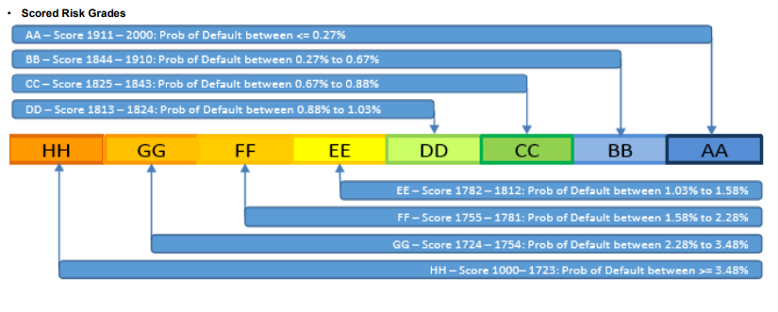
Image: CBS
Some reports show a non-scored grade instead of a number. HX means there's a public record such as a bankruptcy, while CX means there's too little credit activity to score you. Never had a credit card or loan? That's probably you.
Your report will let you see your score, risk grade and risk grade description all together. Can't visualise it? No worries. Look here for the sample credit report of a "Mr Peter Tan".
5. A step-by-step guide to reading a credit report
Looking through the credit report can be confusing as it’s laden with jargon. Here are just some of the phrases you might see in the report—along with a summary from CBS itself.
Jargon | What does it mean? |
Summary | A display of your personal credit facilities, aggregate credit limits and indication of identity theft. |
Previous Enquiry | Shows a list of lenders who have searched on your information and your own searches on yourself. |
Account Status History | Displays all the credit accounts you have with CBS Members. |
Default Records | Reflects lenders who uploaded a default in a credit account, the product type, loan amount defaulted, outstanding balances and repayment status. |
Bankruptcy Proceedings | Information on the original order date and discharge date by Insolvency and Public Trustee's Office (IPTO). |
Narratives | Indicates involvement in Debt Management Programme (DMP) with Credit Counselling Singapore (CCS) and any amendments made to the information in the report. |
Credit Score | A numerical expression based on the past payment history of credit/loan accounts to determine one's creditworthiness. |
Aggregated Outstanding Balances | Outstanding balances are computed based on the amounts outstanding under your credit cards or other credit facilities. |
Aggregated Monthly Instalments | Monthly instalments include the granular amounts for each facility provided by CBS Members for the previous month and aggregated amounts for the preceding 5 months. |
Now that you have a brief overview, here’s a little more context about some of the key things in the report and how you can interpret them:
Account Status History
Possibly the most technical section, the Account Status History shows the different credit accounts a consumer holds, whether singly or jointly with CBS member banks and financial institutions.
These could come in the form of:
- Secured or unsecured credit cards
- Loans i.e., personal, mortgage, car, housing etc
Within this section, you can also see your payment patterns over the last 12 months, whether a cash advance was taken up and if full payment was made.
Yep, there’s no hiding here. The payment codes in the report even explain how prompt the consumer is, in paying the monthly instalments. Poor payment patterns and overdue balances can affect the consumer’s credit score.
Previous Enquiries
This section keeps a record of every enquiry made on your credit report over the past 2 years.
An enquiry can be for a new credit facility application, a CBS member bank's review of the credit facilities you already hold with them, or a guarantor review.
When too many new applications are made within a short span of time, this can affect your credit score, as it's read as credit hunger: an urgent need for funds. That said, it's not possible to define exactly how many applications is too many, or how short a period is too short. Calculating a credit score is a black box and many factors are at play.
The good news is that not every enquiry counts against you. Periodic reviews by your existing banks and guarantor checks don't affect your score. Neither does checking your own report, which is recorded here too. CBS actually encourages you to pull your own report so you understand where you stand.
Default Records
From the last 12 cycles of payment patterns under the Account Status History, readers of the credit report will be able to see whether the consumer is facing financial distress. Typically, when a consumer struggles to make payments, the payment codes will begin to deteriorate and eventually lead to a default.
A default record section will then open to reflect details of the default. Default Records that show "Negotiated Settlement" or "Full Settlement" as their status will be retained for 3 years from the status date, while those with statuses "Outstanding", "Partial Payment" or "Sold Off" will appear indefinitely on your credit report.
The default record section shows the types of products and which CBS member bank they belong to. The status of the default will also be uploaded, showing the method of settlement between the consumer and the CBS member bank. It can be an outstanding default, or a partial, full or negotiated settlement.
For negotiated settlements, the amount written off by CBS member banks will be indicated.
Bankruptcy
When a bankruptcy record is present, the consumer will be given a non-scored grade: HX. A consumer with bankruptcy records will take years to rebuild their credit score and can expect to face difficulties in loan approvals.
Bankruptcy records come from the Insolvency and Public Trustee's Office (IPTO) and are retained in the credit report for 5 years from the date of discharge from bankruptcy.
6. Is credit score important in Singapore?
Of course! Your credit score will essentially be used by banks to assess how likely you are to repay your debts.
If you are planning to borrow from a bank—like when you take out a home loan for a property purchase—you need to ensure that your credit score looks good.
The same goes for applying for an HDB loan. If you’re not a full-time employee with regular CPF contributions, HDB will want to take a look at your Credit Bureau Singapore credit report. They’ll need to assess how likely you will be able to service your loan before they issue you with the HDB loan eligibility letter (HLE).
Your credit score is also important if you are planning to take up any forms of credit or loans, be it applying for a new credit card, taking up a renovation loan for your new place, or applying for an education loan. For example, that new credit card you’re trying to get, the credit limit on that card is either gonna be higher or lower based on your score.
Some employers conduct pre-hire employment checks with CBS, especially those complying to MAS’ Fit and Proper Guidelines. Thus, your credit reputation might influence the hirer’s decision to employ you.
In Singapore, banks and financial institutions screen their employees diligently and your credit score is one of the many possible employment screening tests they can run prior to hiring you. The risk appetite of the employers depends on the role you are applying for.
Having said that, it does not mean that you can mismanage your credit after landing yourself a job in the Banking and Finance industry. This is because employers can still run annual screening on their existing employees to ensure they are financially sound. This is important especially in times of a recession.
7. How is my credit score determined? What causes a bad credit score?
CBS calculates your credit score by applying an algorithm to your current available credit data. Your credit score is by no means a static number. It may change from time to time to account for any new credit activity.
As a benchmark, I'd say anything 1,844 and above (a BB grade or better) is really good, and 1,911 and above puts you in the top AA grade.
These are the key contributing factors that will affect your score negatively. Note that there is no fixed weightage to each factor and how much impact it has on the score.
- Immature credit history: You don't have enough credit history to establish a good credit score
- Credit exposure: The more you borrow, the higher your credit risk
- Delinquency presence: Overdue or slow payments on your accounts will worsen your credit score
- Not enough clean history: Lack of positive loan history (repaying in full and on time)
- Adverse credit history: Presence of negative loan history (late or incomplete repayments)
- Too many enquiries: The frequency and recency of your loan applications also play a part
To find out which factors apply in your case, refer to the key contributing factors section on your credit report to understand what has caused your credit score to drop.
Do note that while you can't remove any accurate information on your report, you can certainly dispute anything you believe is wrong.
8. Why do some banks reject while others approve the same applicant with the same credit score?
Your credit score is assessed every time you apply to borrow from any bank or financial institution that is a CBS member.
But different lenders consider different factors and have different risk appetites in assessing an individual’s credit worthiness. Therefore, there is no universal standard on acceptable credit scores among the lenders.
In addition, each financial institution has its own internal credit score and risk profile for each applicant based on your financial and demographic information.
So, the CBS credit score is only one of multiple pieces of information used in the bank’s assessment process, and it is ultimately up to each bank’s risk appetite to approve or reject the application.
Also, it's worth noting that CBS doesn’t "blacklist" nor play a part in the lending or hiring approval decision. It only provides specific factual credit-related information about consumers who have credit or loan facilities to the lenders.
9. How can I improve my credit score in Singapore, and how long does it take?
If you have over-extended yourself and your credit history has been dented by recent late repayments, you might be wondering when your credit score will look good again.
The good news is that it is within your ability to clean up your credit history! Here are 3 golden rules, folks.
Rule #1
Pay your bills on time, all the time |
Rule #2
Keep at least one credit card active |
Rule #3
Avoid applying for too many credit cards or loan facilities within a short period of time |
If you do not have an active credit facility, you should apply for a credit card to start building your credit score. Make sure to make prompt payments and you’ll be on track to improving your credit score.
There is no fixed period during which your credit score will definitely improve—the score is calculated by a black box algorithm.
But it typically takes a few months of responsible prompt repayments to start seeing an improvement in your credit score.
If applying for new credit facilities has become challenging because of your deteriorated credit score, you might want to try out an unsecured credit card with a low credit limit or take up a secured credit card so that you can start rebuilding your credit reputation.
10. Is there anything in my credit report that cannot be remedied?
Alas, if your credit history problems go deeper than late repayments—such as default, bankruptcy or debt management programmes—these will also be reflected in your credit report. Default records will be retained for 3 years from the Date of Settlement (for Default Records with the status of Negotiated Settlement or Full Settlement), while Bankruptcy records will be retained for 5 years. This means even after you are discharged from bankruptcy, you can still face difficulties taking up loans for the next few years.
The credit report should state whether the default is outstanding, whether debt management programs are in progress or whether you have been discharged from bankruptcy as well.
Generally, these are the codes you (or your banker) definitely do not want to see:
- W code: This refers to loan default, which is basically the worst code you could see. This does not get reset and will scar your credit score.
- R or S codes: This means the bank has closed off your account/credit facility, and you have settled or restructured your outstanding debt.
- H code: Involuntary closure of your account with outstanding balance.
Found this article useful? Share it with someone who might need it.
Related Articles