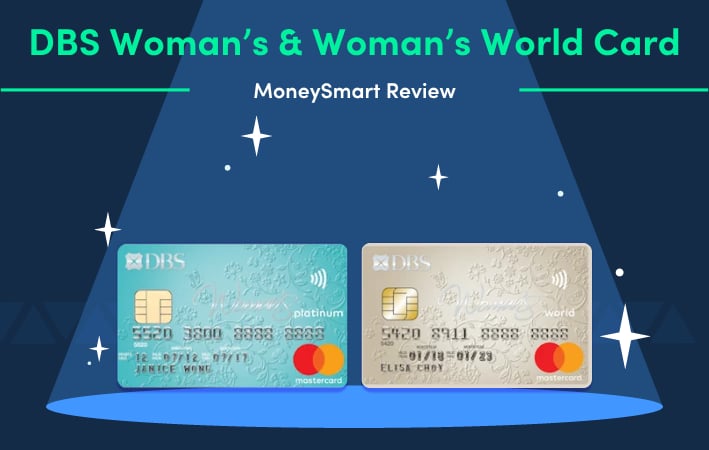
If you've ever stood in front of the DBS credit card page trying to work out the difference between the DBS Woman's Card and the DBS Woman's World Card, you're not alone. The names are almost identical, and despite the branding, both are open to men and women alike. Both reward online spending with bonus DBS Points that convert into miles, but the World Card asks for a much higher income and pays out double the miles per dollar in return.
Both cards work the same way: spend online within a monthly cap, and you'll earn a bonus on top of the base rate. The Woman's Card tops out at 2 mpd on the first $1,000 of online spend a month; the World Card doubles that to 4 mpd on the same cap, plus a smaller overseas bonus. Neither awards miles automatically—DBS Points must first be converted to a partner like KrisFlyer, and that conversion has its own fees and minimums.
The catch: the World Card's online cap used to be a generous $2,000 a month, but DBS has quietly halved it since 2024—now the same $1,000 as the basic Woman's Card. So the once clear-cut upgrade has narrowed to the earn rate alone. Is that worth the higher income bar and steeper fee? Let's find out.
See our credit card ranking rubric to find out how we rank credit cards.
[ms-toc title="DBS Woman's Card vs World Card Review 2026: Which Wins?"]
1. DBS Woman's Card and DBS Woman's World Card—summary
Both cards run on the same basic idea: a modest base rate on everything you spend, topped up with a much juicier bonus on online spend, capped at the first $1,000 you charge online each calendar month. Where they part ways is just how juicy that bonus gets.
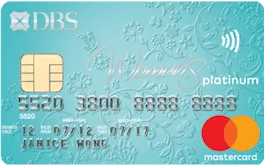
The DBS Woman's Card earns 1X DBS Point per $5 on everything (that's 0.4 mpd), plus an extra 4X DBS Points per $5 on online spend up to the $1,000 monthly cap—so your online spend effectively earns 5X DBS Points per $5, or 2 mpd. There's no separate perk for spending overseas here; unless you're shopping overseas online, you're stuck at the 0.4 mpd base rate.
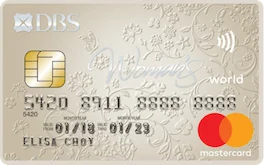
The DBS Woman's World Card, on the other hand, is the more generous sibling. It shares that same 1X base rate, but throws in 2X DBS Points per $5 on overseas spend (uncapped, so it works out to 1.2 mpd on every overseas dollar), plus a much bigger online bonus—9X DBS Points per $5 for local online spend or 7X DBS Points per $5 for overseas online spend—both still capped at that same $1,000 monthly online spend limit, and both working out to 4 mpd once you add in the base rate.
One thing to keep in mind: neither card hands you miles directly. What you're actually collecting is DBS Points, which live in the DBS Rewards Programme and need to be converted to a transfer partner's frequent flyer miles—most commonly KrisFlyer—before you can put them toward a flight. The good news is that principal and supplementary spend gets pooled together under the principal account, and you can even combine DBS Points across different DBS cards when it's time to redeem.

- on Online Purchases
- S$5 = 5 DBS Points (2 Miles per S$1)
- on Other Purchases
- S$5 = 1 DBS Point (0.4 Miles per S$1)
- e-Commerce Protection for Online Purchases
- Complimentary

- on Online Purchases
- S$5 = 10 DBS Points (equivalent to 4 Miles per S$1)
- on Overseas Purchases
- S$5 = 3 DBS Points (equivalent to 1.2 Miles per S$1)
- on all Other Purchases
- S$5 = 1 DBS Point (equivalent to 0.4 Miles per S$1)
2. How the DBS Woman's Card and Woman's World Card work
Here's the mechanic in plain terms: every $5 you charge to either card earns a base 1X DBS Point the next working day. Spend online, and you'll get an extra tranche of bonus points on top—but that bonus only lands at the end of the following calendar month, and only on the first $1,000 you spend online that month. Anything beyond that falls back to the plain 1X base rate for the rest of the month.
Note that DBS decides whether a transaction counts as "online" based on system indicators passed along by the merchant's acquiring bank—not by how the DBS app or your statement describes it. So a purchase that feels like an in-store or in-app payment could still register as online, or vice versa. The cap is also enforced by transaction date rather than posting date, which matters if you're planning a big purchase right around month-end.
And if you've got a supplementary cardholder in the picture, know that they share your points pool—so a household running both a principal and supplementary card only gets one shared $1,000 online cap a month between them, not one each.
3. What counts as eligible spend?
Good news—both cards share the same exclusion list, straight from the DBS Woman's Card and Rewards Programme terms and conditions, so you only need to learn it once.
DBS Woman's Card
DBS Woman's World Card
Key exclusions to know
Both cards take a "blacklist" approach—pretty much any online transaction qualifies unless it's specifically ruled out, so you don't have to memorise a whitelist of merchants. Per the current DBS Woman's Card and Rewards Programme T&Cs (updated 6 July 2026), the exclusions run on two lists: a set of merchant category codes (MCCs), and a list of specifically named merchants and platforms. Here's what that means in practice:
- Government, education, hospital, and utility payments—think court costs, fines, tax payments, postal and intra-government services, schools and universities, hospitals, and your electricity/gas/water bills. All excluded by MCC.
- Insurance, financial institutions, and professional services—insurance sales and premiums, banks and brokerages, and services like legal, accounting, architecture, and advertising won't earn you the bonus.
- Charitable, religious, political, and membership organisations—as of 1 December 2025, this now also explicitly covers political and membership organisations, on top of the existing charity and religious org exclusions.
- Toll and bridge fees, and money transfer services—both specifically excluded by MCC.
- Named payment platforms: AXS, SAM, CardUp, iPaymy, FavePay, SmoovPay, Amaze, EZ-Link, Transit (Link) top-ups, ShopeePay, Singtel Dash, and—worth flagging if you're stacking cards—YouTrip top-ups are on the exclusion list too.
- Cryptocurrency exchanges and forex/CFD trading platforms—a long, specifically named list (Coinbase, Bitpanda, OANDA, Saxo, IG Markets, and similar), plus betting and gaming transactions.
- Cash advances, balance transfers, 0% instalment payment plans, "My Preferred Payment Plan" transactions, and all DBS fees.
One thing to flag: as of 1 December 2025, DBS widened the exclusion list to catch a few more MCCs that weren't excluded before—real estate rental agents, cleaning and janitorial services, and a handful of "quasi cash" codes among them. So if you've been using either card for a broader range of online spend, it's worth double-checking against the current list rather than assuming last year's rules still hold.
Also good to know: points are awarded on the rounded-down transaction amount, and the bonus cap goes by transaction date rather than posting date—so a purchase made right at month-end could end up counting toward a different month's cap than you'd expect. If your online spend is the usual discretionary stuff—fashion, electronics, groceries via an app, food delivery, travel bookings—you shouldn't have much trouble hitting the $1,000 cap without tripping over these exclusions.
ALSO READ: Here's One Thing You're Not Tracking About Your Miles Card
4. Fees, charges, and card eligibility
Fees
Heads up—the annual fee waiver is changing. Per DBS's own rates and fees page, spending at least $15,000 a year on the Woman's Card, or $25,000 a year on the Woman's World Card, gets you the following year's annual fee waived. But from 1 August 2026, the World Card's waiver-on-spend arrangement is being scrapped—hitting that $25,000 threshold will no longer automatically earn you the waiver from that date. The Woman's Card's $15,000 threshold isn't affected. If you're counting on the World Card's fee waiver, it's worth checking DBS's current terms closer to your renewal date rather than assuming the old rules still apply.
ALSO READ: How to Get Credit Card Annual Fee Waivers and Still Enjoy Rewards and Perks (Updated 2025 Guide)
Eligibility
Here's the real dividing line between these two cards: income. If you're a Singaporean earning between $30,000 and $79,999, the World Card simply isn't on the table for you, no matter how much you spend online—the basic Woman's Card is where you'll land.
5. Miles calculation
Let's put both cards to the test with the same monthly spending scenario for a Singapore-based professional:
- Online shopping (fashion, beauty, electronics): $1,200/month
- Overseas spend (in-store, e.g. while travelling): $500/month
- Other spend (groceries, dining, transport): $1,000/month
The gap is stark: on identical spending, the World Card nearly doubles the miles you'd earn on the base card—5,080 versus 2,680 a month, or roughly 60,960 versus 32,160 a year. Weigh that against the annual fee (after the first-year waiver), and the Woman's Card works out to about 0.51 cents per mile, while the World Card comes in cheaper at around 0.32 cents per mile. So if you can meet the income bar and consistently max out the online cap, the World Card is genuinely the better miles engine.
As a rough guide, Singapore Airlines' official KrisFlyer Saver award chart prices a one-way Economy Saver award to Kuala Lumpur at around 8,000 miles and to Bangkok at around 13,000 miles, so a round trip would set you back roughly 16,000 and 26,000 miles respectively. Just bear in mind actual redemption value depends heavily on route, class, and seat availability at the time of booking, and Singapore Airlines does revise its award pricing from time to time—so treat this as a ballpark rather than a promise.
6. Are the DBS Woman's Card and Woman's World Card worth it?
Pros
- Both cards use a straightforward "spend online, earn a bonus" mechanic with no merchant category codes to track.
- The Woman's World Card's 4 mpd rate is competitive against similar online-spend miles cards.
- Both offer complimentary e-commerce protection and a first-year fee waiver.
- DBS Points from both cards pool with other DBS cards you hold, and principal/supplementary spend consolidates under one account.
Cons
- The $1,000 monthly online cap is identical across both cards despite the Woman's World Card's much higher income bar—so once you're maximising the cap, there's a hard ceiling on how many miles either card can earn you.
- DBS Points expire 12 months after being earned, so you'll need to convert to a transfer partner at least once a year to avoid losing them.
- Transferring DBS Points to KrisFlyer costs a fee per transfer and requires a minimum block size, so infrequent, small conversions aren't efficient.
- The Woman's Card's uncompetitive 0.4 mpd base and overseas rate means it only makes sense if your spending is genuinely online-heavy.
Is this card for you?
- You do most of your discretionary shopping online, rather than in-store.
- You can comfortably hit close to $1,000 of online spend a month without needing more.
- You're disciplined about converting DBS Points to miles at least once a year before they expire.
- You meet the $80,000 income bar (for the World Card) or are comfortable with a lower 0.4 mpd base rate (for the standard Woman's Card).
Verdict: if you clear the $80,000 income requirement and can consistently spend close to $1,000 online each month, the World Card is the smarter miles engine of the two, hands down. But if that income bar is out of reach, or your online spend is more modest, the standard Woman's Card is a decent, low-commitment starting point—just keep your expectations in check about that 0.4 mpd base rate once you're past the online bonus window.
7. DBS Woman's Card and DBS Woman's World Card promotion
There's no ongoing promo at the time of writing, but check back for new promotions on the DBS Woman's Card and DBS Woman's World Card pages.
- on Online Purchases
- S$5 = 10 DBS Points (equivalent to 4 Miles per S$1)
- on Overseas Purchases
- S$5 = 3 DBS Points (equivalent to 1.2 Miles per S$1)
- on all Other Purchases
- S$5 = 1 DBS Point (equivalent to 0.4 Miles per S$1)
- on Online Purchases
- S$5 = 5 DBS Points (2 Miles per S$1)
- on Other Purchases
- S$5 = 1 DBS Point (0.4 Miles per S$1)
- e-Commerce Protection for Online Purchases
- Complimentary
- Base Earn Rate
- S$5 = 1X UNI$ (0.4 miles per S$1)
- Category of Choice
- S$5 = Up to 25X UNI$ (equivalent to 10 miles per S$1)
- Min. Spend
- S$0
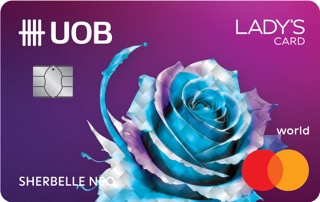
UOB Lady's Card—another female-marketed miles card (also open to everyone, despite the name) that lets you pick your own bonus category each quarter instead of being locked into "online spend only." Worth a look if your spending is spread across things like dining or travel rather than piled up in e-commerce.
- on Online Grocery, Food Delivery, Ride-Hailing
- S$1= 10X Points
- for in-store shopping purchases at Department Store, Clothing Stores
- S$1= 10X Points
- for all other purchases
- S$1= 1X Point
Get S$400 Cash Reward or 6,140 SmartPoints (worth up to S$649 of Gifts) as quickly as 5 weeks —just spend S$500 within 30 days of card approval with your new Citibank Credit Card! T&Cs apply.
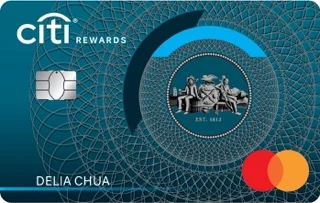
Citi Rewards Card—a close competitor on paper, also offering up to 4 mpd on online and contactless spend up to a monthly cap, but with a noticeably longer points validity period than DBS's 12-month expiry. A solid pick if you want a similar earn rate without the pressure of converting points every year.
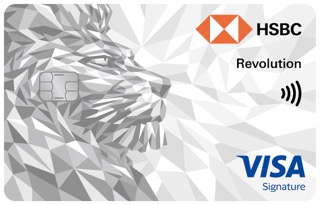
- on Contactless & Online Spending for cardholders who maintain at least S$50,000 average daily balance in your HSBC EGA SGD Account
- S$1 = 20X Points (8 miles)
- on Contactless & Online Spending for all other cardholders
- S$1 = 10X Points (4 miles)
- on All Other Spend
- S$1 = 1X Point
Get UPSIZED S$450 Cash or 6,140 SmartPoints (worth up to S$649 of Gifts) when you spend S$500 from Card Account Opening Date to end of the following calendar month! T&Cs apply.
HSBC Revolution Credit Card—a lower-commitment online and contactless spend card with a friendlier income requirement than the World Card. Great if you're just starting out with rewards cards, or your online spend doesn't quite justify the World Card's $80,000 bar.
So, DBS Woman's Card or DBS Woman's World Card? Honestly, it comes down to two things: your income, and how much of your spending actually happens online. Clear $80,000 a year and you can consistently push close to $1,000 of online spend a month? The World Card's 4 mpd rate makes it the clear winner. Fall short of that bar, and the standard Woman's Card is a perfectly fine, fee-friendly entry point—just walk in with realistic expectations about that 0.4 mpd base rate once you're past the online bonus.
P.S. Here’s our MoneySmart credit card ranking rubric
In case you’re wondering, here’s how we decide on our credit card rankings.
Is that credit card MoneySmart? Our MoneySmart credit card ranking rubric | |
Category | Our rating |
Overall | The average rating for the credit card on the whole, calculated from the ratings for the individual categories below. Plus, we’ll give you a one-liner on who we think the credit card is best suited for. |
Earn rates: Air miles / Cashback / Rewards points | Air miles ✈️✈️✈️✈️✈️ / Cashback / Rewards points . This category looks at the depth rather than breadth of earn rates.
|
Earn categories | This category looks at the breadth rather than depth of your earnings.
|
Annual fees and charges |
|
Accessibility | Minimum income requirements:
Exclusivity: We dock 1-2 stars if there is/are another category/categories that make the card exclusive and very specific to a certain clientele. |
Extras/periphery rewards | These include:
We count the number of benefits and award between 0.5 to 2 stars for each, depending on how good the perk is. |
Sign-up bonus |
|
Check out our ultimate list of credit card reviews for the low-down on credit cards in Singapore.
Found this comparison useful? Share it with a friend who's stuck choosing between the two.
Related Articles