I'm collecting my keys in a month or two. My partner and I bought a Sale of Balance (SBF) flat, which meant a wait of just over two years, not the usual BTO queue. We took up an HDB loan about a year ago, when the 75% loan-to-value limit (and the 25% downpayment that comes with it) was already in place, so that part wasn't a surprise to us.
What did surprise me was how much I had to piece together myself before every HDB appointment. The eligibility rules live in one place, the loan mechanics in another, the fee breakdown somewhere else entirely. I wished I had one guide I could open on the MRT ride there, instead of 5 browser tabs.
This is that guide. I've rebuilt it because a few basic facts about buying an HDB flat have changed since it was last written, starting with a downpayment number a lot of people still assume is 20%.
[ms-toc title="Guide to taking an HDB Loan" headings="h2,h3"]
1. HDB Loan Eligibility: Can I apply for an HDB Loan?
Before anything else, check whether you qualify for an HDB concessionary loan. Here are the conditions you need to meet:
HDB Loan Eligibility Conditions | |
|---|---|
Citizenship | At least one applicant is a Singapore Citizen |
Household income | Maximum $7,000 for singles, $14,000 for families, $21,000 for extended families* |
Private property ownership | Must not own or have disposed of private property in the last 30 months before your HFE letter application |
Commercial property ownership | Maximum 1 market/hawker stall or commercial/industrial property |
Loan history | Must not have taken 2 or more HDB housing loans already |
Employment | Must be working at the point of HFE letter application, and again when HDB disburses the loan |
Note: if you own a market/hawker stall or commercial/industrial property, you have to be operating the business yourself—not earning income from any other source.
*Extended families = you + your spouse + your children (who are earning an income) as co-applicants or occupiers.
If you meet all the conditions above, apply for an HDB Flat Eligibility (HFE) letter. You'll need this before you book a new flat from HDB or exercise an Option to Purchase on a resale flat—so it's the very first step, not something to leave until you've already found a flat you like.
2. What Is the HDB Loan interest rate?
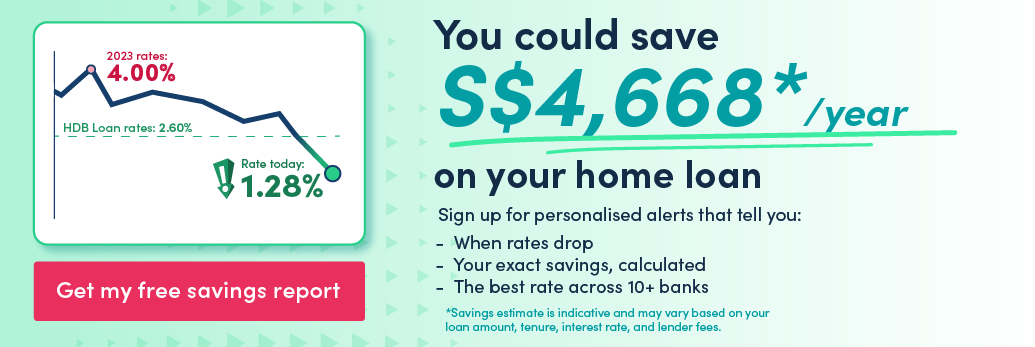
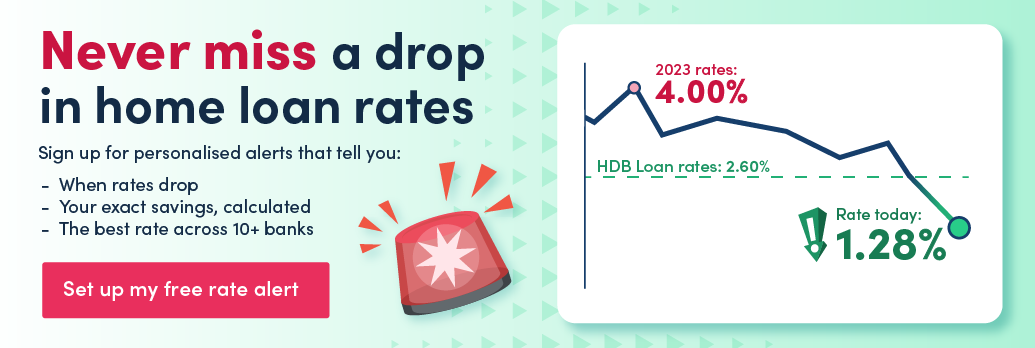
The HDB loan interest rate is currently 2.60%. It's been at this rate for years, and it's still 2.60% as of Q1 2026.
Here's why that number doesn't just move on its own: the HDB concessionary rate is pegged at 0.1% above the prevailing CPF Ordinary Account (OA) interest rate. The CPF OA rate has a floor of 2.5%, so the HDB loan rate can only go up from 2.6%, never down, unless the floor itself changes.
Compare that to a bank loan. Most bank loans are pegged to SORA (the Singapore Overnight Rate Average), which moves with the market, unlike the HDB rate. Bank loan interest rates are usually only fixed for 2 to 3 years before you'll need to reprice or refinance, whereas HDB loan holders never have to worry about that.
⚠️ Worth knowing before you compare: the gap between HDB and bank loan rates isn't fixed. SORA has moved quite a bit even in the two years since this guide was first published, so a bank rate that looked bad in 2024 might look completely different today, and vice versa. Rather than quote you a specific bank rate here (which will be outdated by the time you read this), check live rates on your bank's website or with a mortgage broker before deciding. The one number that hasn't moved is HDB's own 2.6%.

3. What is the HDB Loan downpayment?
The HDB loan downpayment is 25% of the purchase price—not 20%. This changed on 20 August 2024, when HDB lowered the Loan-to-Value (LTV) limit for HDB loans from 80% to 75%, aligning it with bank loans. Since your loan can now only cover 75% of the price, the remaining 25% comes from you.
If you've seen the "20%" figure anywhere, including older versions of this guide, that's outdated. This is the single most important number to walk into your HDB appointment with correct.
Here's the part that trips people up: the 25% isn't paid in one lump sum.
- 10% is due when you sign the Agreement for Lease (new flat) or exercise your Option to Purchase (resale flat). This can be paid entirely from your CPF Ordinary Account, in cash, or a mix of both — there's no minimum cash requirement at this stage.
- 15% is due at key collection, again payable via CPF, cash, or both.
So on a $400,000 flat, you'd need $40,000 at signing and a further $60,000 at key collection, for a total of $100,000, rather than $80,000 all at once.
💡 If you're waiting years for a BTO to complete, your CPF Ordinary Account keeps accumulating contributions in the meantime. That gap between signing and key collection isn't just a delay, it's also time for your CPF balance to grow toward that second payment.
⚠️ If you're financing through a bank instead of HDB, the LTV limit is also 75% for a first home loan, so your total downpayment is the same 25%. The difference is that banks require at least 5% of that in cash upfront; HDB doesn't require any minimum cash at all if your CPF covers it.
4. Type of HDB flat — New or Resale
Your first decision is between a new HDB flat (Build-To-Order, or BTO), a resale flat, or a Sale of Balance Flat (SBF). Each comes with a different trade-off between price and waiting time.
Type of HDB flat | Advantages | Disadvantages |
|---|---|---|
Built-to-Order (BTO) flats | Cheaper | Waiting time varies — see note below |
Resale flats | Immediate move-in, once the sale completes | More expensive |
Sale of Balance Flats (SBF) | Sold at BTO prices; shorter wait than a fresh BTO | Limited units to choose from |
⚠️ The "BTO means a 6-year wait" assumption is outdated.
HDB has been actively building ahead of demand since 2025 through its Shorter Waiting Time (SWT) flats—units where construction starts before the launch, so successful applicants collect keys faster. In the February 2026 BTO exercise, about 8 in 10 flats had waiting times under 4 years, and 1,316 of those units were SWT flats with waits under 3 years. HDB has committed to launching roughly 4,000 SWT flats a year through 2026 and 2027.
That said, SWT flats draw far more applicants per unit than standard launches, since everyone wants the shorter wait. If you're balloting for one, go in expecting steeper odds, not steeper certainty.
Sale of Balance Flats (the type my wife and I managed to secure) sit in between: they're existing units either unsold from a previous launch or returned to HDB, sold at the original BTO price. Because construction is often already complete or well underway, waiting times tend to be significantly shorter than a fresh BTO application, sometimes just over two years, though your options are limited to whatever units happen to be available in that exercise.
5. Location and size of the HDB flat
Once you've decided between BTO, resale, or SBF, your next decision is location and size, and both move the price more than almost anything else.
If you're buying a new (BTO) flat: forget "mature" and "non-mature"
The old system of classifying BTO towns as mature or non-mature doesn't apply to new flat launches anymore. Since the October 2024 BTO exercise, HDB classifies every new project as Standard, Plus, or Prime, based on the project's actual location attributes rather than which town it happens to sit in.
Classification | What it means | Minimum Occupation Period | Resale conditions |
|---|---|---|---|
Standard | The bulk of BTO supply, island-wide, standard subsidies | 5 years | No income ceiling on resale buyers, no subsidy clawback |
Plus | Choicer locations — good transport, near amenities or the city | 10 years | Resale buyers must meet the $14,000/$7,000 income ceiling; subsidy clawback of roughly 6–8% of resale price/valuation |
Prime | The most central, most connected locations | 10 years | Same resale income ceiling; subsidy clawback of roughly 9% |
This means two BTO projects in the same town can now carry completely different rules. It's the project that's classified, not the town.
If you're buying resale: location still drives price the way it always has
The Standard/Plus/Prime system only applies to new flats sold from October 2024 onward. Because it takes a minimum of 5 years (Standard) or 10 years (Plus/Prime) before those flats even reach the resale market, almost every resale flat available today was bought under the old system, and price still tracks the same locational factors as before: proximity to the city, MRT access, and how established the estate is.
Here's how much that still swings the price, using HDB's own Q1 2026 resale data:
- A 4-room resale flat in Bukit Batok had a median price of $649,000, versus $938,000 in Bukit Merah — a difference of nearly $290,000 for the same flat type.
- Flat size matters just as much. In Ang Mo Kio, a 3-room resale flat had a median price of $441,800, while a 5-room flat in the same town went for $1,090,000—roughly two and a half times more.
💡 These are single-quarter medians and will move. Before you commit to a budget, check HDB's own resale statistics page for the current quarter rather than relying on any number in this guide past its publish date.
6. Cost of buying a BTO or new HDB flat
Beyond the price of the flat itself, here's everything else you'll pay, whether you take an HDB loan or a bank loan.
Item | Amount | Payment mode |
|---|---|---|
Online application for HDB flat | $10 | Credit or debit card |
Option fee | $500 (2-room Flexi BTO) / $1,000 (3-room BTO) / $2,000 (4- or 5-room BTO) | NETS |
Stamp duty | Based on selling price, e.g. $6,600 for a $400,000 flat. Use our stamp duty calculator | Cash or CPF |
HDB Conveyancing fee | First $30,000: $0.90 per $1,000. Next $30,000: $0.72 per $1,000. Remaining amount: $0.60 per $1,000 | Cash or CPF |
Registration and microfilming fees | Lease In-Escrow registration fee: $38.30 (fixed). Mortgage In-Escrow registration fee (if taking a home loan): $38.30 (fixed). Title search fee: $32 | Cash or CPF |
HDB Caveat Registration fee | $128.90 | Cash or CPF |
Downpayment | 25% of purchase price (10% at signing of the Agreement for Lease, 15% at key collection) | Cash or CPF |
Survey fee | $150 – $375, depending on flat size | Cash or CPF |
Home Protection Scheme annual premium | Varies depending on buyer's age, sum assured, and loan tenure. Use CPF's HPS calculator to work out your own figure | CPF |
Fire Insurance Scheme 5-year premium | $1.11 – $6.68, depending on flat size | Cheque/Cash |
Note: the option fee is refunded if you complete the purchase, but forfeited if you don't — think of it as a deposit, not an extra cost.
7. Cost of buying a resale HDB flat
Item | Amount | Payment mode |
|---|---|---|
Resale application admin fee | $40 (1- and 2-room) / $80 (3-room and bigger) | Credit or debit card or GIRO |
Option fee | Up to $1,000 | Credit or debit card or GIRO |
Request for Value processing fee | $120 | Credit or debit card or GIRO |
Stamp duty | Based on selling price, e.g. $4,200 for a $300,000 flat | Cash or CPF |
HDB Conveyancing fee | First $30,000: $0.90 per $1,000. Next $30,000: $0.72 per $1,000. Remaining amount: $0.60 per $1,000 | Cash or CPF or NETS |
Downpayment | 25% of purchase price | Cash or CPF |
Home Protection Scheme annual premium | Varies depending on buyer's age, sum assured, and loan tenure. Use CPF's HPS calculator to work out your own figure | CPF |
Fire Insurance Scheme 5-year premium | $1.11 – $6.68, depending on flat size | Cheque |
Before you go
I'll be honest: even after going through this whole process myself, I still double-checked half the numbers in this guide before publishing it. That's kind of the point. Rules like these get revised quietly, and the version you half-remember from a friend or a forum post two years ago might already be wrong.
So if there's one thing to take from this: before your own HDB appointment, pull the current figures yourself rather than trusting anyone's memory, including mine a year from now. I'll be on the other side of key collection by the time you read this. Good luck with yours.
Found this article useful? Share it with a prospective homeowner!
Related Articles