
Your electricity bill has crept up. Petrol is pricier. Somehow the weekly run to FairPrice costs more than it did a few months ago. If your wallet has felt the squeeze this year, you’re not imagining it. Fortunately, there’s some cushioning from the government to take the edge off.
Budget 2026 set it all up back in February. But then conflict in the Middle East choked oil and gas supplies through the Strait of Hormuz, and energy, petrol and grocery prices climbed. Hence, in April, the Government brought forward and topped up its support by close to another $1 billion, landing faster than first promised.
There’s more support arriving, earlier than Budget Day promised: your CDC Vouchers are out this June, Cost-of-Living payout will increase by $200, and 2026 is the final year of the Assurance Package. Here’s everything coming your way, plus a look at what 2027 holds.
[ms-toc title="Government payouts to expect in 2026"]
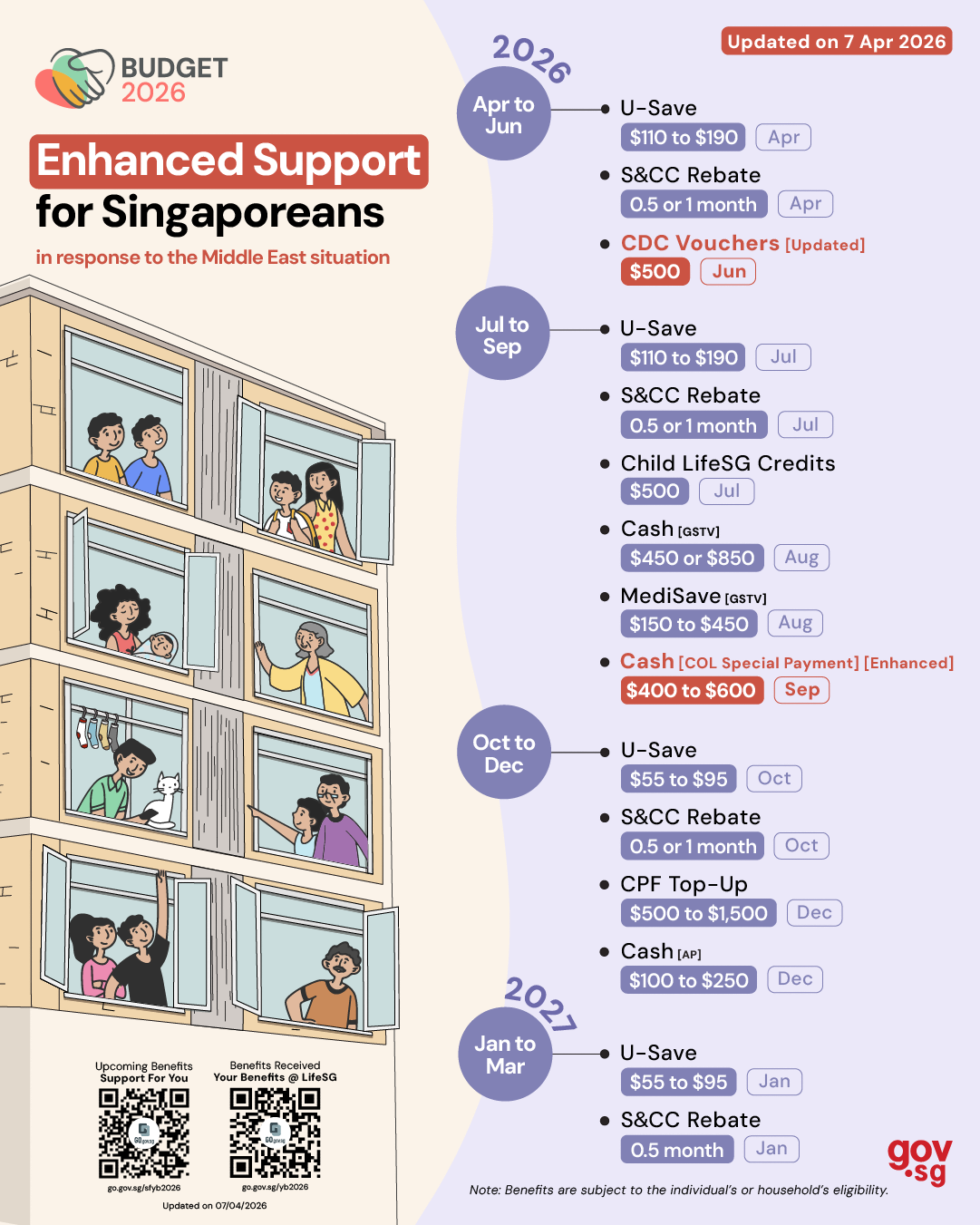
Government payouts 2026: Month-by-month guide
*Note: Benefits are subject to the individual's or household's eligibility.
To get more information and check your eligibility, the LifeSG site does it automatically for you. It also informs you when you will be paid.
What’s already been paid out
A quick stock-take before the good stuff still to come:
- January: the final FY2025 U-Save and S&CC rebates closed out last year’s cycle, and every household could claim the $300 CDC Voucher tranche from the 2025 package. Reminder: those $300 vouchers expire on 31 December 2026, so if they are still sitting in your Singpass, go and spend them.
- April: Budget 2026 effectively doubled the U-Save credited in April (up to $190, depending on flat type), plus the usual S&CC offset.
- Late April: active platform workers, taxi and private-hire drivers received a one-off $200 to cushion higher fuel costs.
Which brings us to right now, June, when the payout of the moment has just arrived.
Why your payouts grew mid-year
This is the part most people missed. While Budget 2026 was set in February, the world did not sit still.
In early April, Senior Minister of State for Finance Jeffrey Siow announced an enhanced support package, roughly $1 billion more, in direct response to rising oil, energy and freight prices flowing from the Middle East situation.
Three of those moves will land straight in your bank accounts:
- CDC Vouchers fast-tracked from January 2027 to June 2026.
- The Cost-of-Living Special Payment topped up by $200, lifting it to $400 to $600.
- A $200 cash relief for the drivers most exposed to fuel costs.
Let’s break down what’s still to come.
CDC Vouchers: $500 (June 2026)
Every Singaporean household with at least one citizen gets $500 in CDC Vouchers this June, a full 6 months ahead of the original January 2027 schedule.
As always, the $500 splits down the middle:
- $250 for participating heartland merchants and hawkers
- $250 for participating supermarkets (FairPrice, Sheng Siong, Prime, and the like)
You have plenty of runway to use them, as they are valid till 31 December 2027. Only one person per household needs to claim digitally via go.gov.sg/cdcv with your Singpass. Not a fan of fiddling with apps? Your nearest Community Centre will help you sort it.
Note: this $500 is separate from the $300 tranche you claimed in January. Those older vouchers expire at the end of 2026, while the new $500 batch runs to the end of 2027.
Cost-of-Living Special Payment (September 2026)
Here’s where that extra $200 shows up. About 2.4 million Singaporeans will receive a one-off Cost-of-Living Special Payment of $400 to $600 in cash, come September.
To qualify, you will need to be:
- A Singaporean aged 21 and above in 2026,
- With assessable income of $100,000 or less, and
- Owning no more than one property.
The exact amount slides with your income and your home’s Annual Value, so lower income and lower-value homes sit at the top of the range. It is straight cash, paid automatically, so there is nothing to apply for. Link your NRIC to PayNow and it reaches you faster.
U-Save Rebates 2026
Your utility bills are getting more help than usual this year, and there's a good reason for it. The carbon tax steps up in 2026, which nudges electricity prices higher. Thus, the Government has bumped U-Save up to 1.5 times the usual amount to soften the blow.
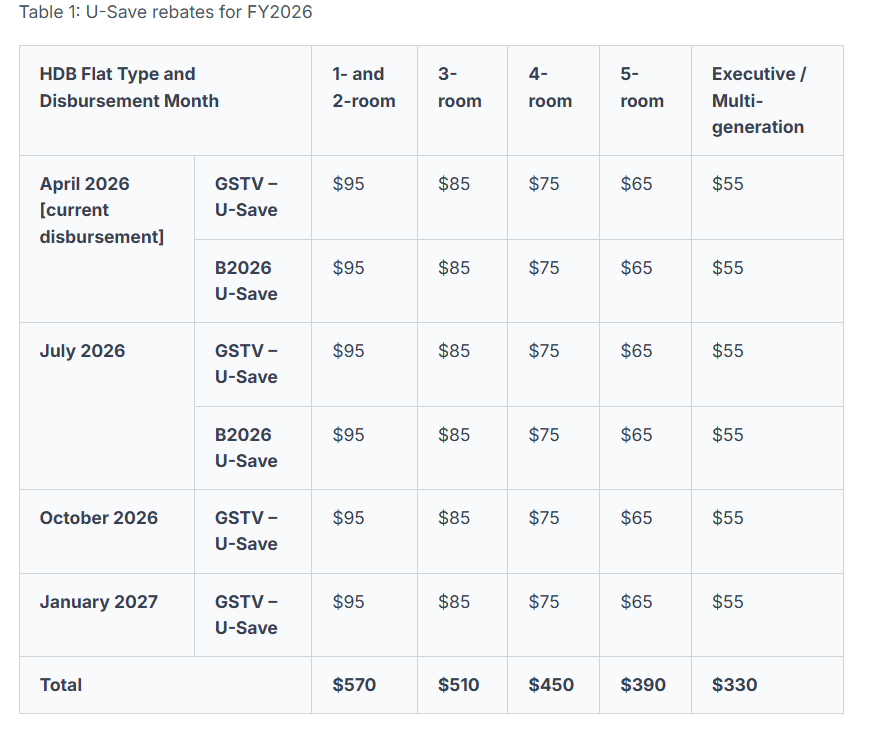
Eligible HDB households receive up to $570 in U-Save across FY2026, in two layers:
- the regular GST Voucher U-Save,
- additional Budget 2026 top-up front-loaded into the April and July credits (when bills are expected to spike).
October 2026 and January 2027 revert to the regular amount.
Here’s what each flat type collects, quarter by quarter:
Source: Ministry of Finance
For the smallest flats, that is enough to cover roughly 5 months of utilities. No forms, no queues, just a credit straight to your SP utilities account.
S&CC Rebates 2026
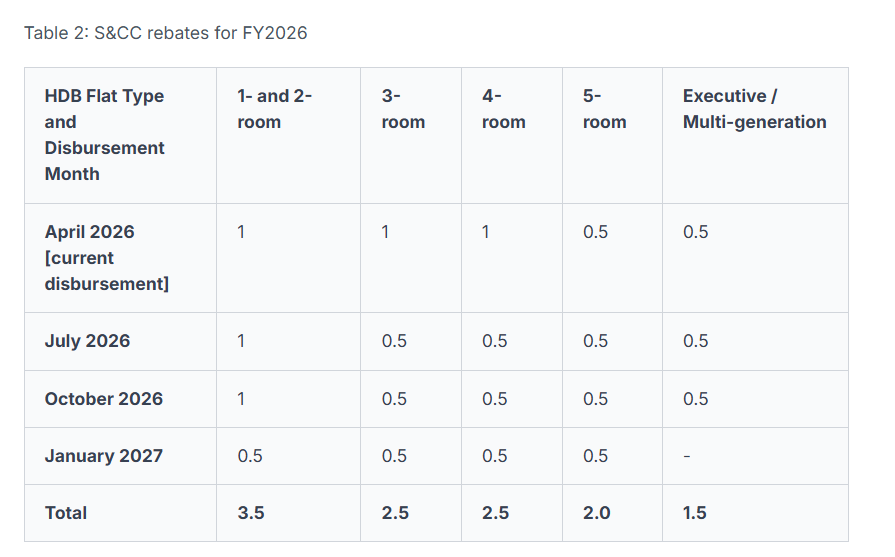
Your Town Council fees get trimmed too. Across FY2026, eligible HDB households receive up to 3.5 months of Service and Conservancy Charges rebates, spread over the 4 quarters.
Source: Ministry of Finance
Like U-Save, it is fully automatic, with nothing to claim.
GST Voucher: Cash and MediSave (August 2026)
The permanent GST Voucher scheme makes its yearly payout in August. Unlike the vouchers everyone gets, how much you receive is influenced by your income and the value of your home, so not everyone (but most) qualifies. It comes in 2 parts.
1) GST Voucher Cash (up to $850)
You will get $450 or $850 if you tick every box:
- Singapore Citizen aged 21 and above in 2026
- Assessable income for YA2025 of $39,000 or less
- Home Annual Value of $31,000 or below (as at 31 December 2025)
- Own no more than one property
Since most HDB flats sit under the $21,000 AV mark, the majority of HDB homeowners will receive the full $850. Those in homes valued $21,001 to $31,000 get $450.
2) GST Voucher MediSave (Up to $450)
Seniors aged 65 and above receive a top-up into their CPF MediSave account, with no income limits, tiered by age and home value:
Going towards your medical bills, MediShield Life premiums, and approved treatments. Never signed up for a past GST Voucher payout? Register once via the e-services on the govbenefits portal and you are set for future rounds.
Child LifeSG Credits (July 2026/April 2027)
Every Singaporean child aged 12 and below in 2026 receives $500 in Child LifeSG Credits. Add the $500 from Budget 2025, and that comes to $1,000 per child over 2 years.
Those born between 2014 and 2025 get their credits from July 2026, and babies born in 2026 follow from April 2027. You can access the credits through the LifeSG app and spend them at merchants accepting PayNow and NETS QR, covering groceries, utilities, pharmacy runs, and other daily necessities.
For parents, that is a soft cushion against a budget that growing kids tend to stretch thin. The next scheme, though, is making its final appearance.
Assurance Package: The final payout (December 2026)
A milestone worth marking: December 2026 brings the final Assurance Package cash payout. The AP was always a finite, 5-year cushion for the GST hike, running from 2022 to 2026 with one cash tranche each December.
All Singaporeans aged 21 and above are eligible, with the amount tied to your income (and property count):
Across all 5 years, eligible Singaporeans would have collected between $700 and $2,250 in AP cash. Your final payout will be this December. Treasure it while it lasts.
From 2027, the permanent GST Voucher scheme goes back to being your regular safety net, topped up by whatever Budget 2027 has in store.
CPF Top-Up for Seniors
New from Budget 2026 for retirement security. Singaporeans aged 50 and above whose CPF retirement savings sit below the Basic Retirement Sum ($110,200 in 2026) will receive a one-time CPF top-up in December 2026, paid into the Retirement Account (or Special Account if you are under 55).
Here's how it works out:
Still working and born in 1973 or earlier? You may also qualify for the Majulah Package’s Earn and Save Bonus, an annual CPF top-up of $400 to $1,000.
Don’t leave money on the table
A few benefits from earlier rounds are still live, or about to lapse:
- SG60 Vouchers ($600 or $800). Claimed during Singapore’s 60th-birthday year via RedeemSG, these are one-off and expire on 31 December 2026 ($600 for ages 21 to 59, $800 for seniors 60 and above). If you have been sitting on them, spend them before the clock runs out.
- Climate Vouchers. For energy- and water-efficient appliances, now open to private-property households too, and valid to 31 December 2027. A smart way to trim future utility bills.
- SG Culture Pass ($100). For Singaporeans aged 18 and above, valid all the way to the end of 2028, for arts and heritage experiences.
- ActiveSG SG60 credit ($100). Valid to 31 December 2026, and if you use it at least once in 2026, the balance rolls over into 2027.
- Workfare Income Supplement (up to $4,900 a year for lower-wage workers) and the Large Family Scheme (up to $16,000 for a third or subsequent child born from 18 February 2025) both roll on.
One perk that didn’t return: the Income Tax Rebate
Not everything carried over. For YA2025, the SG60 celebrations came with a 60% personal income tax rebate (capped at $200); the year before, it was 50%. For YA2026, there is no rebate
It is easy to miss, because nobody announces the absence of a perk. But if your income holds steady, your tax bill is expected to be a little higher than the last two. Worth factoring in before you mentally spend all those vouchers.
ALSO READ: 10 Ways to Reduce Your Personal Income Tax in Singapore for YA 2027
Decoding GSTV, AP and COL
Confused by the alphabet soup? Here’s a quick decoder so you can navigate with confidence:
- GST Voucher (GSTV): The permanent scheme (since Budget 2012) for lower- and middle-income households. Four parts: Cash, MediSave (seniors), U-Save (utilities) and S&CC (Town Council fees). This is the one that is here to stay.
- Assurance Package (AP): The temporary 2022 to 2026 cushion for the 2% GST hike, ends this December. The December cash tranche (and, historically, the COL top-ups) fall under it.
- Cost-of-Living (COL) Special Payment: The targeted cash top-up layered on during high-inflation stretches; this year, the enhanced $400 to $600 in September.
The simple takeaway: GSTV is forever, while the AP finishes in 2026. From next year, GSTV does the heavy lifting, plus whatever Budget 2027 adds.
What about 2027?
The natural question is what is already locked in for next year. Budget 2027 will not be delivered until around February 2027, so the headline cash amounts are not confirmed, but several things are already on the calendar:
- The Assurance Package is done: Once the final tranche lands in December, the permanent GST Voucher scheme becomes the default regular support: Cash and MediSave top-ups in August, U-Save and S&CC rebates every quarter.
- Cheaper preschool and student care. From January 2027, the household income ceiling for means-tested preschool subsidies rises from $12,000 to $15,000, bringing 60,000 more families into reach of higher subsidies.
Example: a household earning $12,500 with two kids at an Anchor Operator sees fees drop about 35%, from $730 to $470 a month. Separately, the Student Care Fee Assistance income ceiling rises to $6,500, helping roughly 13,000 students.
- CPF contribution rates rise for senior workers. From 1 January 2027, total rates will increase by 1.5 percentage points for employees aged above 55 to 60 (to 35.5%) and 1 point for those above 60 to 65 (to 26%).
- U-Save spills into January 2027. The final quarter of your FY2026 U-Save lands in January 2027, so the carbon-tax cushion stretches into the new year.
- CDC Vouchers. The tranche many expected in January 2027 is the one that got moved up to this June, so whether there is a fresh 2027 round depends on Budget 2027.
- Babies born in 2026 start receiving their Child LifeSG Credits from April 2027.
In short, 2027 is partly pre-loaded already, but the full picture only becomes clear on Budget Day. We will update this guide the moment it does.
At a glance
Source: Singapore Government
To put things in perspective, a household with 2 working adults and 2 kids living in a 4-room HDB could collect up to $3,000 this year. $500 in CDC vouchers, $450 in U-Save, $1,000 in Child LifeSG Credits, and $400 to $600 per adult from the Cost-of-Living payment, all before any CPF top-ups.
What’s in it for you
A little extra in the pocket is always nice, but how you use it makes all the difference. Consider parking some in your emergency fund, clearing high-interest debt, or topping up your CPF, as small moves now can mean real security later. And with the Assurance Package bowing out this year, it is worth being intentional with this last, slightly more generous round.
Free money is always welcome, but making it work harder for you? That is the truly savvy Singaporean way.
Was this article useful? Share it with your family and friends!
Related Articles