
If there’s one thing Singaporeans have mastered, it’s treating holidays like an exam we need to ace. The budget must make sense, the itinerary must be optimised, and the trip has to be “worth it”, even if we tell people we’re “just going with the flow”.
So I asked our subscribers something simple: Do you set a clear budget before you travel?
Your answers say a lot about how we actually travel.
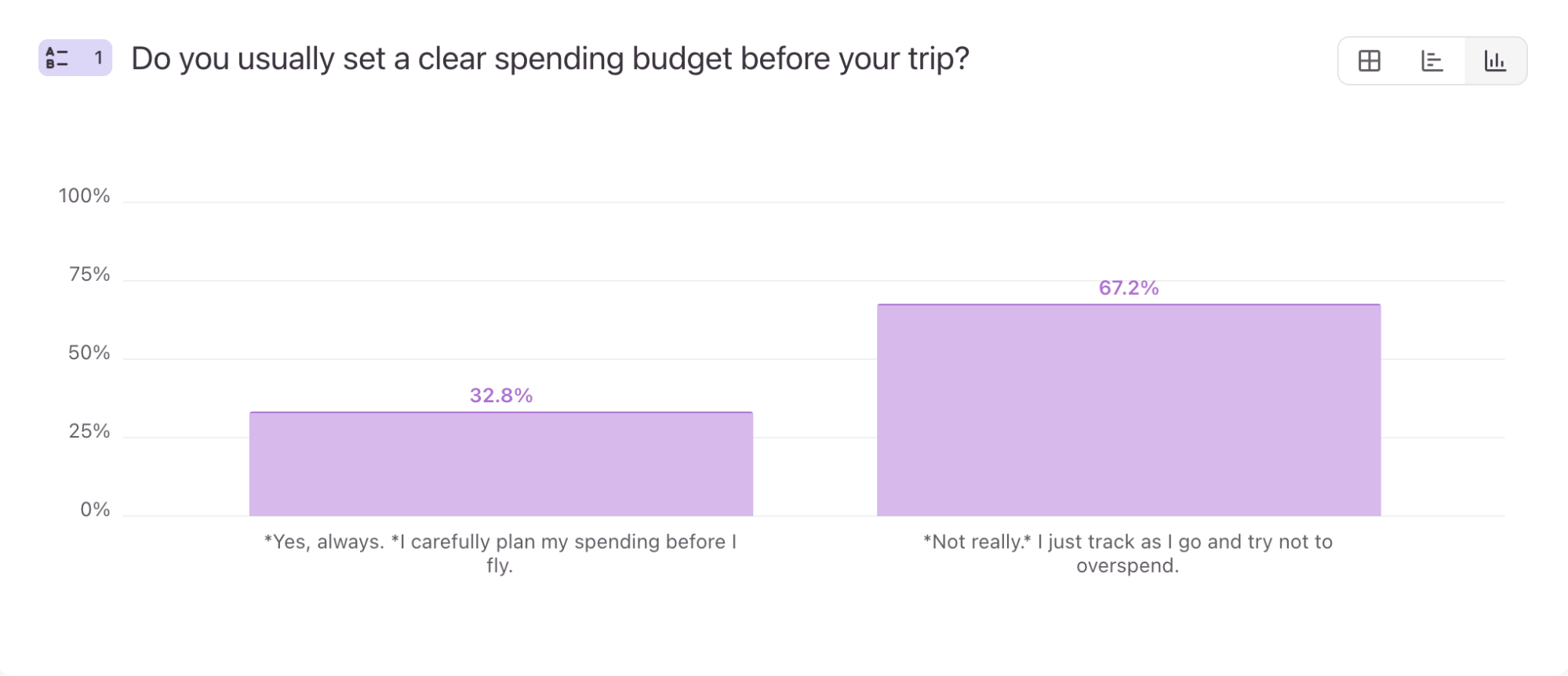
Image: Pocket Change by MoneySmart
Honestly, the results kind of got me by surprise. I thought we Singaporeans would be more inclined to plan out every detail so we spend responsibly. I guess we’re getting a little more spontaneous (to a certain degree).
But budgeting, or not budgeting, can change how much you enjoy your trip and how painful things feel when you’re back home.
That’s what this article is here to unpack.
By the end of this piece, you’ll know:
- The two types of travellers (and why both struggle)
- A simple travel-budgeting framework that doesn’t kill the fun
- How to keep spending in check while you’re overseas
- And what to do if you overshoot, because it happens to the best of us
Let’s get into it.
[ms-toc title="How to spend smart on holiday (even if you don’t set a budget)’?" headings="h2,h3"]
What actually blows your travel budget
From the poll results, most people fall into two obvious camps when it comes to holiday spending: Team Budget-first and Team Track-As-I-Go. FYI, both approaches are completely valid, but each come with its own little caveats.
Here’s a quick look at how each style works in real life:
Traveller Type | How you usually travel | What usually goes wrong | Why it happens |
Team Budget-first | You plan early: daily spend caps, mapped itineraries, allocations for food/transport/shopping | Feeling restricted, guilt when you overspend slightly, or losing spontaneity | You crave control, so even small deviations feel like “failing the plan” |
Team Track-As-I-Go | You prefer freedom: no fixed numbers, just staying “roughly aware” | Small purchases snowball, FX makes things seem cheaper, end-of-trip bill shock | It’s easy to underestimate spending when you’re having fun |
Whether you’re in group 1 or 2, travelling does something funny to the way we spend. Not in a reckless way, but in a very human way. Even if you’re the most disciplined person at home, being overseas switches on a slightly different version of you. Understanding that version is half the battle.
#1 - Everything overseas feels cheaper compared to Singapore
When you’re used to $16 pasta and $7 iced lattes at home, a $5 pastry in Tokyo suddenly feels like a steal. Even if you buy three of them a day, your brain still thinks you’re somehow saving money. The usual “this is expensive” filter gets dulled because you’re no longer comparing prices to what they cost here.
It’s not that you’re careless. It’s that your internal price anchors don’t work overseas.
#2 - Novelty makes everyday things feel special
Travel surrounds you with things you don’t get back home: cafés you’ve seen on TikTok, convenience store snacks, local brands, streets filled with unexpected little temptations. Your brain treats each discovery like a mini-celebration. And celebrations tend to come with small, repeated spending.
Most people don’t overspend on one big thing. It’s the five small “ooh let’s try this” moments a day that quietly add up.
#3 - Group travel = shared spending momentum
When you’re travelling with friends or family, spending becomes social. If someone suggests taking a taxi, everyone usually agrees because no one wants to disrupt the vibe. Same with spontaneous cafés, side trips or shopping stops.
It’s not peer pressure. It’s group momentum. You just go with the flow, even if the flow is slightly more expensive than what you would have chosen alone.
#4 - The ‘I deserve this’ mindset hits hard
Holidays often feel like a reward for working hard, surviving burnout or simply needing a break. So your brain becomes very good at rationalising small indulgences:
- “It’s my holiday”
- “I’ve earned this”
- “Why not, it’s overseas”
- “I won’t be back here anytime soon”
You’re not wrong, but enough of these rational moments can snowball.
A simple travel budgeting framework that actually works
A good travel budget shouldn’t feel like homework. It should feel like something that supports how you already travel, not something that forces you into a rigid system. And now that you know what usually pushes your spending over the edge, the framework below will make a lot more sense.
Start with 5 broad buckets
Instead of tracking every cup of coffee, divide your spending into five simple categories. This keeps your planning clear without overwhelming you.
Bucket | What goes inside |
Flights | Tickets, luggage, seat upgrades |
Stay | Hotel, Airbnb or resort charges |
Getting around | Trains, buses, local SIM cards, ride-hailing |
Food & drinks | Meals, cafés, snacks |
Fun money | Shopping, attractions, small splurges |
Most people underestimate food and fun money. That’s where the small “yes-es” stack up, so having a rough idea helps.
A loose guideline you can use: 40% flights, 30% stay, 30% everything else. Feel free to shift this depending on the city. To make things easier, you can use any of the handy budgeting or expense-tracker apps popular in Singapore.
Here are a few good ones that work well:
- Dobin — Lets you sync multiple local bank accounts and credit cards; it automatically categorises your spending (food, transport, fun, etc.), so you can clearly see how your travel expenses slot into your five buckets.
- Planner Bee — Offers a holistic view of expenses, savings, and net worth. Great if you want to combine travel spending with broader financial tracking.
- Spendee — Works especially well for trips because you can use its multi-currency and shared-wallet functions. Good if you’re travelling with friends or partner and want to split expenses cleanly.
If you don’t wish to download/sign up for any more apps, you could also use the DBS NAV Planner for convenient tracking (if you’re an existing customer with the bank).
Decide what actually matters to you
This part makes the biggest difference. Ask yourself: What are the non-negotiables for this trip? What can I cut without feeling deprived?
Everyone is different:
- Some people care more about food than hotels
- Some prefer comfort over shopping
- Some want one or two “big” experiences and keep the rest simple
When you pick your non-negotiables early, you stop overspending on things that don’t matter.
Keep your spending in one place
For many Singaporeans, this is the most practical part.
Using a single wallet or card helps you see your spending in real time without juggling multiple accounts. Multi-currency wallets like YouTrip work well because you load your holiday budget into it once, spend from that pool and avoid FX mark-ups by paying in the local currency.
It’s simple and contained. You always know how much you’ve used and what’s left. And if you prefer Wise, Revolut or even a single debit card, the idea is the same: one place, one view, less guesswork.


.png)
Have a soft daily amount in mind
This isn’t a strict cap. It’s just a helpful guide that keeps you aware while still feeling free. Something like S$140 to S$200 a day works for most Asian cities.
City | Approx. SGD/day* | What to expect |
Tokyo | ~S$230 | Higher-cost city for food and transport |
Seoul | ~S$170 | Mid-range meals and attractions |
Taipei | ~S$140 | Generally affordable for food and transport |
Bangkok | ~S$140–S$200 | Wide range depending on comfort level |
Hong Kong | ~S$180–S$220 | Typically pricier for meals and transport |
*Estimated amounts only—actual costs vary based on travel style, season and choices made on the ground.
It helps you pace yourself so you don’t spend half your budget in the first 2 days. Adjust it based on where you are, what you’re doing that day and how you like to travel.
In any case, give yourself a buffer. Every holiday has surprises: a café you didn’t expect to like, an activity you didn’t plan for, or a moment where spending a bit more makes the experience better. A small buffer, even $100 to $200, helps you say yes to things you genuinely want without throwing the whole budget off.
It keeps the trip enjoyable and the guilt low.
Closing thoughts
Travelling is supposed to feel good. We’re stressed enough as is, so holidays should be the space where you get to exhale, not add more tension into the mix. Let your trip be what it’s meant to be. A break, not another thing to overthink.
A little structure helps for sure, but the point of a holiday is still to enjoy yourself, not to count every cent. If you overspend, you recover. If you stay on track, great. Either way, the goal is the same: come home with memories you’re glad you paid for and a plan that keeps your finances steady.
Holiday spending doesn’t have to be perfect. It just has to make sense for you.
For more guides and the latest promotions, visit MoneySmart, Singapore’s best and trusted personal finance platform.
Related Articles