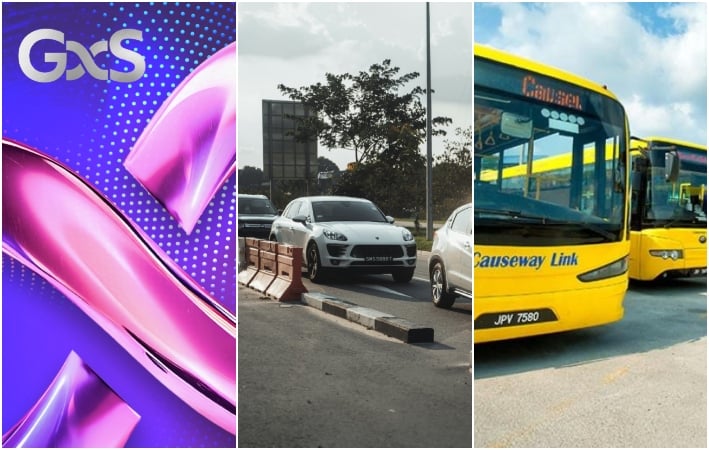
A new credit card just dropped, and it might be the best card for Grab users—especially for overseas spend. Meanwhile, car buyers are feeling the pinch again, as COE premiums climbed across almost every category, motorcycles included. Heading over to Malaysia? Cash is officially out at two more bus stops from this week. And a new study suggests Singapore's wealthy are rethinking what retirement even looks like, though most haven't brought their kids into the conversation yet. Here's everything you need to know this week.
TL;DR |
|---|
|
Psst, missed last week's issue? View all past editions of What's Happening This Week? to catch up.
[ms-toc title="Issue #84: What's Happening This Week?"]
GXS Bank launches new unlimited cashback credit card
GXS Bank has launched a new credit card built around its most popular partner ecosystem: Grab and Singtel. Issued with Visa, the GXS Credit Card offers unlimited cashback with no cap—though some categories of cashback have minimum spend requirements.
Cardholders earn GrabCoins on local Grab spend, including rides, food delivery, and groceries, with no minimum spend required to earn an unlimited 3% cashback in the form of GrabCoins. The local grab spend tiers go up to 10% cashback with minimum spends required. Singtel bill payments earn a flat 1.75% cashback with no minimum. For everything else, cardholders get 1.75% cashback, but need to spend at least $500 a month outside Grab and Singtel to qualify. The card carries a $196.20 annual fee, waived for the first year if approved by 31 December 2026. Applicants must be aged 21 to 65, earning at least $30,000 a year for Singaporeans and PRs, or $120,000 for foreigners.
The first 1,000 customers who order a physical card from 18 August 2026 will receive a limited-edition metal design.
- Grab spend: up to 10% cashback in GrabCoins, no minimum spend for base 3%, minimum spends for 5% and 10% cashback
- Singtel bills: 1.75% cashback, no minimum spend
- All other spend: 1.75% cashback, min. $500 monthly spend (excludes Grab and Singtel)
- Annual fee: $196.20, waived in year 1 for approvals before 31 Dec 2026
ALSO READ: GXS Credit Card—MoneySmart Review
COE premiums rise across most categories, Cat A hits $128,501
COE premiums rose across most vehicle categories at the 19 August tender, with the Category A premium—used to register smaller cars and EVs — climbing 3.7% to $128,501, edging closer to July's record high of $129,000.
This marked the fourth consecutive tender where the motorcycle premium has stayed above $10,000 — the sixth time that's happened in 2026 — and the first time it's crossed $11,000 since October 2023. Komoco Motors' commercial director, Ng Choon Wee, said the Category A jump came "beyond expectations", and expects prices to keep climbing next round given excess demand. The gap between Category A and B premiums has also narrowed to just $2,500, which could push more buyers to bid directly for Category B certificates in the next tender.
ALSO READ: COE Guide in Singapore (2026): What It Means, Bidding Process & Price Trends
Cross-border Causeway Link buses go cashless from 20 August
Cross-border Causeway Link buses departing from Newton and Queen Street will go cashless from 20 August, with commuters needing to pay by card, e-ticket, or app instead of cash on board.
The move follows an announcement by Causeway Link on 17 August, and applies specifically to commuters heading into Malaysia from these two Singapore stations. ManjaLink, the contactless smart card used across cross-border Causeway Link routes and select bus services within Johor, is one of the accepted payment options, alongside major card networks, the LUGO app, or single-journey e-tickets.
Commuters who still prefer paying in cash aren't completely out of luck, but they'll need to sort it out before boarding rather than on the bus.
- Accepted payment: Visa, Mastercard, ManjaLink, EZ-Link, the LUGO app, or single-journey e-tickets
- Cash payers: sort payment before boarding — buy a ticket at the ManjaLink kiosk at Queen Street, or purchase a ManjaLink card from ground staff at Newton
- Alternatives: SBS bus service 170 from Queen Street, or long-distance coaches from both stations
If you're planning a JB trip and want to skip the bus queue altogether, the KTM Shuttle Tebrau train remains another quick cross-border option.
Manulife study: Singapore's wealthy are working longer but leaving succession planning behind
A new study by Manulife and FT Longitude, The New Fluidity, finds that Singapore's high-net-worth individuals (HNWIs) are rethinking retirement—but leaving succession planning behind. Among 250 Singapore-based HNW respondents surveyed:
- 57% want to work beyond retirement age, including 30% who plan to work for as long as possible
- 64% say adaptability and optionality now matter more than wealth accumulation alone
- 53% hold significant assets or residency rights across multiple jurisdictions
- Only 16% have a fully integrated wealth plan covering investments, retirement income, healthcare, and succession
- 51% haven't involved the next generation in wealth planning discussions at all, and only 45% are confident the next generation can manage family wealth effectively
Manulife Singapore CEO Benoit Meslet said wealth planning is "no longer a straight line" from accumulation to succession, with families needing a coordinated approach as priorities increasingly overlap.
That's it for this week! Stay tuned for next week's What's Happening This Week to keep up with the latest in finance, business, and beyond.
Related Articles