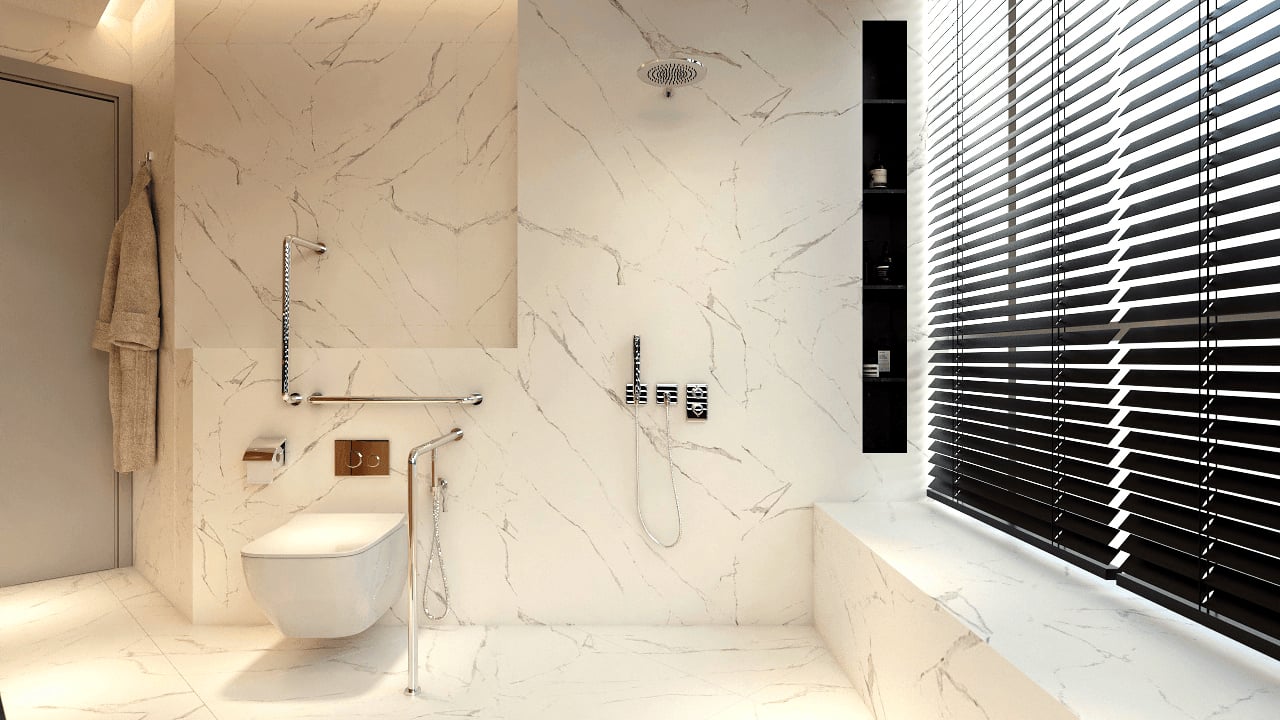
This year, my grandmother turned 90 years old. She remained mobile and able to walk by herself (albeit really slowly) for a good 89 years of her life, but 2026 brought her the misfortune of two falls. One was in the bathroom, while she was showering. The other was in the living room, when she lost her balance while reaching for the newspapers.
As you can imagine, my grandmother isn't very mobile anymore. And while it's easy to say she shouldn't have tried to do those things alone, there's another perspective I'd like to share: we should have retrofitted her home with senior-friendly features earlier.
Now, "senior-proofing" a home can be a daunting task—it conjures up images of hacked-up bathrooms, months of contractor visits, and a bill that rivals a full renovation. So I sat down with Kean Woei and YC, Co-Founders of Homescape, who've guided hundreds of Singapore families through exactly this decision: what's genuinely worth spending on, what to skip, and how far a government voucher can actually stretch. Here's what I learnt.
[ms-toc title="Senior-Friendly Home Renovation in Singapore: The Most Affordable Way to Do It"]
Why senior-friendly home renovation in Singapore doesn't have to cost $30,000
The instinct, when a fall happens, is to think big—rip out the old bathroom, widen every doorway, future-proof the whole flat. But Kean Woei and YC draw a hard line between what's genuinely necessary and what's a much bigger (and pricier) project altogether.
An essential safety retrofit—anti-slip floor treatment for one to two bathrooms, 6 to 8 heavy-duty textured grab bars, plug-in motion-sensor LED night lights, and a low-profile entryway ramp—runs $800 to $2,500. No hacking, no temporary relocation, and most jobs are done within a day.
Image: Homescape Pte. Ltd.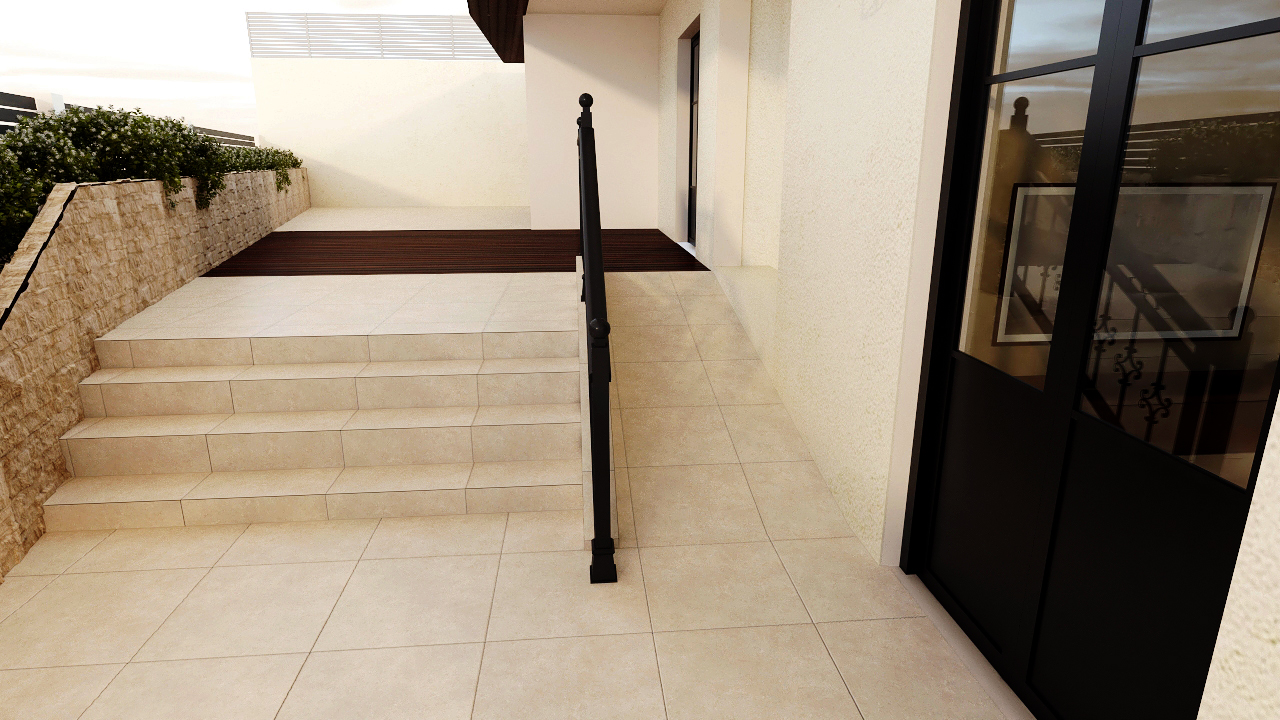
A full senior-friendly renovation, by contrast, runs $30,000 to $80,000+. That's the tier where you're hacking out tiles, re-screeding floors for curbless walk-in showers, widening door frames to wheelchair width, rewiring switches to accessible heights, and installing custom low-height carpentry.
If a parent is still mobile and simply needs a safer home, the retrofit tier addresses the actual risk—the renovation tier solves a different, much pricier problem.
The "safety" upgrades that don't actually make anyone safer
Not every dollar spent on ageing-in-place upgrades buys better protection. Three traps come up again and again:
Smart home systems. App-controlled lighting, touch panels, and voice assistants look impressive in a showroom. But Kean Woei and YC caution against "installing app-controlled lighting grids, touch panels, or voice assistants that seniors struggle to operate"—a feature meant to add convenience ends up adding confusion instead. A $15 to $30 plug-in motion-sensor night light in a low wall socket does the job more reliably, for a fraction of the cost.
Polished chrome grab bars. It's tempting to match grab bars to your bathroom's finishes, but they're far from the safest bet. "Smooth chrome finishes lose surface friction when soapy or wet, turning an intended safety feature into a dangerously slick hazard," Homescape explains. Local fall-prevention guidelines—and schemes like EASE—favour textured, knurled, or nylon-coated grips for exactly this reason. As Homescape puts it plainly: "Grip texture, proper ergonomics, and solid wall-anchoring must always take precedence over decorative looks."
Walk-in tubs ($3,000 to $8,000+). These sound like the premium option, but they're largely impractical in Singapore's humidity—seniors have to step in, seal the door, wait for it to fill, then wait again for it to fully drain before they can get out. A height-adjustable shower chair with rubber feet (under $100), paired with a hand-held shower head, is safer, far less claustrophobic, and a fraction of the price.
The one room responsible for 85% of elderly falls at home
Ask Kean Woei and YC which zone to fix first, and there's no hesitation: "Without question, the bathroom."
The numbers back it up. Around 8,000 seniors are hospitalised every year in Singapore due to falls, with falls accounting for 85% of all elderly trauma cases seen in Emergency Departments, according to Singapore's Health Promotion Board and local hospital trauma studies. Most of these accidents happen at home, and the bathroom stacks every major risk factor on top of each other—slippery tiles, soapy film, a door threshold to trip over, and the sudden blood pressure shift that comes with rising from the toilet bowl. It's also where a fall is most likely to end in a hip fracture or head injury on hard porcelain. As Homescape sums it up, "securing the bathroom neutralises the single largest physical hazard in the house."
Image: Homescape Pte. Ltd.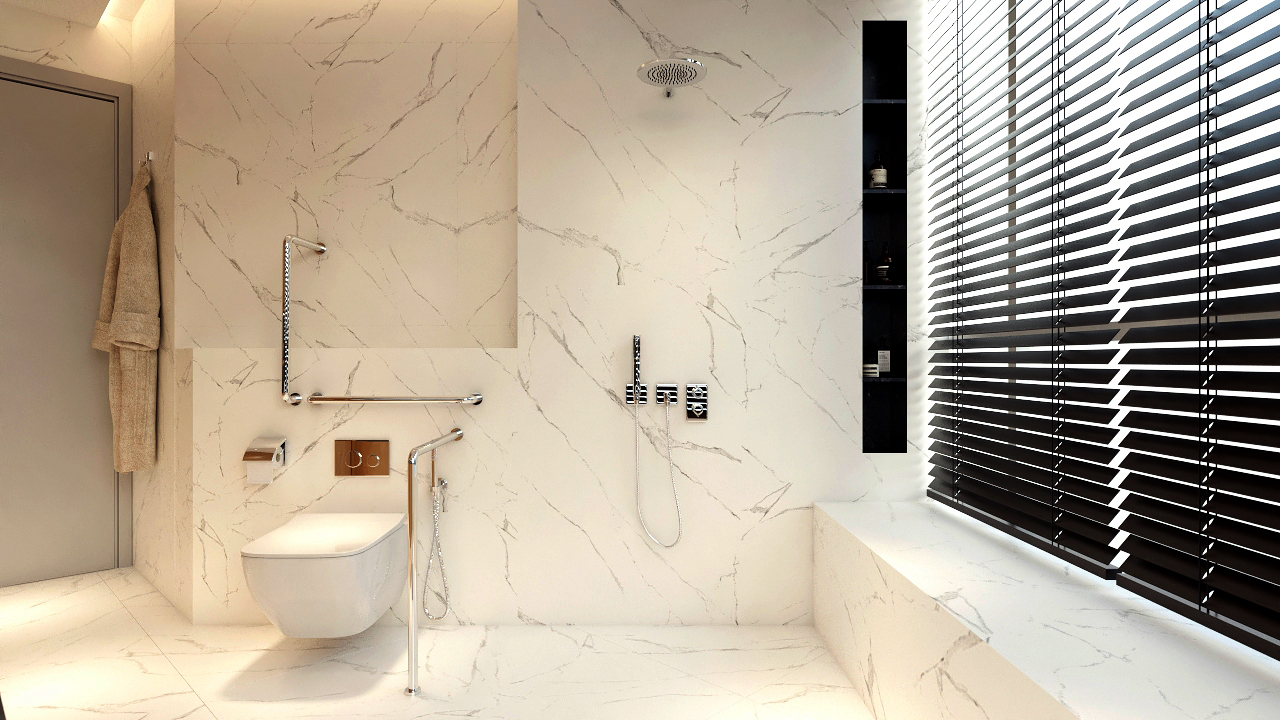
ALSO READ: How to Choose a Renovation Company in Singapore (2026)
How far a $1,200 government voucher can really stretch
This is where the EASE (Private) scheme comes in—and where a lot of families get the maths wrong, in both directions.
Under EASE (Private), run by the Ministry of National Development (MND) and the Building and Construction Authority (BCA), eligible private-housing households receive $1,200 in digital vouchers, subsidising 75% of the cost of pre-approved fittings installed by appointed contractors. The homeowner co-pays the remaining 25% in cash.
When you can apply
The scheme isn't rolling out to everyone at once—eligibility is being phased in by age band through the rest of 2026 (based on the senior's age in 2026):
- From 1 April 2026: households with seniors aged 80 and above, or households with seniors aged 60 and above who require assistance with at least one Activity of Daily Living (ADL)
- From 1 July 2026: households with seniors aged 70 and above
- From 1 October 2026: households with seniors aged 65 and above
Worth checking your household's window rather than assuming you either qualify now or don't at all.
What the voucher actually covers
Because the subsidy covers 75% of cost, a $1,200 voucher pool actually unlocks up to $1,600 worth of installations, for a cash co-payment of just $300 to $400. Here's how the standard items break down:
Put together, a family can fully outfit one main bathroom—anti-slip floor treatment, 8 to 10 grab bars, a foldable shower seat, and a bidet spray—and still add a second item, like anti-slip treatment for a second bathroom or an entryway ramp, all while using roughly $1,000 of the voucher pool. Total cash out-of-pocket: under $350.
Kean Woei and YC say most families start with grab bars and anti-slip floor treatment around the toilet and shower first, since these target the highest-risk areas with virtually no disruption to daily life. Foldable shower seats and bidet sprays tend to follow as secondary add-ons.
What EASE doesn't cover
Where the confusion usually kicks in is what EASE doesn't cover. Homescape sees the same misconceptions repeatedly—families assume the voucher works like a general renovation grant, when in reality it strictly excludes:
- Civil works and hacking (tearing up tiles, removing shower curbs, widening door frames)
- Replacing major sanitary fittings (toilet bowls, vanity cabinets, washbasins)
- Electrical rewiring and lighting (new sockets, ceiling lights, smart sensor networks)
- Mechanical mobility aids (stairlifts, motorised home lifts)
Any structural work, custom carpentry, or electrical work remains fully self-funded. You can check your household's eligibility window and apply through the EASE (Private) portal.
Cash, loan, or bundle—how to actually pay for the rest
For the portion EASE doesn't cover, Homescape's rule of thumb is straightforward: "pay in cash if the total out-of-pocket expense falls below $3,000 to $5,000, rather than taking on debt." There's a practical reason for this: banks typically require a minimum loan quantum of $5,000, plus formal contractor renovation contracts—criteria a minor retrofit rarely meets. Borrowing a smaller sum through a personal loan instead often carries an effective interest rate (EIR) high enough to work against the whole point of keeping a safety upgrade affordable.
Image: Homescape Pte. Ltd.
The calculus does change if you're already mid-renovation. Families doing a full resale flat or condo overhaul often fold senior-friendly features—hacking bathroom curbs, widening doorways, reinforcing wall backing for grab bars—directly into the main contractor's invoice. In that scenario, tapping a renovation loan can genuinely make sense, since renovation loans generally carry lower interest rates than unsecured personal credit. It really comes down to scale: bundling works if you're already renovating, but rarely for a standalone retrofit under $3,000.
If a renovation loan does turn out to be the right call for your situation, it's worth comparing your options rather than taking the first offer—you can compare renovation loans on MoneySmart to see rates side by side.

Per Month
S$385.54
- Interest Rate (p.a.)
- 5.88%
- Processing Fee (approved loan)
- 1%
- Admin Fee
- 0%
- Per Month
- S$385.54

Per Month
S$381.33
- Interest Rate (p.a.)
- 2.88%
- Processing Fee (approved loan)
- 0%
- Admin Fee
- 0%
- Per Month
- S$381.33
ALSO READ: Personal Loan vs Renovation Loan in Singapore: Which Is Better for Home Improvement?
What you really need: the two moves that cost under $800
If a family can only do two things this year, Kean Woei and YC point to the two highest-risk vectors for senior falls: wet surfaces and poor nighttime visibility.
Priority 1: Bathroom anti-slip treatment + two grab bars (roughly $300 to $600, or less with EASE). A chemical anti-slip treatment improves wet traction without re-tiling, and two heavy-duty grab bars—one by the toilet, one in the shower—provide stability exactly where seniors need it most.
Priority 2: Motion-sensor night lighting + clearing trip hazards (roughly $50 to $150). Simple plug-in LED lights along the bedroom-to-toilet path remove the need to fumble for switches in the dark. Pair this with securing loose cords and removing floor rugs.
By Homescape's own estimate, combining these two moves can "neutralise the majority of daily home accident risks" for well under $800 total—no hacking, no structural disruption, and as we've seen, usually no loan required either.
My grandmother's home hasn't had this done—yet. But writing this has convinced me it should have happened long before her first fall, and if this article does nothing else, I hope it moves it up your list too.
Found this article useful? Share it with the adult children juggling ageing parents and a renovation budget.
Masthead image: Homescape Pte. Ltd.
Related Articles