
Recently I was house-hunting for resale flats, and one thing quickly became clear: no 2 homes come with the same renovation needs.
Some units had beautifully done-up kitchens that I’d happily keep as-is, but the rest of the house needed work. Others had stylish living rooms and bedrooms, but outdated bathrooms that would definitely need upgrading. In a few cases, I found myself mentally adding up the cost of renovating just 1 or 2 rooms—and realising how quickly those numbers stacked up.
It also got me thinking: if this is what resale flats look like, what about new Build-to-Order (BTO) flats where you’re starting from scratch? The costs don’t just come from one big renovation—they build up room by room.
That’s why it helps to have a rough sense of what each space might cost before you commit. In this guide, we’ll walk you through the typical renovation costs for kitchens, bathrooms, and living rooms in Singapore, so you can plan your budget with fewer surprises.
[ms-toc title="How much do kitchen, bathroom, and living room renovations cost in Singapore?"]
1. Overview: Renovation costs in Singapore by room type
When planning a home renovation, understanding renovation cost in Singapore by room type is a good starting point for setting a realistic budget. Whether you’re revamping a new HDB BTO, updating a resale flat, or upgrading a condo, each property type comes with different layouts that naturally affect costs.
In general, the bigger and more customised the space, the more you’ll need to spend.
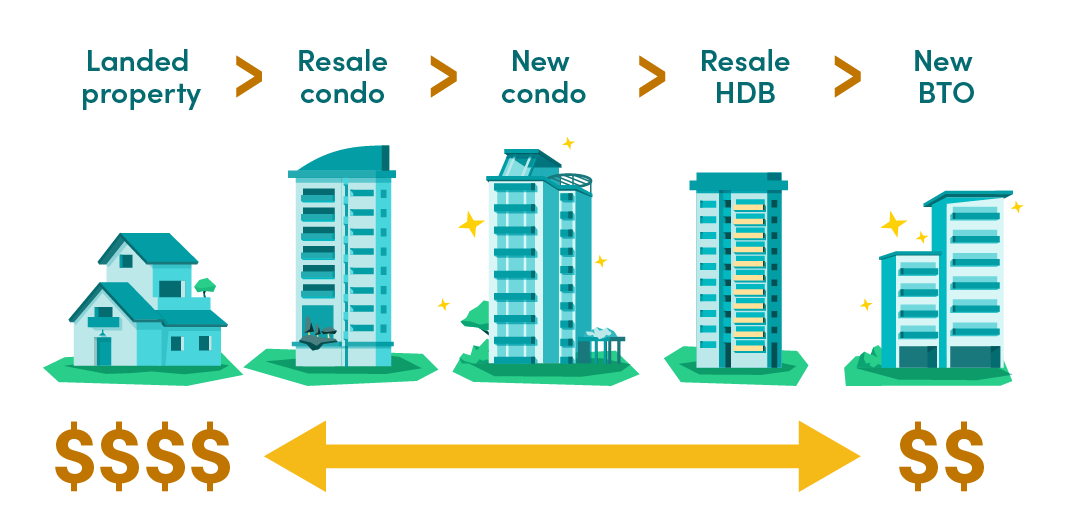
As a rough guide, renovation costs typically follow this order (from highest to lowest): landed property > resale condo > new condo > resale HDB > BTO HDB.
Average renovation costs by room
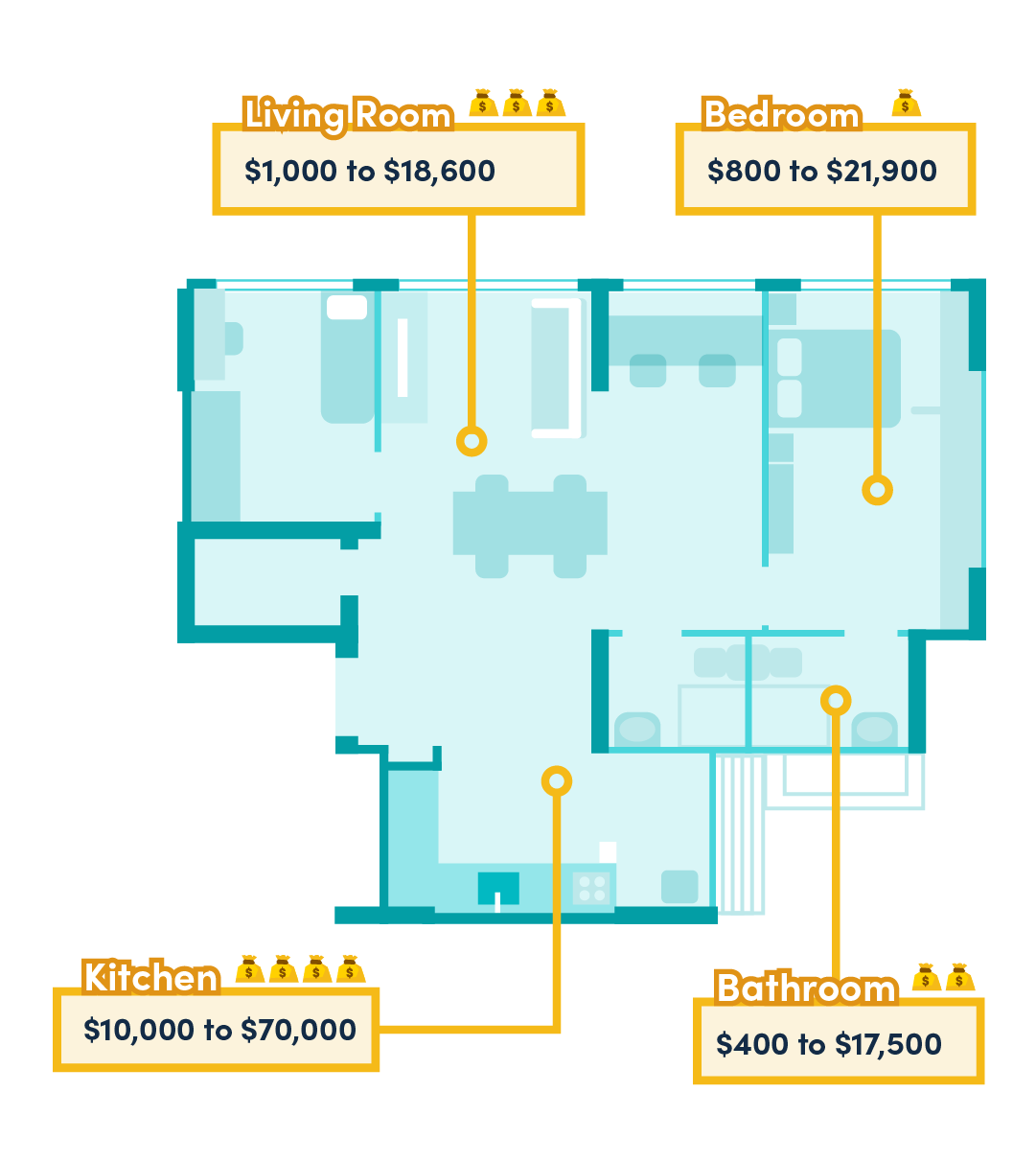
Room type | Key cost drivers—renovation works/upgrades | Estimated cost |
Kitchen |
| $10,000 to $70,000 |
Living room |
| $1,000 to $18,600 |
Bathroom |
| $400 to $17,500 |
Bedroom |
| $800 to $21,900 |
 (1).png)
Per Month
S$841
- Interest Rate
EIR*: From 1.75% p.a. - From 0.90% p.a.
- Total Amount Payable
- S$10,090
- Processing Fee
- S$0
- Per Month
- S$841
Sign up via MoneySmart and claim:
Up to S$5,725 Cash OR 19,050 SmartPoints (enough to redeem Apple iPhone 17 Pro Max and more) T&Cs apply.
Bonus promotion:
- Up to 1.61% cashback of your loan amount
- Only applicable to loans over S$18,000 with a 3 to 5 year tenure
- New-to-card and new-to-loan customers only
T&Cs apply.

What drives renovation costs by room?
Beyond property type, several factors can significantly affect your renovation cost in Singapore.
The biggest ones? The age and condition of your home, the materials you choose, and how much structural work or customisation is involved. For example, hacking walls, doing extensive carpentry, or opting for premium finishes will quickly push up your costs. Labour also plays a part—rates can vary depending on the contractor or interior designer you engage.
Tip: In Singapore, HDB renovation costs typically range from $15,000 to $90,000. Condo renovations usually fall between $40,000 and $100,000, while landed property renovations can easily exceed $100,000.
2. Kitchen renovation cost guide in Singapore
Estimated breakdown of kitchen renovation costs
Assuming a range from a 3-room HDB BTO flat to a resale condo, renovating a kitchen in Singapore roughly costs between $5,000 to $19,300. Add appliances, fixtures, and fittings, and that’s another $6,500 to $10,000, bringing your total up to $29,300.
Here’s an estimated breakdown of bathroom renovation costs across new and resale HDB flats, condos, and landed properties.
Renovation works / upgrades | Estimated costs |
Hacking works | $500 – $8,600 |
Cabinetry & carpentry | $150 – $30,400 ($150 – $450 per sq ft) |
Countertops installation | $2,500 – $8,000 |
Masonry works (Flooring & wall tiling) | $100 – $18,400 |
Plumbing & sink fixtures (incl. waterproofing) | $200 – $3,100 |
Electrical works & appliances | $120 – $16,800 |
Painting & surface treatment | $100 – $8,600 |
Glass works (Backsplash) | From $25 per sq ft |
Sources: Qanvast, Kitchenate, and Tiling; figures are rough estimates, subject to changes without prior notice
Tips to save on kitchen renovation costs
- Choose smarter materials
You don’t need premium finishes to get a good look. Laminates or melamine are far cheaper than solid wood, while quartz countertops give you durability without the hefty granite price tag.
- Keep carpentry simple
Custom designs can get expensive fast. Stick to clean, simple carpentry or modular options—they can cut costs significantly without sacrificing style.
- Overlay instead of hack
If your existing tiles are still in decent shape, consider overlaying instead of hacking. You’ll save on labour and avoid adding a few thousand dollars to your bill.
- Reuse what still works
Appliances aren’t cheap. If your stove, hood, or fridge is still in good condition, keep them and spend your budget where it matters more.
- Get a few quotes
Prices vary a lot between contractors. Comparing 3 to 5 quotes helps you spot better deals and avoid overpaying.
3. Bathroom renovation cost guide in Singapore
Renovating a bathroom in Singapore can cost anywhere from $3,000 to $17,500, depending on the size of your space and the extent of work needed. Once you factor in fixtures, fittings, and accessories, you’re likely looking at a total of up to $20,500.
Here’s a quick breakdown of typical bathroom renovation costs across HDB flats, condos, and landed homes.
Breakdown of typical bathroom renovation costs
Renovation works / upgrades | Estimated costs |
Hacking works | $100 – $7,100 |
Waterproofing | $500 – $1,500 |
Masonry works (floor & wall tiling, screeding) | $100 – $19,500 |
Plumbing works (pipe relocation, new water points, drainage) | $100 – $7,500 |
Vanity, sink, & toilet | $1,500 – $4,000 |
Shower enclosure & fittings | $250 – $1,200 |
Heater installation | $100 – $500 |
Electrical works & ventilation | $150 – $500 |
Mirror & glass works | From $80 |
Sources: Gaincity, Atlasworks, Allstarwaterproofing, Repair.sg, Homees.co, Gethandyman; figures are rough estimates and subject to change without prior notice
Renovating a bathroom in a new HDB BTO flat is usually cheaper. That’s because HDB doesn’t allow you to remove the original wall and floor tiles or alter the waterproofing layer within the first 3 years after getting your keys—so there’s less work (and cost) involved.
Common bathroom fixtures and features to consider
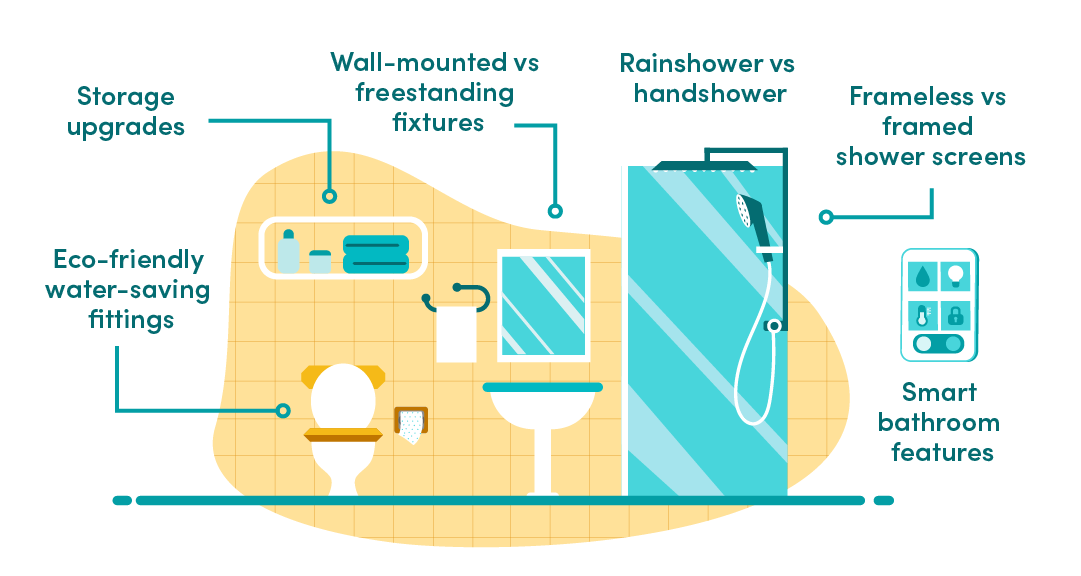
Beyond tiles and plumbing, a few key upgrades can improve both function and style—without blowing your budget.
- Wall-mounted vs freestanding: Wall-mounted fixtures give a cleaner, more modern look and make cleaning easier, but they cost more. Freestanding options are more affordable and simpler to install.
- Water-saving fittings: Eco-friendly taps and toilets can help lower your water bills over time—good for both your wallet and the environment.
- Rainshower vs handshower: Rainshowers look great but come at a higher cost. A handshower is more practical and budget-friendly, especially for smaller bathrooms.
- Frameless vs framed screens: Framed shower screens are cheaper and work well for compact spaces. Frameless designs look sleeker but cost more.
- Smart features and storage: Extras like smart mirrors or built-in storage can make your bathroom feel more premium and organised—but expect to pay a bit more for these upgrades.
The bottom line? Premium add-ons can easily increase your bathroom renovation cost by about $500 to $2,000, so pick what matters most to you.
4. Living room renovation cost guide in Singapore
From a 3-room HDB BTO flat to a resale condo, renovating a living room in Singapore roughly costs between $12,000 to $29,600, inclusive of appliances and furnishings.
Breakdown of typical living room renovation costs
Renovation works / upgrades | Estimated costs |
Hacking work | $200 – $6,300 |
Masonry (floor levelling, tiles, parquet, vinyl*) | $200 – $21,300 |
Ceiling works & modifications (false ceiling, lighting) | $100 – $8,300 |
Carpentry (TV console, storage cabinets) | $100 – $24,800 |
Painting & wall treatments | $400 – $2,300+ |
Electrical works | $800 – $2,000 |
Sources: Qanvast, mycleanhomesg, 1fullertoncredit, getelectrician.sg; figures are estimates and are subject to change without prior notice
*Note: Vinyl flooring is usually installed as a direct lay over the existing tiles, with little to no masonry required unless floor leveling is needed.
Design trends and cost implications
Thinking of upgrading your living room? Here are a few popular design choices—and how they can affect your renovation budget.
- Open concept vs traditional layouts: Hacking walls to create an open layout is popular in Singapore, but it comes at a cost. Expect to spend an extra $3,000 to $6,000 for the additional masonry work.
- Smart lighting and automation: From smart switches to app-controlled lighting, these upgrades add convenience—but also about $500 to $2,000 to your electrical costs.
- Feature walls and mounted TV consoles: Trendy designs like fluted panels or stone feature walls can elevate your space, but typically cost around $3,000 to $7,000.
- False ceilings and cove lighting: For a cosier, mood-lit space, false ceilings with cove lighting are a popular choice—budget $2,000 to $5,000, depending on size.
5. Bedroom renovation cost guide in Singapore
Renovating a living room in Singapore roughly costs between $8,000 to $21,900 (or $59,900 if you’re feeling really bougie), inclusive of furniture and other furnishings.
Estimated breakdown of bedroom renovation costs
Renovation works / upgrades | Estimated costs |
Hacking works (if needed) | $200 – $6,500 |
Masonry (Vinyl flooring, tiles, parquet, laminate) | $200 – $11,900 |
Carpentry (e.g. built-in wardrobe) | $100 – $43,100 |
False ceiling & lighting | $200 – $7,400 |
Painting & wall treatments | From $2,300 (+$600 for sealer) |
Feature wall / headboard panel | Depends on vendor |
Electrical works (sockets, lighting points, switches) | $800 – $2,000+ (with fancy lighting) |
Aircon installation or repositioning | $1,000 – $5,000 |
Sources: Qanvast, 1fullertoncredit, minorreno, coolingsingapore; figures are estimates and subject to change without prior notice
Tips to save on bedroom renovation costs
- Go easy on custom carpentry: Custom built-ins can look great, but they add up quickly. Think about what you really need—keeping things simple can save you thousands and make your space more flexible in the long run.
- Keep flooring simple: Skip expensive materials like solid wood. Vinyl flooring is affordable, durable, and looks just as good for most homes.
- Minimise hacking: If your existing flooring or carpentry is still in good shape, try working around it. You’ll save quite a bit on hacking and masonry costs.
- Plan lighting smartly: Mood lighting is nice—but it doesn’t have to be over the top. A well-planned lighting setup can give you the same cosy feel without overspending on designer fixtures.
6. Smart budgeting advice for room renovation
Still stumped on how to plan your room renovation budget effectively? Here are some tips you can try.
Allocate by priority rooms
Identify the rooms you’d like to prioritise renovations for, based on your family’s and home’s preferences and needs. These considerations will help guide and dictate how to allocate your budget accordingly by structural work types required and room types.
Room type | Intensity and order of structural work |
Living room | Carpentry > hacking > masonry |
Kitchen | Carpentry > masonry > plumbing > hacking |
Bathroom | Masonry > plumbing > hacking > carpentry (optional) |
Bedroom | Carpentry > masonry > hacking |
For a new 45m2 HDB BTO unit (1 bedroom & 1 bathroom), here’s what an estimated renovation cost breakdown will look like:
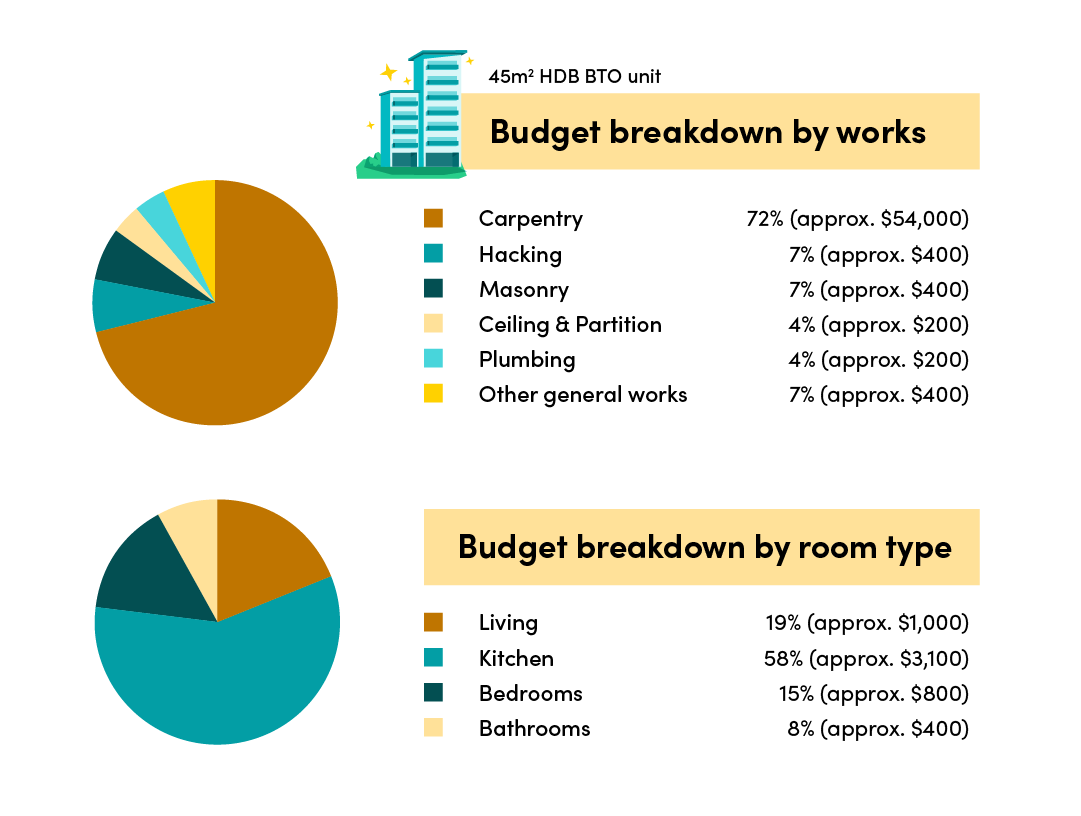
In smaller flats, carpentry usually takes up the biggest chunk of your budget—built-in storage helps make the most of limited space. On the flip side, things like plumbing or ceiling partitions are often less of a priority.
If you spend a lot of time at home (and want to save on eating out), it also makes sense to invest a bit more in the spaces you use most—like a well-designed kitchen, a cosy living room, and a functional bedroom.
Meanwhile, for a 100m2 resale condo (3 bedrooms and 2 bathrooms), here’s what an estimated renovation cost breakdown will look like:
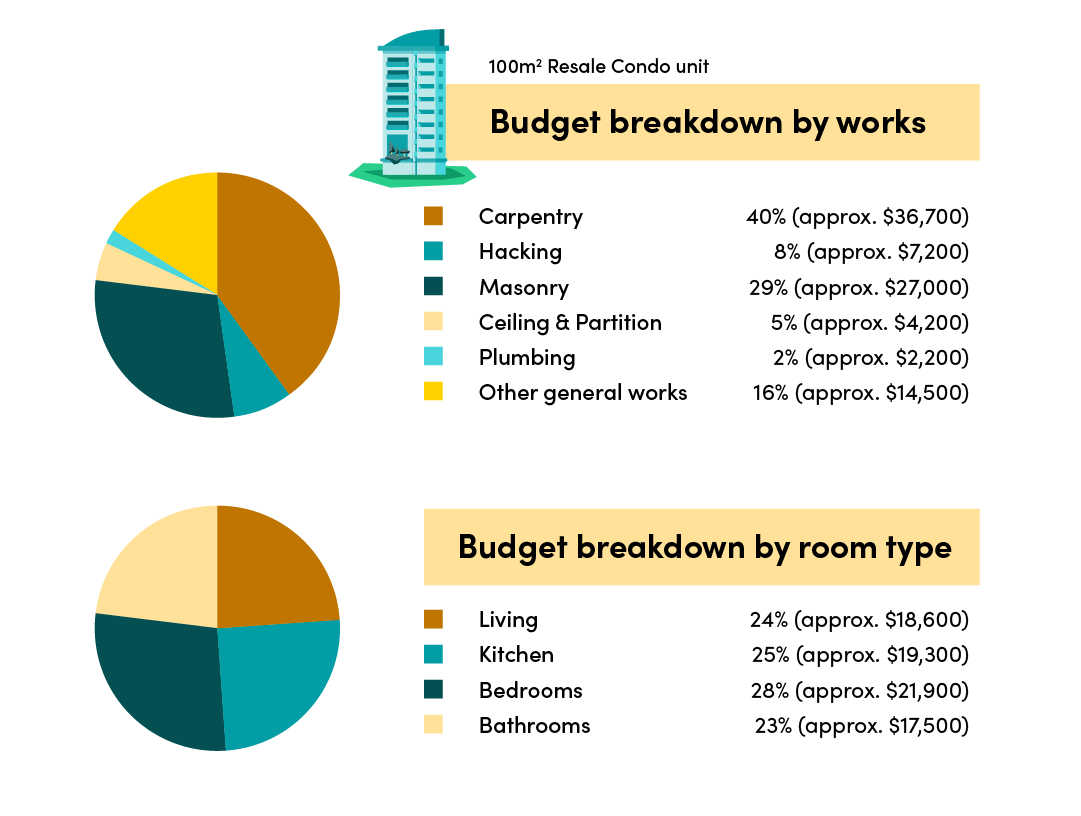
In larger resale condos, your renovation budget is usually spread across multiple rooms—but carpentry and masonry still take up a big chunk. Simply put, bigger spaces mean more flooring, tiling, and built-ins to cover, which drives up both material and labour costs.
No matter your home size, carpentry tends to be the biggest cost driver, followed by hacking or masonry—so it’s worth planning your budget around these first.
Plan for contingency
As with general finances, always set aside a 10% to 15% contingency buffer in your renovation budget. Unexpected costs like hidden defects (especially in resale units), material shortages or price fluctuations, and last-minute design changes can creep up very easily—and in some cases, feel almost inevitable. But with a good buffer in place, your bank account won’t be caught off guard.
Avoid scope creep
Scope creep happens when extra renovation works start adding up after your initial plan—think a few more lighting points or extra carpentry here and there. Before you know it, your budget balloons.
To avoid this, lock in your project scope early and stay aligned with your contractor or ID on timelines and costs.
Work with experienced contractors
A seasoned contractor or ID helps you avoid costly mistakes, poor material choices, and inefficient layouts. They’ll know how to advise on proper sequence structural works (hacking, masonry, plumbing, carpentry) to keep your renovation on schedule and within budget.
Can I use a personal loan for renovation?
Absolutely. But perhaps the next question you might ask is: how do I choose between a renovation loanorpersonal loan for home renovations? It depends on
- What you need the extra budget for
- Which part of renovation you need more flexible financing for
Once you’ve pinpointed your needs, compare both loan types using the criteria below:
Criteria | Renovation loan | Personal loan |
Interest rates | From 1.00% p.a.* (EIR from 1.94% p.a.) | From 1.00% p.a.* (EIR from 1.94% p.a.) |
Loan tenure | Up to 5 years | Up to 5 years, sometimes 7 years |
Loan limits | Typically up to 6X monthly income, capped at $30,000 | Typically up to 4X monthly income, or up to 8X monthly income for those with at least $120,000 annual income. Mostly capped at $200,000, but varies across banks |
Fund flexibility | Strictly for home renovationsMust submit documents like contractor quote or invoice, proof of ownership, HDB or MCST renovation permit | For any purpose |
Income eligibility | Depends on bank, but usually $20,000 – $30,000 | Depends on bank.
|
Upfront fees | May include processing fees (1 – 2%), disbursement fees, or admin charges | |
Loan approval & funds disbursement |
|
|
* Lowest rate at time of writing.
So, which should you choose?
- If you’re looking for lower interest rates and plan to fund structural works or major upgrades, a renovation loan is usually the better fit.
- But if you want more flexibility, quicker access to funds, or a higher loan amount, a personal loan might suit you better.
Make use of our personal loan calculator to easily plan your loan amount, tenure, and monthly repayments.

Per Month
S$842
- Interest Rate*
EIR: From 1.93% p.a. - From 1.00% p.a.
- Total Amount Payable
- S$10,100
- Processing Fee
- S$0
- Per Month
- S$842
Sign up via MoneySmart and claim:
Up to S$1,700 Cash via PayNow OR 19,050 SmartPoints (enough to redeem an Apple iPhone 17 Pro Max and more)
And get your rewards in as fast as 4 weeks!
T&Cs apply.

ALSO READ: Personal Loan vs Renovation Loan in Singapore (2026): Which Is Better for Home Improvement?
Found this article useful? Share it with your family and friends!
This article was first drafted with the help of AI and later reviewed and refined by the author.
Related Articles