
If you're footing part of the bill for your parents while also trying to keep your own finances in shape, you're living the classic sandwich-generation squeeze. The good news: Singapore's tax system actually rewards you for it. Between Parent Relief and CPF top-ups, you could knock a meaningful chunk off your chargeable income for supporting your parents—and there's a bonus move involving your credit card that most people don't know about.
Here's how the parent relief tax Singapore system works, how CPF top-up tax relief stacks on top of it, and how you might even earn miles paying your tax bill.
[ms-toc title="Parent Relief & CPF Top-Up: How to Save Tax Supporting Parents in Singapore"]
What is Parent Relief (and Parent Relief, Disability)?
Parent Relief is IRAS's way of recognising the fact that you're financially supporting your parents, parents-in-law, grandparents, or grandparents-in-law. To claim it for Year of Assessment (YA) 2026, your dependant must have met all these conditions in 2025:
- They're 55 or above.
- Their annual income in 2025 didn't exceed $8,000 (this threshold was raised from $4,000 starting YA 2025).
- They either lived with you in Singapore, or lived separately and you spent at least $2,000 supporting them that year.
The payout depends on whether you stay together:
You can claim for up to 2 dependants, and if several siblings support the same parent, the relief can be shared based on an agreed split—it doesn't multiply per sibling. One catch: once you've claimed Parent Relief on a parent, that blocks certain other tax reliefs from being claimed on the same parent by someone else.
For example, if your father has claimed Spouse Relief on your mother, you and your siblings can't also claim Parent Relief on her in the same year. The same works in reverse too, if your mother has claimed Spouse Relief on your father.
So it's worth sorting out as a family who claims what, before anyone files.
Topping up your parents' CPF: how it boosts your tax relief
This is where it gets interesting. Beyond Parent Relief, you can also get CPF top-up tax relief for cash top-ups made to your parents' CPF accounts under the CPF Retirement Sum Topping-Up Scheme (RSTU).
Here are the mechanics:
- You can claim up to $8,000 for top-ups to your own Special or Retirement Account, and a further $8,000 for top-ups to family members (including parents, parents-in-law, grandparents, and grandparents-in-law)—a combined cap of $16,000 a year.
- The top-up must be in cash. Transferring funds from your own CPF account to theirs doesn't qualify.
- The top-up needs to be made within the calendar year—by 31 December—to count toward that Year of Assessment's relief. Leave it too late and it rolls into next year's claim instead.
- If your parent's CPF savings have already hit the Full Retirement Sum, no further top-up will earn tax relief. The money can still go in, but it won't reduce your tax bill.
Heard of a matching grant relief? Unfortunately, from YA 2026 (top-ups made from 1 January 2025), cash top-ups that attract a matching grant under the Matched Retirement Savings Scheme (MRSS) no longer qualify for CPF top-up tax relief. If your parent is an MRSS recipient, run the numbers: the government's dollar-for-dollar match is usually still worth more than the tax break, so you're not losing out, just avoiding a double dip. It's also worth remembering that CPF policy keeps shifting year to year, so do check the current rules before you commit to a top-up.
Parent Relief + CPF top-up: a real savings example
Let's say you're supporting your father, who lives with you and earns no income of his own. Your chargeable income (before reliefs) sits at $80,000, putting you in a bracket where every dollar of relief counts.
That's $17,000 shaved off your chargeable income from just these two moves, and that's before you've even touched SRS contributions or your own CPF top-up. Using IRAS's resident tax rate table, the actual tax bill works out to $3,350 on a $80,000 chargeable income, versus $2,160 on $63,000. That's $1,190 in tax savings.
ALSO READ: 10 Ways to Reduce Your Personal Income Tax in Singapore for YA 2027
Bonus move: you can pay your income tax bill with a credit card
Here's the part most people miss. IRAS doesn't accept credit cards directly on myTax Portal, since the transaction costs are too high for them to absorb. But there are 2 workarounds: bank tax facilities and third-party platforms.
Bank tax facilities built into specific cards, like the Standard Chartered Visa Infinite (1.9% preferential processing fee, earning miles) or Citi PayAll (2.6% service fee, earning your card's base rate), let you route the payment through a partnering bank's own facility.
Third-party platforms like CardUp accept most Singapore-issued cards—Amex, Citi, HSBC, Maybank, OCBC, POSB, Standard Chartered, and UOB—for a standard fee of around 2.6%, though promotional codes for discounted rates tend to appear each tax season, especially for Visa cardholders.
The trade-off is simple: you pay a small fee, but you earn credit card rewards—miles, points, or cashback—on a bill that would otherwise earn you nothing. If your card's rewards rate is high enough to outweigh the processing fee, you come out ahead. Miles chasers in particular use this every tax season to hit minimum spend requirements or rack up air miles on money they'd have to pay anyway.

- on Overseas Spend
- S$1 = 3 miles
- on Local Spend
- S$1 = 1.4 Miles
- visits to Airport Lounges worldwide
- 6 Complimentary
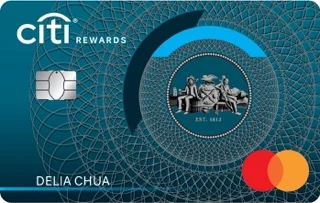
- on Online Grocery, Food Delivery, Ride-Hailing
- S$1= 10X Points
- for in-store shopping purchases at Department Store, Clothing Stores
- S$1= 10X Points
- for all other purchases
- S$1= 1X Point
Snap up baseline gifts: be among the first 200 approved applicants spending S$500 to enjoy S$450 Upsized Cash or a S$500 Amazon.sg Gift Card, or still grab S$400 Cash or 6,140 SmartPoints (use SmartPoints earned to redeem the latest Apple products on our Rewards Store) if you come after.
But the real treat? Dive into spooktacular Halloween rewards with MoneySmart! Each day, the first 10 fastest claimants snatch exclusive Flash Deal prizes—from iPhone 18 Pro, MacBook Neo, Switch 2, PS5 and more—on top of your baseline reward! T&Cs apply.
ALSO READ: Best Credit Cards for Income Tax Filing - Singapore
Picking the right card for your tax bill
So you've decided to put your tax bill on plastic. Smart move—but before you tap that card, spend 5 minutes doing the maths, because not every card is worth it.
Start with the obvious question: does your card's earn rate actually beat the processing fee? Say your card earns 1.4 miles per dollar and the facilitator's charging 1.9%. Is the value of those miles (by your own reckoning) worth more than what you're paying to get them? If yes, tap away. If it's close, it might not be worth the hassle.
Don't just use last year's numbers, either. Facilitators love rolling out fresh promo codes each tax season, so it's worth a quick check before you commit, that fee could be lower than you remember.
And here's a neat trick if you've got a new card sitting in your wallet: a tax bill is basically a free, predictable way to hit a minimum spend for a welcome bonus. If you've been meaning to unlock that sign-up offer, this is as good an excuse as any.
Still shopping around? Have a browse through the full range of credit cards before you settle on "the one" for tax season.
Other reliefs and moves worth stacking
Parent Relief and CPF top-ups are the headline acts, but they're not the only tricks up your sleeve. If you're already elbow-deep in restructuring your taxes, it's worth checking whether these apply to you too:
- SRS contributions: Singapore Citizens and PRs can contribute up to $15,300 a year to a Supplementary Retirement Scheme account for further relief.
- CPF top-up to yourself: You can claim up to $8,000 for topping up your own Special or Retirement Account. That's on top of, not instead of, the family top-up cap we walked through earlier.
- Grandparent Caregiver Relief: If a parent or parent-in-law looks after your child and you're a working mother, this is worth a further $3,000, and can be claimed alongside Parent Relief for the same dependant, which isn't normally allowed. A rare win-win from IRAS.
ALSO READ: Support for Working Mothers in Singapore in 2026: Financial Grants, Tax Reliefs, and More
Found this article useful? Share it with the sandwich generation you know.
Related Articles