
If you’ve opened your food delivery apps recently, you might have noticed something missing—Deliveroo is gone for good in Singapore as of 4 Mar 2026. That leaves just 2 big names fighting for your next takeaway: Pandapro and GrabUnlimited.
With fewer choices on the table, you might be wondering, “Which subscription actually saves me more money?” Instead of guessing, I decided to put both to the test. Let’s find out which one stretches your dollar further—so you can enjoy your next meal without worrying about extra fees.
[ms-toc title="Pandapro vs GrabUnlimited—Comparing costs, fees and more"]
1. Real-world cost test: Which actually saves you more?
To see how GrabUnlimited and Pandapro subscriptions perform in practice, I tested 2 common ordering scenarios—a lower-cost meal for 2 and a higher-value group order—to check whether the savings actually scale.
For consistency, I selected standard delivery for all orders, although in some cases standard and priority delivery were priced the same. The cost of food items remained identical across all platforms and subscription tiers, so any differences come purely from delivery fees, service fees, and subscription perks.
Order #1
Order #1: McDonald’s | ||||
Platform / subscription | Cost of food | Delivery fee (Standard delivery) | Platform fee / Service fee | Total cost |
Foodpanda | $19.50 | $4.49 | $1.00 | $24.99 |
Pandapro | $19.50 | Free | $1.00 | $20.50 |
GrabFood | $19.50 | $4.40 | $0.60 | $24.50 |
GrabUnlimited | $19.50 | $1.40 | $0.60 | $21.50 |
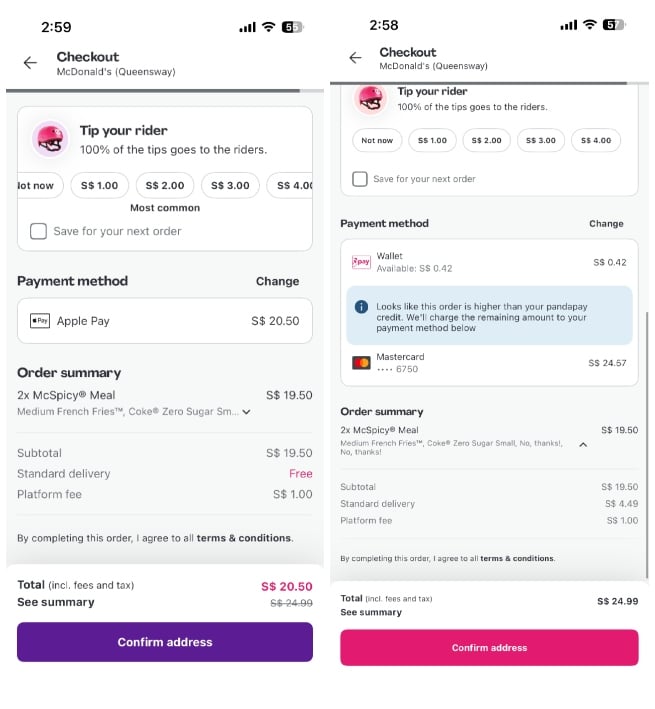
Sample order from McDonald's using Pandapro (left) and a regular Foodpanda account (right). (Images: MoneySmart)
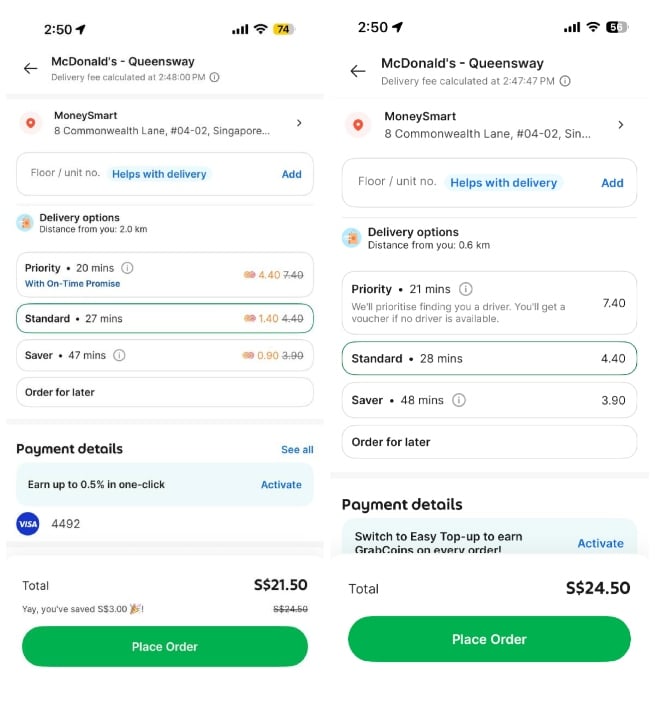
Sample order from McDonald's using GrabUnlimited (left) and a regular GrabFood account (right). (Images: MoneySmart)
Winner: Pandapro
For smaller orders, delivery fees make up a big chunk of your total cost—almost $4.50 here if you’re not subscribed. That’s why Pandapro comes out clearly ahead at $20.50, by fully removing that cost.
Compared to non-subscribers, Pandapro saves you $4.49 on this single order, while GrabUnlimited saves about $3.00. While both subscriptions reduce costs meaningfully, Pandapro’s zero delivery fee model gives it a stronger advantage for everyday, lower-value meals.
Notice that even though Foodpanda had a higher platform fee of $1.00 compared to Grab’s $0.60, its free delivery was its trump card. Speaking of delivery fees on Foodpanda, notice also that although I didn’t hit the $25 minimum spend Foodpanda stated was needed for free delivery, I still enjoyed delivery at $0 with my Pandapro account. I don’t know why this was the case, but if Foodpanda regularly drops such pleasant surprises, no one’s going to complain.
Order #2
Order #2: Sushi Zanmai | ||||
Platform / subscription | Cost of food | Delivery fee (Standard delivery) | Platform fee / Service fee | Total cost |
Foodpanda | $104.80 | $3.49 | $1.50 | $109.79 |
Pandapro | $104.80 | Free | $1.20 | $106.00 |
GrabFood | $104.80 | $3.20 | $0.60 | $108.60 |
GrabUnlimited | $104.80 | $0.20 (free upgrade to Priority) | $0.60 | $105.60 |
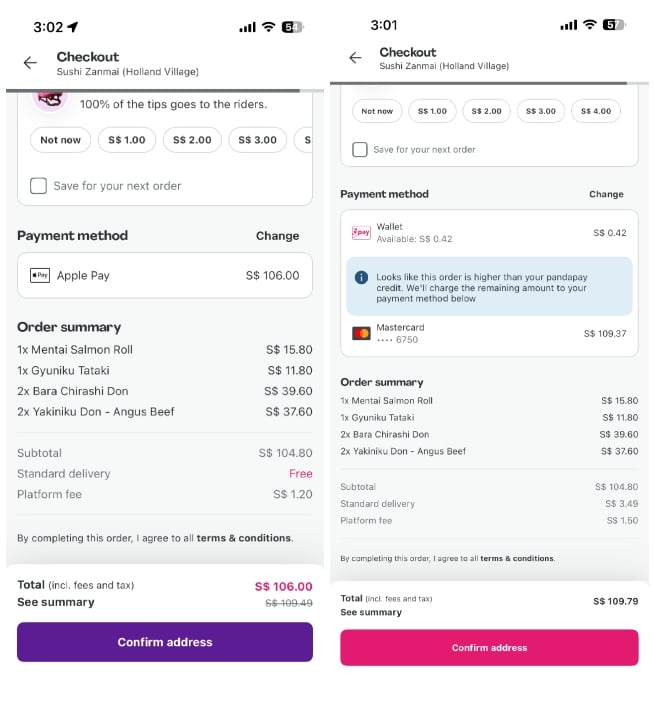
Sample order from Sushi Zanmai using Pandapro (left) and a regular Foodpanda account (right). (Images: MoneySmart)
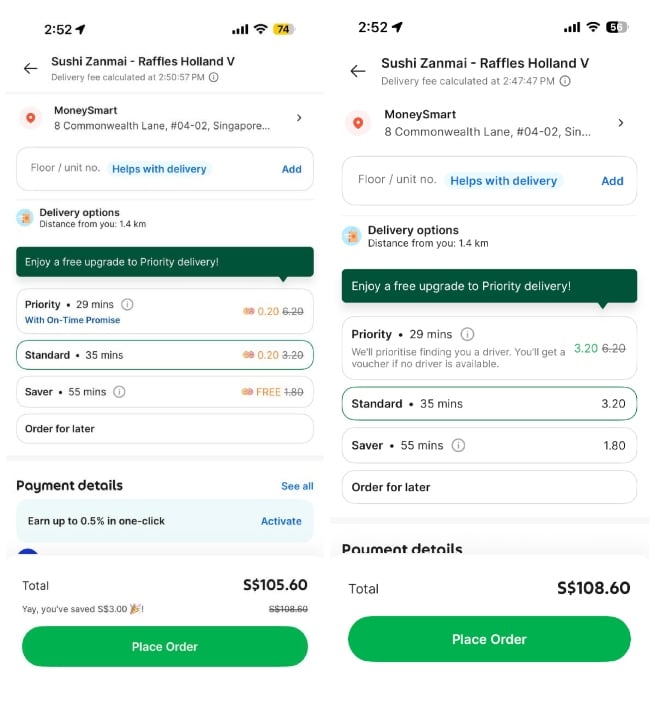
Sample order from Sushi Zanmai using GrabUnlimited (left) and a regular GrabFood account (right). (Images: MoneySmart)
Winner: GrabUnlimited
For larger orders, the dynamics shift. Delivery fees now make up a much smaller share of the total bill (just a few dollars out of over $100), so the difference between “free” and “almost free” becomes negligible.
Here, GrabUnlimited edges ahead at $105.60. Compared to non-subscribers, it saves $3.00, slightly more than Pandapro’s $3.79 savings versus Foodpanda. However, most crucially, its lower overall fees allow it to come out cheapest in total. Although Pandapro lowered the Foodpanda platform fee from $1.50 to $1.20, Grab still came up on top with its low service fee of $0.60 across both orders on both types of subscriptions.
Key takeaway from both tests
- Pandapro wins on smaller orders, where eliminating delivery fees has the biggest impact on your total bill.
- GrabUnlimited becomes more competitive on larger orders, where delivery costs matter less and small fee differences can tip the balance.
Most importantly, both tests show that your savings come primarily from reducing delivery fees—not food prices. That means the real value of each subscription depends on:
- how often you order, and
- how much you typically spend per order.
ALSO READ: Best Credit Cards to Use for Dining in Singapore
2. Savings and break-even analysis
So far, we’ve seen how Pandapro and GrabUnlimited perform across different order sizes—but are they actually worth paying $4.99 or $5.99 a month for?
To answer that, let’s break it down into how quickly each subscription pays for itself.
Break-even by order type
From the test orders, here’s how much you save per order—and how many orders it takes to recover the subscription cost:
Platform | Small order savings | Orders to break even | Large order savings | Orders to break even |
Pandapro | $4.49 | ~2 | $3.79 | 1–2 |
GrabUnlimited | $3.00 | 2–3 | $3.00 | 2–3 |
What this shows is quite straightforward: Pandapro breaks even slightly faster. Because it removes delivery fees entirely, the savings per order are higher and more consistent—especially for smaller orders.
The annual plan factor
One important factor is that both Pandapro and GrabUnlimited offer plans that bring the monthly subscription cost down to $4.99 per month. This changes the math slightly:
Plan type | Price | Effective monthly cost | Estimated break-even |
Pandapro (billed every 6 or 12 months) | $29.94/6 months OR $59.88/year | $4.99 | 1–2 orders/month |
GrabUnlimited (billed every 12 months) | $59.88/year | $4.99 | ~2 orders/month |
At $4.99 per month (effective), both GrabUnlimited and Pandapro see their break-even points become even easier to achieve.
That said, the trade-off is flexibility—you’ll need to commit upfront for 6 or 12 months, which may not suit everyone.
What this means in practice
Ultimately, whether these subscriptions are worth it depends on how often you order:
Usage frequency | Is it worth it? | What it means for you |
1–2 orders/month | Not always | You may not fully recover the subscription cost |
3–5 orders/month | Yes | Both plans start to make financial sense |
6+ orders/month | Definitely | Savings become more meaningful over time |
In other words, frequency matters more than anything else. Even the best perks won’t help if you don’t use them often enough.
Which gives better value over time?
Stepping back, the difference between the 2 platforms comes down to how predictable you want your savings to be:
Platform | Strength |
Pandapro | Faster break-even, more consistent savings per order |
GrabUnlimited | Better value on annual plan, but savings depend on vouchers and merchants |
Over a month, this can translate into:
- Around $12–$18 in savings with Pandapro (at 4 orders)
- Around $6–$12 with GrabUnlimited, depending on how well you optimise deals
Overall, both can be worth it—but Pandapro is easier to extract value from, while GrabUnlimited rewards users who are willing to be more deliberate with their orders.
ALSO READ: Affordable Meal Prep and Tingkat services in Singapore
3. Looking beyond the test: How the perks stack up
The cost test gives a useful snapshot—but it doesn’t tell the whole story. In reality, how much you save depends on how consistently you can tap into each platform’s perks over time.
Here’s how Pandapro and GrabUnlimited compare on paper:
Pandapro | GrabUnlimited | |
Subscription fee |
|
|
Food delivery fee | Unlimited free delivery (minimum $25 spend) | Free delivery on preferred stores or up to $3 off per order |
Savings per month | Save over $50/month* on average | Save $20/month** on average |
Restaurant deals | Unlimited 20% off on 2,000+ restaurants |
|
Pick-up deals | 20% + 5% off on 4,000+ pick-up restaurants | Additional pick-up deals |
Grocery savings |
|
|
Other perks |
|
|
*Based on the average amount a pro subscriber saves a month based on internal data, but actual savings will vary based on order frequency, basket sizes, and other factors.
**Based on the average savings of GrabUnlimited members in Singapore. Actual savings may vary.
Food delivery value
From the test earlier, one thing was clear: most of your savings come from delivery fees. This table helps explain why.
With Pandapro, free delivery applies broadly—as long as you hit the minimum spend. That’s why it performed so well in the smaller order test, and why its savings tend to be more consistent across different orders.
With GrabUnlimited, the value is more conditional. Free delivery only applies to selected merchants, and otherwise you’re working with capped discounts (like up to $3 off). That’s why its performance can vary—it depends on whether your order qualifies for the better deals.
Another key difference is how often you can realistically use the perks.
- Pandapro’s core benefits (delivery + 20% off) are easy to apply repeatedly
- GrabUnlimited’s higher discounts (like up to 30% off) are typically tied to specific merchants or promotions
This aligns with what we saw in the cost test:
- Pandapro delivered more consistent savings, especially on everyday orders
- GrabUnlimited could be just as competitive—but only under the right conditions
What this means for value
In practice, the “better” subscription isn’t just about who’s cheaper in a single order—it’s about how reliably you can extract value over time.
- If most of your orders meet the $25 minimum and come from common restaurants, Pandapro’s benefits are easier to stack month after month
- If you’re willing to switch between merchants, track deals, and occasionally take advantage of non-food perks, GrabUnlimited can still hold its own
Lifestyle perks value
Beyond food delivery, GrabUnlimited differentiates itself with lifestyle perks—like discounts on Viu Premium and Trip.com hotels.
Whether these are valuable really comes down to your habits. If you already pay for streaming services or book hotels regularly, these perks can translate into real, additional savings on top of food delivery. In that case, GrabUnlimited’s value extends beyond just meals and into your broader spending.
On the other hand, if you don’t actively use these services, the benefits may go largely unused—and won’t meaningfully offset your subscription cost.
Pandapro takes a different approach by focusing on everyday spending categories:
- Grocery discounts (with no minimum spend)
- Ride savings via TADA
- On-time delivery compensation
These may feel less premium, but they are tied more closely to frequent, practical use cases, which can make their value easier to realise for regular users.
ALSO READ: Best Grocery Credit Cards in Singapore
4. Final verdict: Which is more worth it?
With Deliveroo out of the picture, the choice now comes down to Pandapro vs GrabUnlimited—and as the tests show, there’s no single winner for everyone.
If you’re looking purely at consistent, predictable savings on food delivery, Pandapro comes out ahead. Its unlimited free delivery and flat 20% discounts make it easy to save on almost every order, especially for smaller, everyday meals. You don’t need to think too much about whether a deal applies—the value is built in.
On the other hand, GrabUnlimited can be just as competitive in the right situations. For larger orders, or if you’re using the annual plan at $4.99/month, the cost difference narrows significantly. And if you regularly use its lifestyle perks—like streaming or travel discounts—the overall value can go beyond just food delivery.
Ultimately, it comes down to how you use these platforms:
- Frequent, routine orders: Pandapro offers stronger and more reliable savings
- More flexible, deal-driven usage: GrabUnlimited can still deliver solid value, especially with some optimisation
- Broader lifestyle spending: GrabUnlimited may edge ahead if you actively use its non-food perks
The bottom line: both subscriptions can be worth it—but only if you use them enough. If you order food regularly and want hassle-free savings, Pandapro is the easier choice. If you don’t mind putting in a bit more effort to maximise deals—or can take advantage of its wider ecosystem—GrabUnlimited remains a viable alternative.
One final note: this comparison is based on food delivery orders only, and on 2 specific test scenarios. Results may vary depending on the restaurants you order from, your basket size, and how often you use each platform’s grocery or non-food perks.
This article was first drafted with the help of AI and later reviewed and refined by the author.
Found this article useful? Share it with your family and friends!
Related Articles