
At 10 pm, your day is supposed to be winding down. Dinner’s done, the laptop is finally closed and you’re deciding whether one more episode on Netflix is worth tomorrow morning’s regret. Wall Street, naturally, has other plans.
Then, a company you’ve been following reports after the US market closes. Its share price starts moving while Singapore is somewhere between 4 am and breakfast. You did the homework and caught the news. Your only mistake? Having a bedtime.
The problem isn’t always knowing what happened. Sometimes, you can’t act on it until later during local office hours. Furthermore, your money might still be sitting in the bank, brokerage account set up still on your to-do list, or you’re three tabs deep trying to figure out what to do next.
We break down which of these delays are actually worth fixing. Just remember that some platforms offer access through CFDs, which use leverage and can magnify both gains and losses. Faster access to markets shouldn’t mean making faster decisions.
[ms-toc title="The 3am Problem: Trading US Stocks From Singapore"]
Delay #1: The market moves while you sleep
Wall Street’s 9.30pm opening time isn’t even fixed. Twice a year, the US switches between daylight saving and standard time, shifting the Nasdaq’s regular session by an hour.
During US daylight saving time, the market runs roughly 9:30 pm to 4 am Singapore time. When the US switches back to standard time, that becomes 10:30 pm to 5 am. So if you’ve spent months thinking “US market open = 9.30pm”, consider yourself warned.
The timing gets even trickier during earnings season. For instance, NVIDIA’s upcoming results are expected around 4:20 am Singapore time, followed by its earnings call at around 5 am—almost exactly when regular Nasdaq trading wraps up.
More flexibility around timing
If a listed company drops big news after the US market closes, the frustrating part is having to wait until regular trading resumes before you can act. Extended-hours trading gives you another window, so you have more flexibility over when to respond.
Here’s how both options compare:
If US earnings and overnight announcements are already on your radar, you might want to reconsider your current platform. Plus500 offers extended-hours trading for selected US stock CFDs on weekdays, giving another window to trade eligible stocks outside the main US session.
However, fewer buyers and sellers during extended hours can mean wider spreads and sharper price moves, making trades more expensive or harder to exit. We recommend viewing extended hours as another strategic option for events, like earnings release or announcements, that land outside regular market hours.
While more market access helps, there’s another delay to deal with: getting your money into the market in the first place.
Delay #2: Your money is still in the bank
The market is moving, but you’re busy interchanging between apps, making the transfer and waiting for your funds to land into your trading account. It’s not exactly difficult, but when timing matters, even these few extra steps can get on your nerves.
That is why the funding experience matters. You want the transfer to be quick, simple and something you can do without learning a whole new transaction process.
Funding through PayNow
PayNow is often preferred. It operates 24/7, 365 days a year and transfers SGD instantly through FAST.
To keep funding user-friendly, Plus500 supports PayNow deposits, a process most Singaporeans are familiar with.
Simply select PayNow on the deposit screen, scan the QR code with your banking app and confirm. Note: PayNow is for deposits only. For withdrawals, please refer to other available methods.
Of course, funding only becomes a problem once you actually have an account to fund. For many, the delay starts even earlier: opening the account in the first place, which somehow keeps getting pushed to next weekend—indefinitely.
Delay #3: The account is still on your to-do list
There’s never a thrilling Saturday afternoon to spend typing in your personal details and filling out an application. Here’s where Plus500’s Singpass-assisted setup can help. Verified details can be pulled into parts of the application, so you don’t have to key everything in manually.
The shortcut is on the admin, not the assessment. Account approval and any required suitability or knowledge checks still apply, which is still crucial given that CFDs are leveraged products and come with a high level of risk.
Not ready to make any commitments yet? Plus500 also offers a demo account, so you can explore the platform first, subject to current terms.
If you made it this far, you’re mostly set to trade. Still, there are mistakes to be aware of—catching the headlines but watching the wrong market.
Delay #4: You are watching the wrong thing
A Fed decision might move the US dollar or gold first, while an oil shock starts with—well, oil. Being quick to the news doesn’t help much if you’re looking in the wrong place.
Sometimes a stock falls even when nothing’s gone wrong with the company. A change in US interest rates, a spike in oil prices or bad news across the industry can influence prices. Watching one ticker alone rarely tells the whole story.
Depending on the confirmed offering, Plus500’ offers a broader market range to access CFDs across shares, indices, commodities, forex and ETFs from the same account, with options available for more experienced traders.
If following the story means opening filling up your Chrome tabs, +AI Bites comes in handy to summarise recent news and technical context into bite sized updates.
Useful for getting up to speed, but don’t confuse a faster summary with making all the decisions on your behalf. The homework still needs to be yours.
The delay worth keeping
Not every delay is a bad thing. If you’re taking a few extra minutes to decide whether a trade still makes sense, that’s probably time well spent.
Especially with CFDs, using leverage can magnify both gains and losses from relatively small market moves.
Also, Extended-hours trading can also come with sharper price swings since there are fewer buyers and sellers. If you’re trading late at night, you won’t want to be figuring out your limits on the fly.
Know your exit strategy
Think of it as setting a hard budget before heading for a sale. Once you’re there and something looks too good to pass up, it becomes surprisingly easy to talk yourself to burst the limit you set.
Trading is easier to keep disciplined when the big decisions are made before prices start moving:
- Set your loss limit: Decide how much you’re willing to lose and size your trade accordingly.
- Know your exit: Set the price or market move that would make you close the position.
- Use the tools: Stop-loss orders and other risk-management tools can help enforce those limits once you’re in the trade.
Here’s where Plus500’s risk-management tools can be useful. They help stick to the limits you’ve already set rather than leaving you to make those decisions while the market is moving. Before trying to trade faster, make sure you’re not skipping the necessary diligence that should take time.
Where is your lag?
The goal isn’t to develop superhero reflexes every time Wall Street sneezes. It’s to get the bits that slow you down out of the way before there’s a trade worth considering.
Plus500 tackles these practical hurdles: Singpass-assisted onboarding cuts down on form-filling, PayNow deposits make funding more straightforward, while extended-hours access to selected US stock CFDs on weekdays gives you another window around a market halfway across the globe.
If “open trading account” has been sitting on your to-do list for months, ticking it off might finally be more satisfying than closing another browser tab or regretting the missed opportunities you could have leveraged.

- Min. Commission Fee for US Stocks
- $0
- Min. Commission Fee SG Stocks
- $0
- Min. Funding
- S$150
Sign up and get REWARDS:
• S$300 Cash via PayNow
• OR Apple Airpods Pro 3 (worth S$349)
• OR Apple Watch SE 3 (worth S$349)
and more when you open a NEW Plus500 account, deposit S$1,000 and make 3 trades on Plus500 on Commodities, Indices and/or Options! T&Cs apply.
[Stackable Plus500 Promos]
- Enjoy upsized rewards when you stack the MoneySmart promotion with the Plus500 promos!
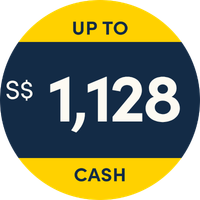
- Get S$828 Cash Bonus when you make a min. deposit of S$1,000 & earn at least 438 Trader Points with promo code MS828
- Get S$238 Cash Bonus when you make a min. deposit of S$400 & earn at least 105 Trader Points with promo code MS238
This post was written in collaboration with Plus500. While we are financially compensated by them, we nonetheless strive to maintain our editorial integrity and review products with the same objective lens. We are committed to providing the best information in order for you to make personal financial decisions with confidence.
Related Articles