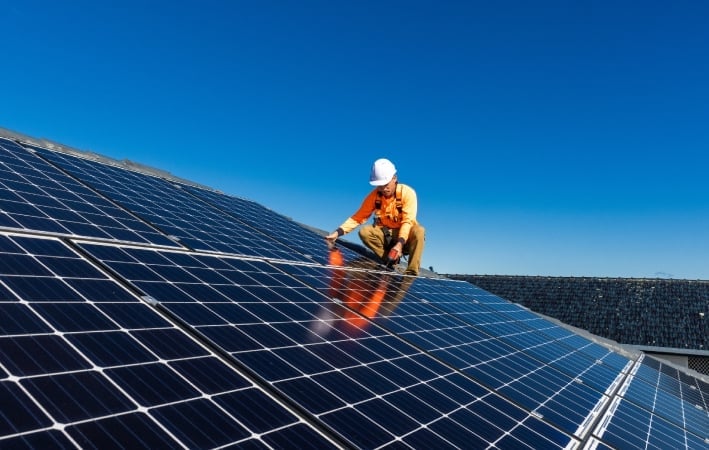
As the weather heats up, along with our electricity costs from staying cool, you may be wondering if solar panels could help reduce electricity costs. Given how it’s sunny most of the time (when it’s not rainy season or hazy) in Singapore, solar panels are an energy efficient way that helps reduce reliance on natural gas where most of Singapore’s electricity comes from.
But how do solar panels work especially if many of us are living in buildings along with hundreds of others?
We look at whether you can install solar panels on your place in Singapore, how it works, the costs, payback period and whether it’s worth it.
[ms-toc title="Solar Panels for Singapore Homes (2026): Cost, Payback Period, and How to Finance Them"]
1. Can you install solar panels on your home in Singapore?
The first thing is eligibility for solar panels. Is the roof actually yours to install solar panels?
Landed homes
Congrats, your house is yours to do what you please and you can get a contractor to come install solar panels.
HDB flats
Can you even install solar panels if you live in a HDB flat? While those living in HDB flats cannot have their own personal solar panel, HDB has a SolarNova programme that aims to install solar panels for about 8,400 HDB blocks by 2030.
Around 5,300 blocks have had solar panels installed as of Dec 2025, which is around half of all HDB blocks in Singapore.
But this doesn’t mean you get cost savings on your electricity bill though. The electricity generated from these solar panels power common services such as lifts and lights.
Condominiums
Those who stay in condominiums can’t do it individually either as they’re subject to the Management Corporation Strata Title (MCST)’s approval and sometimes, agreement between residents. Savings from solar also don’t go to the individual units too but instead, channelled to common areas, so you don’t really get the cost savings if you stay in a condo.
While eligibility is one thing, what about the practical considerations?
Rooftop space must be sufficient enough to have enough solar panels to power the home. And the structure itself has to be sturdy as well to hold the solar panels. There’s also other factors such as the amount of shade on the roof, whether it’s blocked by other buildings or structures on the roof that may prevent sunlight from reaching the panels to consider.
2. How much does solar panel installation in Singapore cost?
Factors such as the system size of the panels and its deployment, inverter, roof type, optional battery storage all affect the cost of solar panels.
Here’s a rough breakdown using estimates from Energy Market Authority (EMA):
Solar vendors also have different prices and most require a quotation to fit the needs of specific house types.
Here are the rough prices of what we found from a few vendors’ websites:
- GetSolar: S$160-S$210/month for renting, S$20,000–S$40,000 for purchase
- FOMO Energy: S$10,0000–$50,000
- SUNOLLO: S$14,500–S$16,000
Get at least 3 itemised quotes using the same target capacity and equipment specifications. Ask whether scaffolding, roof repairs, electrical work, grid connection and monitoring are included.
Then budget beyond installation. EMA estimates annual residential operation and maintenance at roughly 1%–2% of system cost, so that’s about S$200–S$400 on a S$20,000 system. Check cleaning charges and set aside money for eventual inverter replacement if it falls outside warranty.
3. What’s the payback period for solar panels?
EMA puts average residential payback at about 5 to 7 years. Larger systems serving households with substantial daytime consumption may recover their cost in 4 to 5 years.
The basic calculation is: Payback period = upfront cost ÷ annual net savings.
Here’s an example of a landed home with a consumption of 1208.2 kWh monthly.
- Upfront cost of solar PV installation: $16,600
Assuming solar replaces 50% of the household’s electricity, annual savings would be:
- 1,208.2 kWh × 50% × $0.3116 × 12 = $2,258.85
Allowing $249 annually for maintenance, an assumed 1.5% of installation cost, within EMA’s 1%–2% range:
- Annual net savings: $2,009.85
- Payback period = $16,600 ÷ $2,009.85 ≈ 8.3 years.
Savings depends on your usage, electricity rate and maintenance costs as each house’s consumption differs.
There are still other factors such as financing costs, major replacements and declining panel output that can affect the actual payback.
What changes the result?
- Usage: Using appliances during solar-generating hours can reduce how much electricity you buy.
- Roof orientation and shading: These influence output. Ask for a site-specific generation estimate.
- Tariffs: Higher avoided electricity prices improve savings; lower prices can stretch payback.
- Selling excess electricity back to the grid: You can sell whatever electricity generated from your solar panels back to the national grid and receive payment (based on the prevailing low-tension electricity tariff minus grid charge) from SP Group. This can offset your monthly electricity bill.
Under EMA’s payment schemes, eligible households buying regulated electricity from SP Group can use Simplified Credit Treatment. They receive the regulated tariff minus grid charges for excess electricity sold back to the grid.
Households buying electricity from retailers can use the Enhanced Central Intermediary Scheme. Their payments for selling excess electricity depend on wholesale electricity prices, which change every half-hour.
Ask installers to calculate savings using your actual electricity plan, daytime usage, maintenance costs and the applicable rate for selling excess electricity.
4. How to finance solar panels in Singapore
1) Paying upfront
Paying cash avoids interest and keeps future savings yours. Just make sure the purchase leaves enough for emergencies and other household expenses.
2) Installer instalment plans
Spread payments through an installer’s available financing or rent-to-own arrangement. Compare the total payable, fees, maintenance coverage and ownership-transfer terms. A low monthly payment can still mean a hefty overall bill.
3) Solar leasing or power purchase agreements
Under a solar leasing or PPA arrangement, the provider owns the system and sells you its electricity. Check rates, escalation clauses, maintenance responsibilities, who receives payments for the excess electricity that’s sold, and exit charges, especially if you might sell your home.
4) Taking a solar panel loan in Singapore
Aim to align the loan tenure with your expected payback period, subject to available terms and affordable repayments. Check the effective interest rates (EIRs), total repayment, processing fees and early-settlement charges available of loans. A longer tenure lowers monthly payments but can increase total interest.
Compare the best personal loans on MoneySmart, then rerun your savings calculation including borrowing costs.

Per Month
S$842
- Interest Rate*
EIR: From 1.93% p.a. - From 1.00% p.a.
- Total Amount Payable
- S$10,100
- Processing Fee
- S$0
- Per Month
- S$842
Sign up via MoneySmart and claim:
Up to S$1,700 Cash via PayNow OR 19,490 SmartPoints (enough to redeem the Latest Apple iPhone 18 Pro 256GB, and more)
And get your rewards in as fast as 4 weeks! T&Cs apply.
5. Things to check before you sign with an installer
- Warranties: Check panel product and performance warranties separately, plus inverter and workmanship coverage. Ask whether labour, transport and roof leaks are covered.
- Track record and support: Request comparable completed projects, customer references, monitoring details and written response times for faults.
- Home insurance: Ask your insurer whether rooftop panels are covered, whether they must be declared, and what exclusions apply. Compare the best home insurance products in the market, then confirm solar coverage directly before buying.
6. So, are solar panels worth it for your home?
Solar is worth considering if you own a suitable landed roof, expect to stay long enough to recover the investment, and can finance it comfortably. Strong daytime usage helps.
Hold off if your roof needs major repairs, shading limits output, or repayments would strain your budget.
For HDB and condo residents, solar-generated or renewable-certificate-backed electricity plans offer another route. Check their pricing and environmental claims; greener doesn’t automatically mean cheaper.
Before signing, get several quotes, run the payback maths using realistic assumptions, and compare financing options. Make that sunshine earn its keep.
Found this article useful? Share it with your family and friends!
Related Articles