If you’ve been watching the markets lately, one thing is clear: price fluctuations are no longer limited to one country or sector.
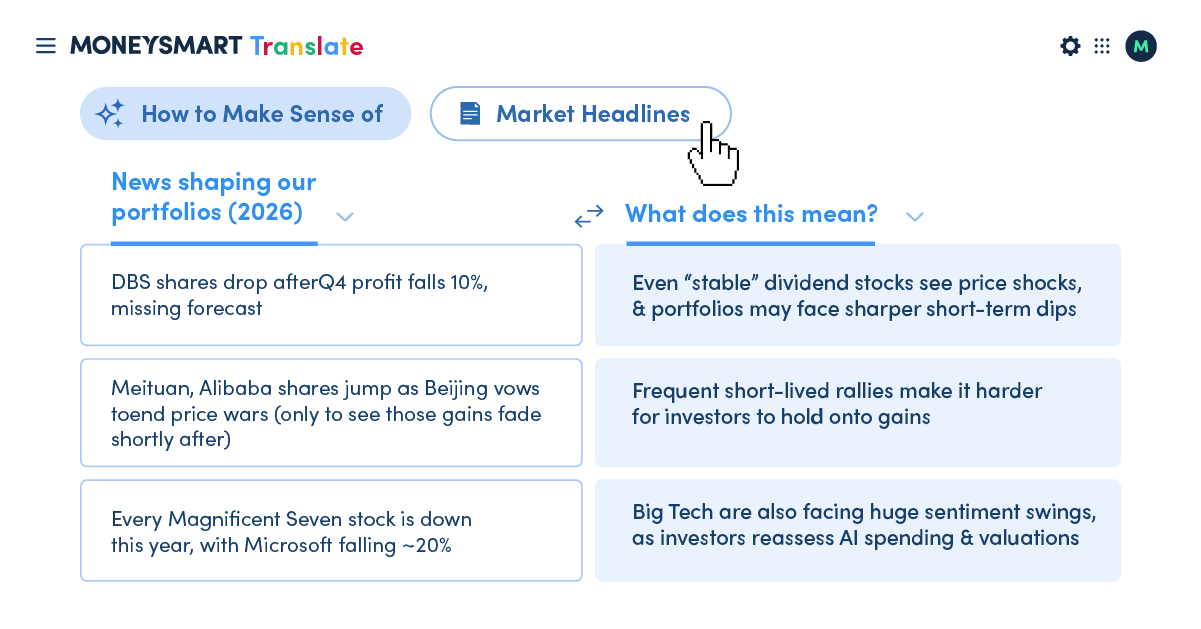
Whether it’s Singapore’s DBS hitting an all-time high in January before correcting 7% just a month later, or Hong Kong’s Alibaba rallying 22% in January only to erase those gains the following month, sharp moves are now part of the daily investing rhythm.
For some, the “whiplash” is a good enough reason to stay on the sidelines. Yet for those who prefer to act on short-term moves, here’s where the goldmine of opportunities reside. The goal isn’t to predict every twist and turn, it’s to have the right tools ready to react when markets swing.
[ms-toc title="Why 2026 needs a new gameplan for your investments" headings="h2"]
1. Why global market feels like a rollercoaster
If you’re checking your portfolio and seeing a different story every few hours, you’re not imagining it. For many, 2025 was a year of constant adjustment—from tariff headlines affecting regional trade to the ongoing “will-they-won’t-they” around the US interest rates.
As we move into 2026, conditions haven't exactly eased, especially with the ongoing US-Iran conflict. Key markets continue to swing, and some of the options we once considered “safe” have not been immune to the shifts:
Singapore
Even steady dividend names have had their woes. DBS, often seen as a long-term hold, hit an all-time high in January before correcting about 7% a month later. While payout remains solid for long-time holders, short "shocks" are expected to stay. In fact, DBS has projected that its 2026 will continue to be volatile. For long-term investors, this means we might need to brace ourselves for sudden drops as a regular occurrence.
Hong Kong
For anyone monitoring HK big tech: stocks rally 3% to 5% on a whiff of mainland policy news, only to return those gains days later. Much is due to a huge price competition that saw the giants burn over $14B in subsidies to see who leads in China’s instant retail. Even with rallies in late 2025, Alibaba has slid 18% back from its January peak, while Meituan is down 22% year-to-date,as of end February.
United States
Meanwhile, the Magnificent 7 are off to a rough start. All seven (Alphabet, Amazon, Apple, Meta, Microsoft, Nvidia, Tesla) are in the red year-to-date end February, with Microsoft facing the biggest decline, falling roughly 20%. The recent slides show just how unpredictable tech sentiment has become—as investors reassess AI spending/ valuations and how long US interest rates will remain high before potential cuts.
2. What does it mean to invest in 2026
For the longest time, the advice was always: “Just buy blue chips and stay patient”. If you held long enough, you’d eventually see green. Today, the "wait and see" strategy is getting a lot harder to pull off.
Saving for big ticket items, like a BTO downpayment or a comfortable retirement, requires a net value balance that grows. Instead, a month’s worth of progress now gets wiped out by a single bad Friday. And as mentioned above, they aren’t going away anytime soon.
Now, you can keep 'trusting the process' while capital moves in circles, or, you can play the market we have. Since the swings are happening anyway, it’s worth exploring how to find opportunities in rising and falling markets — rather than simply sitting through the dips.
Short-term trading—a viable option
Here’s where a shorter-term gameplan might make more sense.
You aren't waiting years for a company to "eventually" grow; you’re looking to profit from the price gaps this week. It’s about being nimble enough to catch a 48-hour rally or perhaps, trading the other direction by taking a short position to profit from failing markets.
Basically, you’re making the most of the price swings that are happening while everyone else is watching their screens in frustration.
Making those mini-moves count
Yet there’s a catch: A 2%-3% price bounce doesn't move the needle if you're buying regular shares with a modest budget.
After waiting for the right entry and exit, a small gain barely covers transaction fees, let alone helps you hit your savings goals. Instead of pumping in a massive amount of cash to see a decent return, some use tools that amplify these daily price swings—including Daily Leverage Certificates (DLCs).
3. Play both sides with DLCs
So what exactly are Daily Leverage Certificates?
In short, DLCs are SGX-listed, leveraged and inverse instruments typically issued by banks that track the daily performance of stocks or indices with a fixed"multiplier" effect—typically 3x, 5x, or 7x.
- Short-term trading focuses on reacting to price moves rather than waiting years for a perfect trend. If a stock climbs, you position for the upside. If momentum fades, you pivot for the downside.
DLCs make the switch straightforward;
There are both Long DLCs available for upward moves and Short DLCs for when things slide. All it means is that you’re never locked into just one direction—you can potentially profit even when the market is dropping, instead of just sitting and watching your portfolio turn red.
Here’s how it works for, say, a $1,000 investment on a LONG DLC*:
Underlying Move | 3x DLC (Long) | 5x DLC (Long) | 7x DLC (Long) |
Underlying rises 2% | +6% ($1,060) | +10% ($1,100) | +14% ($1,140) |
Underlying falls 2% | -6% ($940) | -10% ($900) | -14% ($860) |
Conversely, that $1,000 investment on a SHORT DLC*:
Underlying Move | 3x DLC (Short) | 5x DLC (Short) | 7x DLC (Short) |
Underlying falls 2% | +6% ($1,060) | +10% ($1,100) | +14% ($1,140) |
Underlying rises 2% | -6% ($940) | -10% ($900) | -14% ($860) |
*Fixed leverage performance of the DLCs (e.g. 3x, 5x, 7x) is calculated on a market close-to-close basis, before cost and fees.
Unlike traditional margin trading, the leverage is built into the product.
There are also no margin calls, so your maximum loss is limited to the amount you initially invested. As mentioned, since they’re listed on SGX, you can buy and sell them just like a regular stock via existing brokerage accounts (like Moomoo, Tiger, or POEMS).
4. Societe Generale as a DLC issuer
For those seeking a reliable and well-supported setup, established issuers like Societe Generale offers a comprehensive range of DLCs alongside tools and resources to help you make more informed moves:
All-access pass to global stocks
Currently,Societe Generale offers one of the broadest DLC line-ups on SGX, with over 200 DLCs spanning markets in Hong Kong, Singapore and the United States.
This means you can track a wide array of names across different regions; From big-cap HK tech names like Alibaba, Tencent and Meituan, to local blue chips DBS and UOB, or US heavyweights like Nvidia, Apple and Tesla, chances are there’s already a SocGen DLC tracking it.
The same goes for major indices like the Hang Seng TECH Index, MSCI Singapore Free Index, and S&P 500.
Liquidity backed by a strong track record
For more than 8 years, Societe Generale has been issuing DLCs on SGX with billions of dollars traded via its products. As the designated market maker for DLCs, the bank provides daily bid and ask liquidity across its entire range of 200+ products.
This ensures that you’re able to buy and sell DLCs efficiently during market hours, without worrying about whether there is enough trading liquidity in the market.
Comprehensive learning hub
For those wanting to amp up their knowledge expertise on DLCs, Societe Generale also maintains dedicated educational resources on its website, including:
- Bite-sized trading handbooks
- Videos explainers
- Market insights
- Numerous practical tools to explore / compare different DLCs, grasp on leverage levels and track opportunities more easily
5. For investors new to DLCs
If you’re new to the whole DLC scene altogether, the good news is starting out is more straightforward than you think. Here’s how to approach it step by step with Societe Generale:
Step 1: Understand what you’re trading
Getting approved to trade
Because of the fixed leverage involved, whether it’s 3x, 5x, or 7x, the Monetary Authority of Singapore (MAS) classifies DLCs as Specified Investment Products (SIP). A standard requirement to ensure you’re comfortable with how these multipliers work before you dive in.
You don’t need a finance certification to clear this. Most brokerages (e.g. Moomoo, Tiger, or POEMS) have a 15-minute e-learning module or an online quiz (i.e. SGX Online Education Quiz) built right into their apps. Once you pass, your account will be approved to trade DLCs.
Reading DLC names
Another useful thing is to know how DLC names are structured.
Each name typically includes the underlying stock or index, the leverage level, and whether it is a Long or Short product.
- Example: a DLC labelled “HSTECH 7xLong” simply means the product will generate leveraged gains when the Hang Seng Tech index goes up, by seven times the daily performance of the index.
Conversely, a “HSTECH 7xShort” DLC will generate leveraged gains when the Hang Seng Tech Index goes down, by seven times the daily performance of the index.
Once you are familiar with this format, it becomes much easier to quickly identify the product you’re trading.
Get familiar with the Compounding Effect & Airbag Mechanism
It’s also good to learn how DLCs behave in the market—especially how key concepts like the Compounding Effect come into play, alongside Societe Generale’s built-in safety features:
- As DLC leverage is reset daily, returns are calculated on a daily close-to-close basis rather than over a longer holding period. Compounding works in your favour during strong trending markets, yet it may work against you in a sideways or choppy market, where prices move up and down without any clear direction.
- To help cope with extreme market moves, the Airbag mechanism slows down the rate of loss when the underlying stock moves sharply against your position, though it does not prevent losses.
You can explore these features—along with the associated risks of DLCs trading—on their website with available resources and product guides.
Step 2: Find the DLC for you
Instead of staring at a blank screen and guessing which DLC to trade,Societe Generale's DLC website maintains a daily updated list on what’s available—especially the names or indices you have already been following.
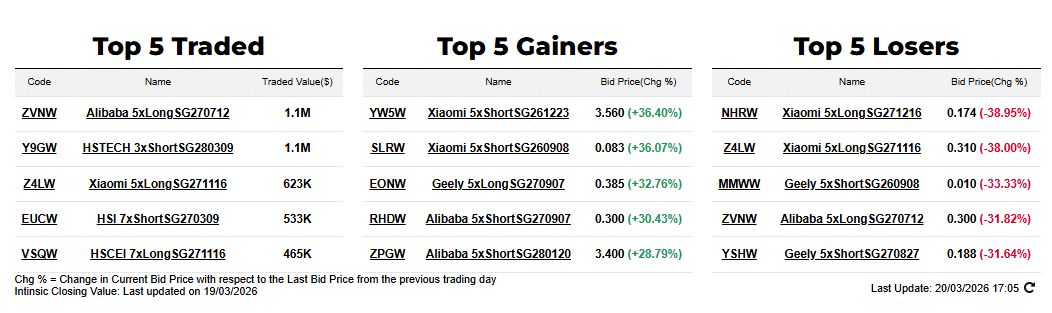
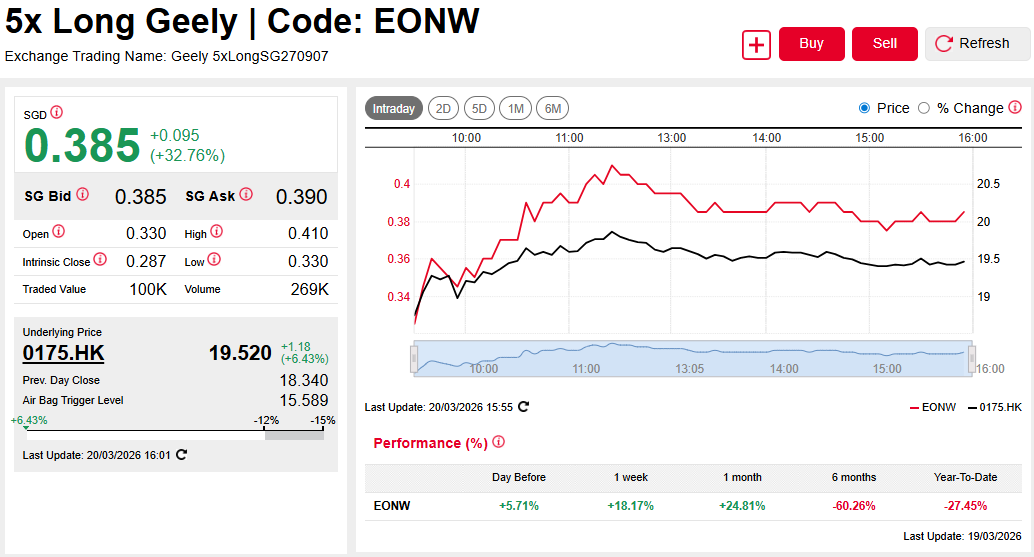
Each listing shows the stock code, whether it’s Long or Short, and the leverage level, so you know exactly what you’re looking at. Furthermore, theupdated “Top 5” lists highlight the most traded DLCs, biggest gainers and decliners.
Here’s what it looks like on a particular trading day, along with the bid prices for the one of the top gainers:
Source: Societe Generale (Information relating to past performances is for illustrative purposes only, and is not a reliable indicator of future performance)
It gives you a quick sense of where the action has been, instead of guessing where to even begin.
Step 3: Execute trade on your broker platform
You don’t need to open a special account or jump through new hoops to start.
Since Societe Generale’s DLCs are listed on the SGX, they are bought and sold just like any other local stock during market hours. After finding the DLC you’d like to trade, enter the DLC code into your current platform, decide on your allocation, and place your order.
As trades are settled in SGD, you get exposure to US and Hong Kong markets without having to worry about the currency conversion fees that usually come with foreign stocks.
Step 4: Don’t forget–check & move
The final rule is to remember that Societe Generale’s DLCs are meant for active, short-term moves rather than "set and forget" investing.
As these products track daily performance, they are designed to be monitored closely. Treat them as a way to respond to what the market is doing right now rather than a “buy-and-hold”—stay updated on the news, track your positions, and be ready to pivot your strategy as conditions change.
6. Final words
Global markets aren’t necessarily more intimidating—they’re just moving faster. Now, short-term trading might not be for everyone; some still find success with a buy-and-hold strategy—provided you can navigate volatility and have a proper long-term view.
Yet for those who prefer to engage actively with the swings, SGX-listed DLCs from Societe Generale offer a structured way to play the game. With defined risk, accessible liquidity, plus a wide range of stocks and indices available via your existing brokerage, the setup is in place for your next move in 2026!
Biggest TakeawayWhen price swings are the norm, a flexible investment strategy that deploys tactical instruments across calls and pullbacks could make all the difference! |
Disclaimer
This advertisement has not been reviewed by the Monetary Authority of Singapore. The views expressed under this article represent the personal and independent views of the author and do not constitute investment advice. The content of this article does not form part of any offer or invitation to buy or sell any daily leverage certificates (the “DLCs”), and nothing herein should be considered as financial advice or recommendation. The price may rise and fall in value rapidly and holders may lose all of their investment. Any past performance is not indicative of future performance. Investments in DLCs carry significant risks, please see dlc.socgen.com for further information and relevant risks. The DLCs are for specified investment products (SIP) qualified investors only.
This post was written in collaboration with Societe Generale. While we are financially compensated by them, we nonetheless strive to maintain our editorial integrity and review products with the same objective lens. We are committed to providing the best information in order for you to make personal financial decisions with confidence.
Related Articles