
For investors in Singapore, dividend stocks are like the crème de la crème of the local stock market. That’s mainly down to the fact that dividend payments in the Lion City don’t have any withholding tax nor do they count as income by the Inland Revenue Authority of Singapore (IRAS) when looking at what individuals are on the hook for.
As a result, the local Singapore Exchange (SGX) is now home to a plethora of dividend stocks—who doesn’t love dividends? They’re tax free in terms of income received, so you could technically live off dividends without ever having to pay a cent to the Inland Revenue Authority of Singapore (IRAS). But dividend stocks here come in different flavours and 2 of the biggest are blue chips and real estate investment trusts (REITs). Many investors here in Singapore default to REITs as the passive income option for a number of reasons.
But are blue chip dividend stocks still worth holding? I’ll break down the differences between blue chip dividend stocks in Singapore and S-REITs, their risk profiles, growth potential, and other considerations for Singapore investors. Let’s get into it.
[ms-toc title="Blue Chip Dividend Stocks Beyond REITs: Still Worth Holding?"]
Singapore REITs vs. Blue Chip Stocks: What’s the Difference?
First off, it’s important to establish the difference between Singapore REITs and their blue-chip brethren. REITs in Singapore are basically a vehicle for investors to get passive, low-maintenance exposure to properties. These properties can be in any number of sectors, from industrial and commercial right through to retail and healthcare.
Large listed REITs, like CapitaLand Integrated Commercial Trust (CICT) or Keppel DC REIT, will own a number of properties and then charge tenants rents for them. As unitholders of these REITs, you’re able to benefit from this rental income (without the stress of actually owning a property) as the REIT managers oversee the properties, leases, maintenance, and any asset enhancement initiatives (AEIs) that improve the properties. REITs in Singapore are also legally required–by the Monetary Authority of Singapore (MAS)–to distribute at least 90% of their taxable income to unitholders. REITs typically utilise debt to grow their portfolios. Overall, REITs offer investors a lot of choice in the “dividend yield” category.
So, what about Singapore’s blue chip dividend stocks? Well, it’s important to define what a “blue chip” is first and foremost. Blue chip stocks are large and well-known, as well as financially-stable, companies. Typically, they’re also consistently profitable. That doesn’t automatically mean they pay dividends but, in Singapore, many blue chip stocks do pay generous dividends. The key defining difference, though, is that blue chip dividend stocks aren’t required to pay out a certain amount in dividends. The amount they pay is totally up to management’s discretion. So, they could technically pay anywhere from 30% of net profits as dividends to 80% of net profits as dividends. Examples of prominent blue chip dividend stocks in Singapore include the likes of the big banks (DBS, OCBC, UOB) and other recognisable large companies, such as Singtel, Singapore Exchange (SGX), Singapore Technologies Engineering, or Sembcorp Industries.
ALSO READ: Best Brokers For Beginners In Singapore (2026)
Differences in dividend yields
These differences in payouts obviously lead to varying dividend yields between S-REITs and Singapore dividend stocks. Because of their legally-mandated 90%-of-taxable-income payouts, REITs in Singapore tend to have higher yields than Singapore blue chip dividend stocks. For REITS, you can typically expect yields that average over 6% (see below) and some REITs can even yield up to 10%. That’s a big difference to Singapore blue chip stocks that pay dividends, with even the banks—which have been generous with payouts—currently yielding between 4% and 5%, based on their ordinary dividends. Other blue chip stocks, like SGX and ST Engineering, are yielding below 3%.
Yields of key asset classes in Singapore
Sources: Bloomberg, SGX Stock Exchange, data as of 31 March 2026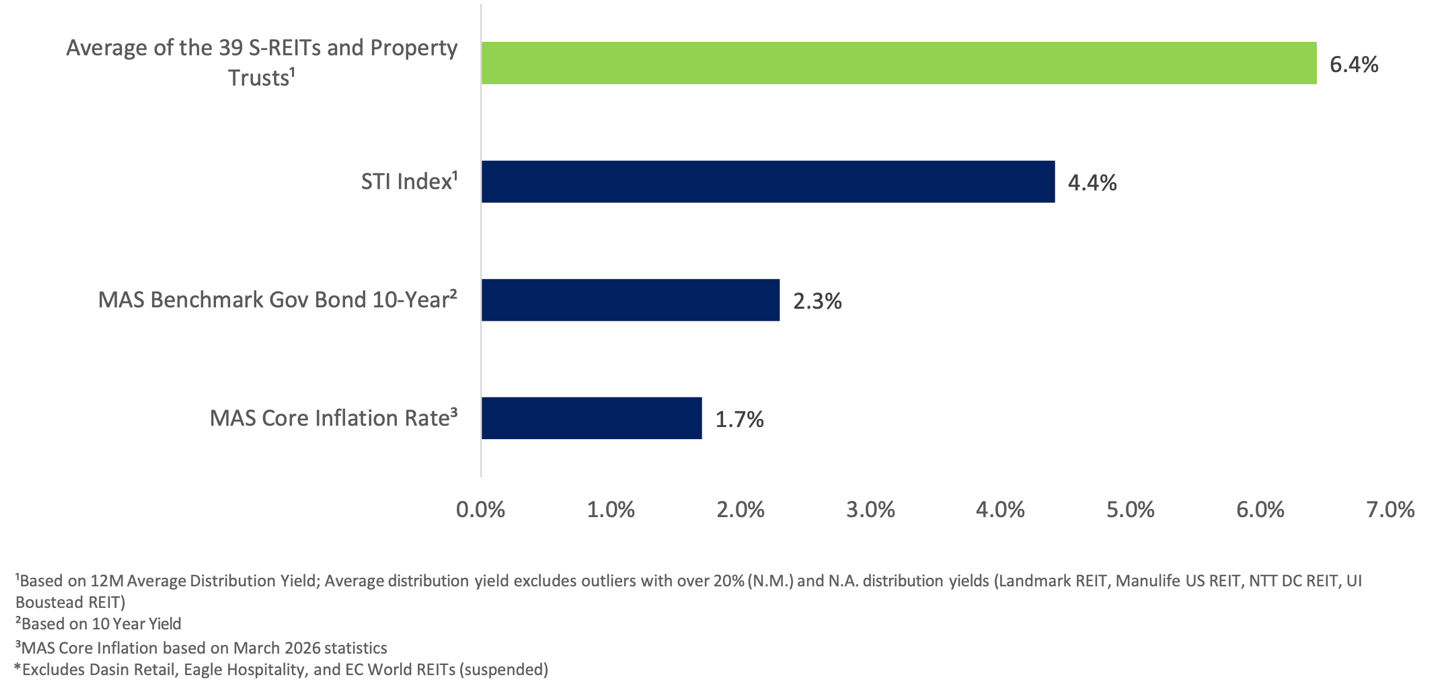
Of course, these yields are completely a function of both their business models but also the way their prices move. With higher capital appreciation returns, a stock’s (or REIT’s) price goes up. When that happens, the dividend yield automatically falls. The same also applies to the reverse so yields can look really high (wow, a 10% yield!) but that is often a warning sign that the share price has fallen 20%, 30%, or even more. In turn, that then means that the dividend/payout isn’t sustainable and could be cut, which is a great lead-in to the next section.
Risk and stability: Which holds up better in a downturn?
For investors, you want to understand how your Singapore dividend stocks (whether blue chips or REITs) actually perform when there’s a downturn. For example, if you’re relying on them for consistent income, you do NOT want a dividend to be potentially cut. Ideally, you want it to consistently be rising. So, the more resilient that dividend is, the better.
The most recent example we have is the 2022 market sell-off, when interest rates were hiked extremely quickly by the US Federal Reserve (Fed). While there was no recession, it did make the cost of debt more expensive and, as we know, that’s not good for REITs given they rely on it for growth. For the whole of 2022, the iEdge S-REIT Index actually delivered a total return (price appreciation + dividends) of -11.9% while the Straits Times Index (a good proxy for blue chip dividend stocks) had a total return of +8.4% over the same period. A lot of REITs actually had to cut their distributions post-2022 as rates ate into their profits. Meanwhile, for bank stocks, it was a rate party given higher interest rates lead to higher profits on loans–what’s called “net interest income”.
Given blue chip dividend stocks aren’t tied down to paying out 90% of profit as dividends, they have a lot more flexibility (versus REITs) if there’s a recession or something hits their profits. Of course, in a situation like the Global Financial Crisis of 2008, both blue chip stocks and REITs in Singapore got absolutely hammered. But overall, blue chip stocks tend to hold up better in terms of both their price and dividends when there is a market correction. However, it’s also worth noting that bank stocks are “cyclical” in nature. If there’s an economic slowdown, banks tend to suffer given lower loan growth and falling interest rates.
ALSO READ: What Should a Beginner Invest In? Singapore Guide to Investing Basics
Growth potential: Blue chips vs. REITs
If you’re going to be objective about it, the growth potential of Singapore blue chips (from both a price and dividend perspective) is greater. That’s down to 2 reasons. First off, they’re typically not paying out as much in dividends as REITs–given their whole 90% payout rule. And that leads to the second point, which is that this lower dividend payout ratio gives them more headroom to both grow the dividend (if they want to) or reinvest those profits for the business’s growth.
Unfortunately, for REITs, that’s not a lever that is available to them as they effectively have a minimum dividend payout ratio of 90%. That leaves them little headroom to be able to use remaining cash (after payouts) to grow. Normally, they either have to issue debt or raise equity—by selling more shares—and that’s not ideal for unitholders. In terms of the dividend, that high payout ratio also limits dividend growth for REITs while in recent years there has been strong dividend growth for the likes of the big banks and various other blue chips.
Finally, there’s also the fact that REITs are “rate-sensitive” in that they are extremely tied to the interest rate cycle. If interest rates are low, and money is cheap, then they tend to do well but right now, we have elevated interest rates globally and that’s constraining the growth of a lot of REITs.
Blue chip dividend stocks worth watching beyond REITs
At the end of the day, there are a number of blue chip dividend stocks that are worth watching in Singapore and many of them will be names we’re familiar with. Here are just a few below:
- DBS Group (SGX: D05) – Singapore’s largest bank and a consistent dividend payer. It has raised its dividend consistently, is yielding over 5% and pays a dividend four times a year.
- Singtel (SGX: Z74) – The largest telco in Singapore, Singtel is a staple of the local broadband and mobile scene but it also owns stakes in a number of regional telco firms as well. Singtel shares currently yield around 4%.
- Sembcorp Industries – The former conglomerate has reimagined its business as a pure utilities business and is now focused on growing its renewable energy assets. It has raised its dividend over the past few years and is currently yielding over 4%.
- Singapore Technologies Engineering – The defense and engineering company in Singapore has seen its book of business grow strongly in recent years as the “de-globalisation” process has seen a spike in defense spending. Its shares yield around 1.7%.
- Singapore Exchange (SGX) – The sole stock exchange operator in Singapore has been busy building up its fast-growing futures and derivatives business while also trying to attract more IPOs to the exchange. It currently yields close to 2%.
Ready to build your own dividend portfolio? Get started with these brokers below.

- Min. Commission Fee US Stocks
- US$1
- Min. Commission Fee SG Stocks
- $2.50
- Min. Funding
- $0

- Min. Commission Fee US Stocks
- US$0
- Min. Commission Fee SG Stocks
- S$0*
- Min. Funding
- $0
[MoneySmart Exclusive]
Get S$100 Cash via PayNow OR Sennheiser Accentum Wireless Headphones (worth S$269) OR S$130 GrabGift Vouchers when you meet the eligibility criteria with Moomoo SG. T&Cs apply. Use SmartPoints to redeem your favourite product from our Rewards Store today.
[Moomoo Welcome Rewards - stackable with MoneySmart offer]
Get S$1,100* rewards, including up to S$470* NVDA share + S$570* Trading cash coupons + limited-time bonus S$60 Trading Cash coupon when you meet the criteria. Valid till 5 August 2026. T&Cs apply.

Compare more online brokerages at a glance on MoneySmart.
Found this article useful? Share it with your family and friends.
Related Articles