
If someone asked you to name the highest paying job in Singapore, chances are "doctor" or "lawyer" came to mind first. Kiasu parents have been steering their kids toward medicine and law for decades, and for good reason—these professions do pay well.
But according to the Ministry of Manpower's latest Occupational Wage Survey (June 2025), the actual top earners aren't who you'd expect. A general practitioner's median monthly wage is a respectable $7,165—solid, but nowhere near the top of the list. The real top earners include flying instructors, diagnostic radiologists, and financial derivatives dealers, several of whom report median gross wages of $20,000 a month.
In this article, we're using MOM's most recent wage data to map out where Singapore's highest and lowest paying jobs actually sit—and just as importantly, what your income bracket means for the credit cards and loans you're actually eligible for.
[ms-toc title="12 Highest & Lowest Paying Jobs in Singapore 2026 (And What They Mean for Your Wallet)"]
How we ranked this
Recruiter salary guides are a useful starting point, but they're naturally shaped by the roles those firms place candidates in. For a fuller picture, we pulled directly from MOM's Occupational Wage Survey, June 2025—a government survey covering over 500 occupations, reporting median, 25th percentile, and 75th percentile monthly gross wages for full-time resident employees in Singapore.
We're using gross wage medians throughout, since this reflects total monthly pay before CPF and tax more accurately than basic wage alone.
The highest paying jobs in Singapore right now
Here's where the median gross monthly wage lands at the top of the market:
A few things might jump out at you from the table above. For one thing, financial derivatives dealers—traders who buy and sell contracts like options and futures on behalf of banks or financial institutions—hit a ceiling almost immediately, with their 25th and 75th percentiles sitting close together. That means most people in this role earn near the top regardless of experience, likely a reflection of how few people hold this specialised role and how directly it's tied to trading performance.
On the other hand, flying instructors and radiologists show a much wider spread. A flying instructor at the 25th percentile earns about $9,567 each month, but one at the 75th pockets a whopping $30,000 on payday. In these occupations, experience and specialisation matter more.
Wait, where are the doctors and lawyers?
This is the part that surprises most people. "Doctor" and "lawyer" aren't single salary brackets—they're umbrella terms covering wildly different pay scales depending on specialisation and seniority.
According to MOM, a general practitioner's median gross wage is $7,165 a month. An internal medicine physician does a bit better at $8,883. But a diagnostic radiologist—a specialist who reads scans rather than seeing patients directly—reports a median of $20,000, tying the highest earners in the entire survey.
It's the same story in law. A legal clerk's median sits at $4,500. A practising advocate/solicitor reports $10,000. In-house legal counsel comes in higher still, at $13,000. The title "lawyer" tells you almost nothing about which of these 3 brackets someone's actually in.
All in all, if you're chasing a high income, the specific specialisation or seniority tier matters far more than the job title on your business card.
What a top-bracket income means for your credit card and loan options
Credit cards
If you're earning in the $10,000+ a month bracket, you're in prime territory—and the higher you climb within that bracket, the more clearly the card tiers start to separate.
Take the DBS Woman's Card lineup (open to all genders, despite the name). The entry-level Woman's Card asks for a $30,000 annual income and earns 2 miles per $1 spent online. Cross $80,000 and you unlock the DBS Woman's World Card, which doubles that to 4 miles per $1.

- on Online Purchases
- S$5 = 5 DBS Points (2 Miles per S$1)
- on Other Purchases
- S$5 = 1 DBS Point (0.4 Miles per S$1)
- e-Commerce Protection for Online Purchases
- Complimentary

- on Online Purchases
- S$5 = 10 DBS Points (equivalent to 4 Miles per S$1)
- on Overseas Purchases
- S$5 = 3 DBS Points (equivalent to 1.2 Miles per S$1)
- on all Other Purchases
- S$5 = 1 DBS Point (equivalent to 0.4 Miles per S$1)
UOB runs a similar playbook with its Lady's Card ($30,000 entry) versus the Lady's Solitaire Card, which needs $120,000 a year for a richer rewards rate.
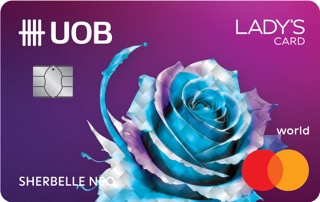
- Base Earn Rate
- S$5 = 1X UNI$ (0.4 miles per S$1)
- Category of Choice
- S$5 = Up to 25X UNI$ (equivalent to 10 miles per S$1)
- Min. Spend
- S$0
Get SURE-WIN S$30 Cash —no minimum spend required, just be a New-To-UOB Customer! T&Cs apply.
PLUS celebrate Singapore's birthday with a S$61 Cash Bonus when you are the first 10 customers to submit the claim form during the National Day Flash Deal! T&Cs apply.
Get S$100 Samsung e-vouchers when you spend a min. of S$1,000 in the first month from card approval. Plus enjoy 10% off at Samsung online store. T&Cs apply.


- Base Earn Rate
- S$5 = 1X UNI$ (or 0.4 miles per S$1)
- on Two Categories of Choice
- S$5 = Up to 25X UNI$ (equivalent to 10 miles per S$1)
- Min. Spend
- S$0
Climb higher still and you reach cards such as Standard Chartered's Beyond Card, which sets its bar at $200,000 a year. And right at the very top sits cards like Citi's Ultima Card—by invitation only, and reserved for Citigold Private Client or Citi Private Bank members, per Citi's own site. Most of us (the likes of myself included) will never see an invitation to apply for that one. But if there's anyone reading this who can actually afford it and qualifies, it's probably the high earners in this article's top bracket.
It’s worth comparing your options across our full credit card comparison page before settling on one—the best pick depends on whether you spend more on travel, dining, or everyday essentials.
ALSO READ: 9 Best Air Miles Credit Cards in Singapore (Apr 2026)
Personal loans
On the loan side, a higher income bracket typically unlocks a larger loan quantum. Some banks offer up to 8 times your monthly income and preferential interest rates for personal loans if you earn at least $120,000 a year. These include the CIMB Personal Loan and HSBC Personal Loan, the latter of which also offers the longest loan tenure in Singapore (7 years).

Per Month
S$842
- Interest Rate
EIR*: From 1.94% p.a. - From 1.00% p.a.
- Total Amount Payable
- S$10,100
- Processing Fee
- S$0
- Per Month
- S$842

Per Month
S$844
- Interest Rate*
EIR: From 2.50% p.a. - From 1.30% p.a.
- Total Amount Payable
- S$10,130
- Processing Fee
- S$0
- Per Month
- S$844
Compare personal loan rates and quantum limits on our personal loan comparison page.
The lowest paying jobs in Singapore
On the other end, here's where the median gross monthly wage sits lowest, per the same MOM survey:
It's worth noting that even within these roles, the 75th percentile shows real room to grow—a dishwasher at the top of their pay band earns $2,180, well above the median. Experience, employer, and industry all shift where someone lands within a role's range.
What this income bracket means for your credit card and loan options
Credit cards
If your monthly income sits under $3,000, you've got more usable options than you might expect. Most credit cards set a minimum annual income of $30,000 (about $2,500/month) for approval, which already covers a good part of this bracket—and for those who aren't quite there yet, several cards are built specifically for this stage of life.
The GXS FlexiCard skips the income requirement entirely, offering randomised cashback on transactions of $10 and above—a solid option for gig workers, freelancers, or anyone just starting out. Full-time students have their own lane too: the DBS Live Fresh Student Card waives income requirements altogether, offering up to 5% cashback on everyday spend like food delivery and streaming, within a modest $500 credit limit built to keep spending in check.

- on McDonald’s, Starbucks, Netflix etc.
- 5% Cash Back
- on selected Eco-Eateries, Retailers and Transport Services
- Additional 5% Green Cashback
- on All Other Spend
- 0.3% Cashback
If you'd rather work toward a mainstream card with fuller benefits, a secured credit card is worth knowing about too—place a fixed deposit (typically $10,000) with a bank, and that deposit becomes your credit limit, no income proof required. It's a solid stepping stone toward building credit history or unlocking a card you might not otherwise qualify for yet.
For more on how deposit-based cards work, see our guide to secured credit cards.
Personal loans
Personal loans are more accessible at this income level than the credit card income bar might suggest. Several banks set their minimum annual income at just $20,000 for Singaporeans and PRs—the GXS FlexiLoan and DBS Personal Loan both sit at this threshold. Foreigners typically need more, ranging from $40,000 to $90,000 depending on the bank.

Per Month ²
S$857
- Interest Rates ¹
EIR: From 1.84% p.a. - From 1.00% p.a.
- Total Amount Payable
- S$10,288
- Processing Fee ²
- S$0
- Per Month ²
- S$857

Per Month
S$846
- Interest Rate*
EIR: From 3.22% p.a. - From 1.48% p.a.
- Total Amount Payable
- S$10,148
- Processing Fee
- From 1% of Approved Loan Amount
- Per Month
- S$846
For a fuller breakdown by bank, including options if you're between jobs or self-employed, see our guide to personal loans for low income earners.
It's also worth knowing that Singapore's Workfare Income Supplement scheme, administered by the CPF Board, provides cash payments and CPF top-ups for lower-wage workers—a useful resource alongside whatever loan or card options you're weighing at this income level.
Quick reference: jobs by income bracket
The bottom line
Pay in Singapore has less to do with job titles than most people assume—specialisation, seniority, and industry shift where you land within a profession far more than the label itself. Knowing your actual income bracket, rather than assuming based on your job title, is the better starting point for figuring out which credit cards and loans genuinely make sense for you.
Found this article useful? Share it with anyone curious about what Singapore actually pays.
Related Articles